
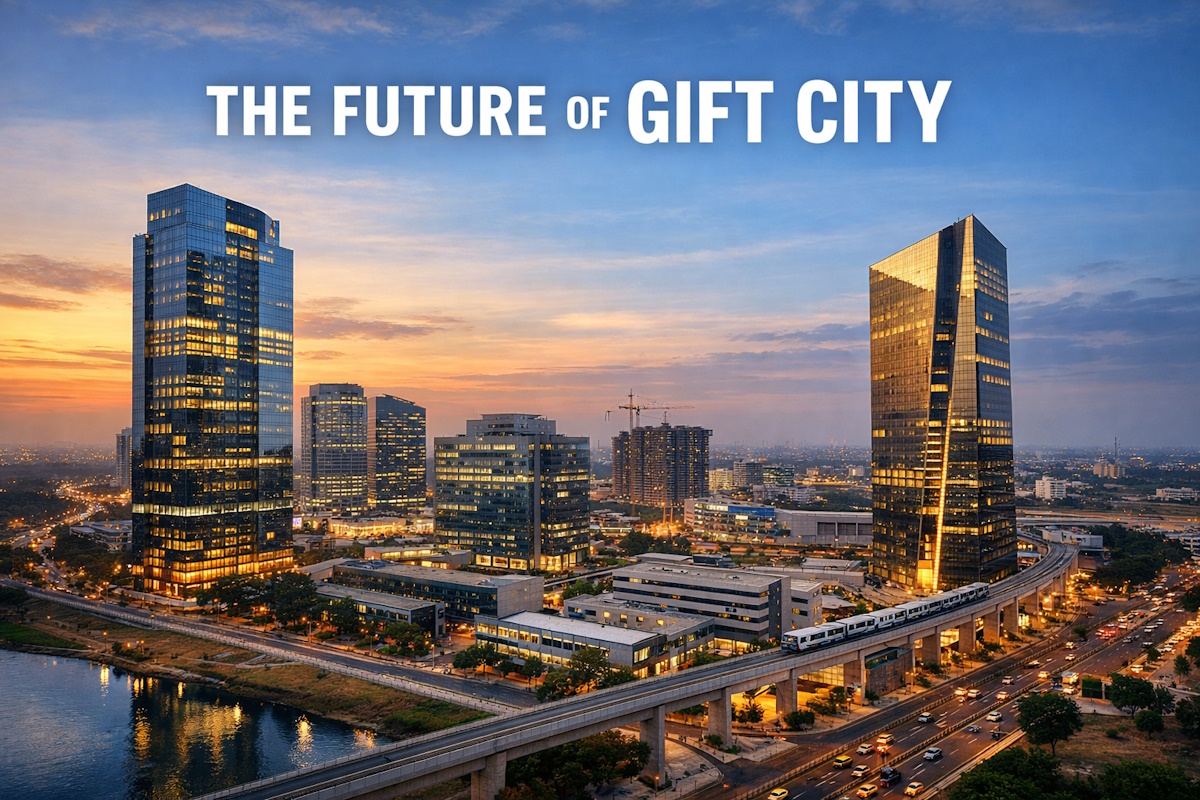
If you are looking at GIFT City seriously, the future matters more than the past. You are not buying into what it was supposed to be. You are deciding whether what is being built now and what is officially planned makes sense for your money, your career, or your long term holding strategy.
This piece is about the future of GIFT City in practical terms. Not slogans. Not artist impressions. Just how the government sees it, what growth is planned, when things are expected to come together, and where the gaps still exist.
By the end, you should have a clearer sense of whether the future of GIFT City lines up with your own timelines.
What the Government Actually Wants GIFT City to Become
At a policy level, the government’s vision for GIFT City is very clear and very narrow.
GIFT City is meant to be India’s global financial services hub. Not a general IT park. Not a large residential suburb. Not a lifestyle city competing with metros.
The focus is financial services, capital markets, fintech, insurance, asset management, aircraft leasing, ship leasing, bullion exchanges, and related professional services.
This matters because everything flows from this intent.
Office approvals, tax structures, zoning rules, infrastructure spending, even residential permissions are shaped around this one goal. If your expectation is that GIFT City will behave like a mixed use township driven by retail and end user housing demand, you will feel disappointed.
If your expectation is a policy-backed financial ecosystem that grows in phases, the direction becomes easier to understand.
How the GIFT City Master Plan Is Structured
The GIFT City master plan is not one big launch. It is a layered plan designed to unfold in stages.
At full scale, GIFT City spans over 880 acres across SEZ and Non-SEZ zones. The idea is to accommodate:
- Global financial institutions
- Domestic banks and insurers
- Fintech firms
- Supporting legal, consulting, and compliance firms
- Residential housing mainly for professionals working inside the city
The master plan breaks development into functional zones rather than lifestyle clusters. That is a key difference compared to private townships.
Commercial space comes first. Residential follows slowly. Social infrastructure comes only when workforce density justifies it.
This explains why progress often feels uneven on the ground. It is not stalled. It is sequenced.
IFSC Growth Is the Real Driver of the Future of GIFT City
When people talk about the future of GIFT City, they often mix real estate development with IFSC growth. These are related but not identical.
IFSC, the International Financial Services Centre, is the engine. GIFT City is the container.
As of now, IFSC has attracted hundreds of registered entities across banking, capital markets, insurance, fintech, and leasing. The numbers change every quarter, but the direction is consistent.
What matters more than raw registrations is the widening of permitted activities.
Over the last few years, regulators have steadily expanded what companies can do inside IFSC. New frameworks have been rolled out for:
- Aircraft and ship leasing
- Global in-house centers for finance teams
- Fund management and portfolio services
- Fintech sandboxes
- Bullion trading
This gradual widening tells you something important. The government is committed to making IFSC work, even if growth is slower than headlines suggest.
If IFSC continues to deepen, real estate demand follows. If it stagnates, real estate narratives weaken quickly.
GIFT City Growth Forecast: What Is Realistic and What Is Not
Any GIFT City growth forecast needs to be handled carefully.
You will hear claims of explosive growth, overnight transformation, or comparisons with global financial hubs. Ignore those.
A more grounded forecast looks like this:
- Office absorption grows steadily as new financial activities are allowed
- Employment growth remains specialized rather than mass scale
- Residential demand grows mainly from working professionals, not speculative buyers
- Retail and social infrastructure lag employment by a few years
Over the next 5 to 10 years, GIFT City is likely to move from early execution to functional maturity, not full saturation.
This is important if you are evaluating appreciation or rental yield expectations. Growth is real, but it is controlled and policy-led.
Timelines: How Fast Is GIFT City Really Moving
Timelines are where most buyer frustration comes from.
GIFT City does not move on private developer timelines. It moves on regulatory approvals, infrastructure readiness, and global financial participation.
Here is how timelines generally play out:
Short term, one to three years
- More office buildings get operational
- More IFSC entities start actual operations rather than just registration
- Residential inventory increases slowly
- Rental demand remains selective
Medium term, three to seven years
- Workforce density improves
- Support services grow
- Residential occupancy stabilizes
- Secondary market activity picks up
Long term, seven to fifteen years
- GIFT City starts behaving like a mature financial district
- Rental demand becomes more predictable
- Resale liquidity improves
If your investment horizon is under three years, the future of GIFT City may feel slow. If you are comfortable holding through cycles, timelines look more reasonable.
Residential Growth Plans and Their Limits
Residential development in GIFT City is often misunderstood.
The government does not want GIFT City to turn into a speculative housing market disconnected from employment. Residential supply is deliberately controlled.
Most residential approvals are aimed at:
- Professionals working in IFSC
- Executives on medium term assignments
- Rental housing rather than end user townships
This affects pricing behavior. It also affects resale liquidity.
If you are buying residential property expecting fast end user absorption like a metro suburb, the future of GIFT City will not match that assumption.
If you are buying with a long term rental mindset tied to IFSC employment, the logic becomes clearer.
Commercial Real Estate: Where the Future Is Stronger
Commercial real estate is more closely aligned with the GIFT City master plan.
Office buildings, especially in SEZ and IFSC zones, are where government incentives, tax benefits, and regulatory support are concentrated.
This does not mean commercial investments are risk free. Vacancy cycles exist. Tenant concentration is real. Lease structures vary widely.
Yet, from a policy standpoint, commercial space is the priority asset class.
If you are comparing residential versus commercial exposure to the future of GIFT City, commercial assets reflect government intent more directly.
Infrastructure Commitments That Shape Long Term Growth
Infrastructure is not just roads and utilities. In GIFT City, it includes:
- District cooling systems
- Underground utilities
- Automated waste management
- Data connectivity
- Security and access control
Most of this infrastructure is already built or operational. That is a quiet strength.
External connectivity continues to improve slowly. Road links, metro planning, and airport access are all part of longer timelines.
This again reinforces the long term nature of the GIFT City growth forecast.
Tax Policy Stability and Why It Matters for the Future
One reason institutions are willing to commit to GIFT City is tax clarity.
IFSC tax incentives are written into policy with long validity periods. They are not short term giveaways.
For investors and businesses, stability matters more than generosity.
If tax structures were uncertain, the future of GIFT City would be far weaker. Policy continuity is one of the strongest signals supporting long term confidence.
For individual buyers, tax benefits apply indirectly. They influence tenant demand and institutional participation rather than personal tax planning in most cases.
Risks That Could Slow Down the Vision
No future projection is complete without acknowledging friction points.
Some risks that could affect the future of GIFT City include:
- Slower global financial expansion
- Regulatory complexity delaying operations
- Talent reluctance to relocate
- Overpricing of early real estate inventory
- Mismatch between residential supply and actual demand
These risks do not mean failure. They mean uneven growth.
If you are entering GIFT City expecting smooth linear appreciation, you will likely feel uncomfortable during slower phases.
Who the Future of GIFT City Is Not Ideal For
This is important to say clearly.
GIFT City is not ideal if:
- You want quick flips
- You need strong end user resale demand
- You expect metro-style rental liquidity
- You prefer lifestyle-driven real estate markets
The future of GIFT City favors patience, alignment with policy direction, and comfort with specialized demand.
How to Read the GIFT City Master Plan as a Buyer
When you look at maps, phases, and announcements, ask yourself simple questions:
- Does this development support IFSC growth or is it peripheral
- Is demand policy-driven or speculative
- Who is the likely tenant or buyer five years from now
If you cannot answer these, wait.
Clarity improves with time in GIFT City. Rushing decisions rarely helps here.
Final Thoughts on the Future of GIFT City
The future of GIFT City is not dramatic. It is deliberate.
It is shaped more by regulators than marketers. More by institutions than individual buyers. More by timelines than launches.
If you align with that reality, GIFT City can make sense. If you fight it, frustration follows.
The government vision is consistent. The growth plans are layered. The timelines are long.
Your decision should depend less on excitement and more on whether your patience matches the city’s pace.
That is the real question you need to answer before investing or moving into GIFT City.