
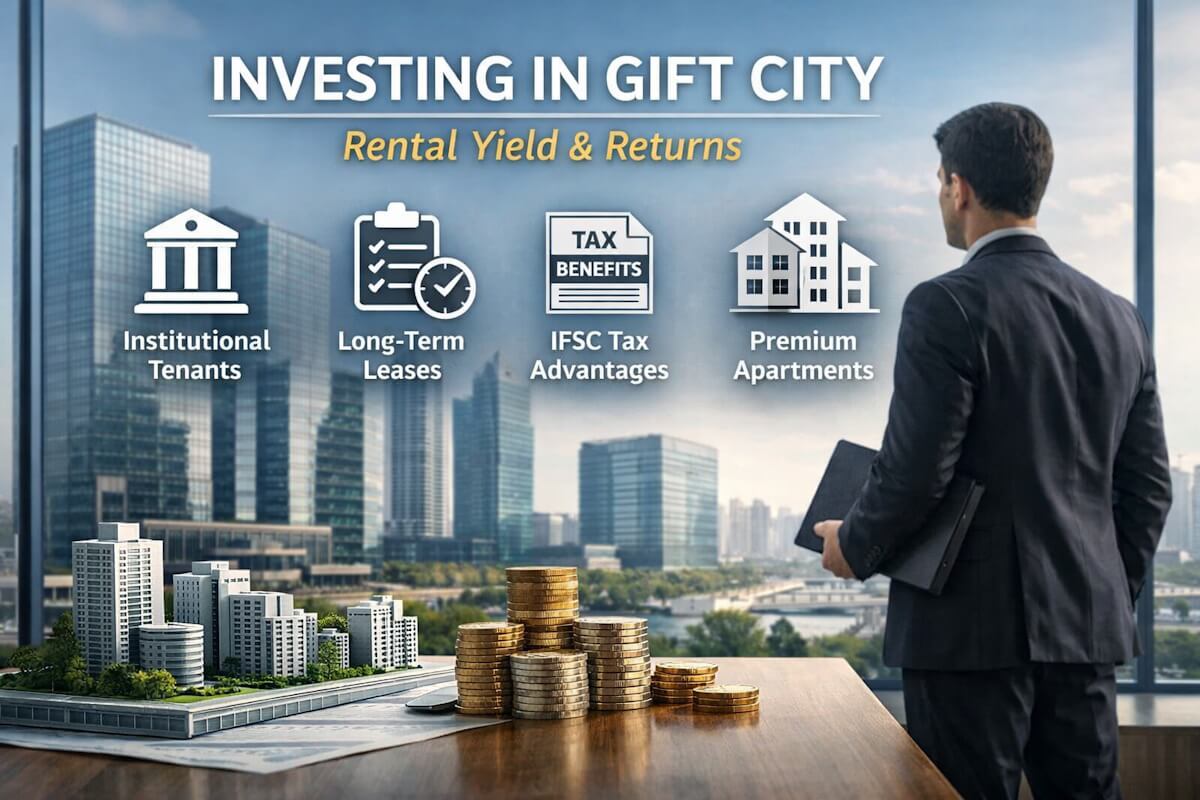
A Consultative Guide to Evaluating GIFT City Rental Yield and Investment Performance
When evaluating investment opportunities within GIFT City, investors often apply traditional real estate metrics only to discover that the market dynamics here operate on a different regulatory and demand matrix. Unlike conventional metropolitan real estate, the core driver of asset value and, critically, the GIFT City rental yield is mandated institutional and corporate relocation, not local population growth.
For high-net-worth individuals, NRIs, and institutional buyers, the focus shifts from speculative land plays to stable, high-quality, recurring GIFT City rental income generated by creditworthy tenants—banks, FinTech companies, insurance providers, and international firms leveraging the International Financial Services Centre (IFSC) framework. Understanding the specific components of this unique demand ensures your investment decision is grounded in long-term regulatory certainty and high-quality tenancy, mitigating the typical risks associated with commercial leasing. The question is not just “What is the yield?” but “What specific factors guarantee the sustainability and potential growth of that yield?”
Deconstructing the GIFT City Rental Yield Formula
Achieving superior rental returns in GIFT City requires looking beyond the gross yield figure. The actual net yield is heavily influenced by policy tailwinds, the quality of the tenant, and specific tax advantages available to investors operating within or associated with the IFSC/SEZ structure. Failure to account for these unique variables can lead to significantly inaccurate ROI projections.
The IFSC Arbitrage: A Non-Negotiable Demand Driver
The regulatory framework of the IFSC mandates and incentivizes the presence of financial services entities. This is the single most powerful driver of GIFT City leasing demand. Companies establishing a presence here are required to do so by regulation or are heavily incentivized by the tax holidays, capital market advantages, and ease of international transaction processing. This creates a non-cyclical, sustained demand for Grade-A office space and premium residential accommodations.
Long-Term Corporate Tenancy Guarantees
Unlike standard commercial rentals where tenancy can be volatile, IFSC-regulated entities typically require long-term commitments (5 to 9 years) to justify their operational setup and regulatory compliance. This stability drastically reduces vacancy risk and operating uncertainty, leading directly to predictable and stable GIFT City rental yield, a crucial consideration for large-scale investors.
Commercial vs. Residential: Yield Profile Comparison
Investors often wrestle with the commercial vs. residential allocation. While commercial properties dominate GIFT City, the residential sector serves a critical, niche demographic: CXOs, expatriates, and core operational staff of the IFSC institutions. Their specific needs drive demand for high-end, furnished apartments, which can command premium rental returns in GIFT City.
- Commercial Yield: Generally characterized by higher capital outlay, but secured by creditworthy institutional tenants, offering stability and predictable escalations.
- Residential Yield: Lower capital entry point, potentially higher gross yield percentages due to specialized demand, but requires careful management to mitigate periodic churn and furnishing costs.
A balanced portfolio often involves strategic allocation across both segments. We help clients model scenarios based on their capital deployment strategy and risk tolerance. If you are ready to evaluate specific projects and their associated lease structures, we invite you to Start your investment journey in GIFT City now.
Analyzing Core Demand Segments for Rental Income
The key to maximizing your GIFT City rental income lies in understanding the tenant profile. In GIFT City, tenants are not SMEs or local retailers; they are large, global, and highly compliant organizations. This fundamental difference influences everything from lease contract negotiation to property management requirements.
The Role of BFSI and Fintech Institutions
Banking, Financial Services, and Insurance (BFSI) remain the anchors of GIFT City’s commercial ecosystem. These tenants require stringent compliance, robust infrastructure, and often seek large, contiguous floor plates. Investing in buildings specifically designed and certified for institutional use ensures alignment with the primary demand segment and secures robust GIFT City leasing demand.
Investment Evaluation Focus: Infrastructure and Compliance
When assessing commercial property for investment, look beyond the facade. Investors must verify power backup redundancy, HVAC systems, data center readiness, and security features. These technical specifications are non-negotiable for IFSC entities and directly determine leaseability and, consequently, the GIFT City rental yield you can command.
Expatriate and CXO Residential Demand
Residential demand here is largely driven by professionals relocating to operationalize or oversee institutional branches. This tenant pool demands quality, convenience, and services often lacking in surrounding cities. The residential projects that succeed offer amenities that cater to a high-standard, international lifestyle, ensuring premium rental returns in GIFT City.
The proximity of the residential tower to the core office zones (walk-to-work culture) is a major differentiator. The premium a tenant pays for eliminating commute time significantly impacts the rental income potential for the investor. This hyper-localized market study is essential before committing capital. For proprietary insights into the tenant profiles and rental rate benchmarks of currently leasing properties, you should Start your investment journey in GIFT City with a consultation.
SEZ/Non-SEZ Considerations for Commercial Leases
GIFT City is divided into Special Economic Zone (SEZ) and Non-SEZ areas, and this distinction profoundly affects commercial property investment and leasing. SEZ units are primarily for exports and international financial services, offering significant tax advantages, which translates to high commitment from tenants but also stringent compliance requirements for the owner. Non-SEZ caters to domestic and support services.
Investors must be clear on which zone their property falls, as this determines the eligible tenant pool and the corresponding regulatory framework. Mismanaging a SEZ asset can negate potential tax benefits. This complexity is why advisory services like Gift City Realty are crucial for ensuring compliance and optimizing your GIFT City rental income strategy.
Ready to see the current inventory leased by blue-chip institutions? Request specific property details, including existing lease tenure and current rental rate averages, to calculate your precise ROI. Request Property Details
Maximizing Rental Returns in GIFT City: Strategy & Evaluation
Strategic investors focus on net yield, not just gross rent. Maximizing GIFT City rental yield involves sophisticated management, tax planning, and accurate forecasting of operating expenses and vacancy cycles, which are usually minimal given the institutional nature of the tenants.
Calculating Net Yield: Accounting for Operating Costs and Vacancy
The ‘true’ GIFT City rental yield subtracts all holding costs: property taxes (if applicable), maintenance fees, insurance, and professional management costs. While operating expenses might seem high in premium buildings, the stability and quality of the tenancy often offset these costs. We advise conservative vacancy projections (typically <5% for well-managed, Grade-A assets) due to sustained GIFT City leasing demand.
The Impact of Tax Incentives on Net Returns
For qualifying investors, particularly NRIs or those using specific investment vehicles, the tax treatment of rental income and capital gains within the GIFT City SEZ/IFSC regime can dramatically enhance the net rental returns in GIFT City, often making the effective yield far superior to comparably priced assets in mainland India. This requires careful structuring prior to purchase. Ensure you understand the full regulatory benefit spectrum before finalizing your investment structure. Consult our detailed guide: Start your investment journey in GIFT City.
Lease Structure and Tenure: Mitigating Risk
Lease agreements are the bedrock of investment security in GIFT City. Look for robust agreements that include predictable annual escalation clauses, clear lock-in periods (ideally 3+ years), and defined maintenance responsibilities. Standard practice here includes structured rent reviews every three years, ensuring that your GIFT City rental income keeps pace with market appreciation and inflation.
Location Within GIFT City: Walkability and Connectivity Premium
GIFT City is a dense, highly connected urban core. Premium assets are those situated centrally, offering proximity to the banking towers, the proposed metro link, and social infrastructure (hotels, retail). This proximity justifies higher rents and ensures sustained GIFT City leasing demand, particularly for residential investments catering to the expat demographic.
Don’t rely on generalized market data. Speak directly with a GIFT City investment specialist to receive tailored ROI estimates based on actual lease contracts in key projects. Schedule an Investment Consultation
Risk Mitigation and Long-Term Appreciation Factors
While the focus is currently on maximizing GIFT City rental yield, experienced investors prioritize long-term capital appreciation and risk mitigation. The regulatory framework and planned urban development are the primary engines supporting long-term value creation.
Regulatory Stability and Policy Tailwinds
The government’s continued commitment to establishing GIFT City as a global financial hub provides an essential layer of stability. Regulatory changes tend to favor expansion and incentives, reinforcing the competitive advantage of entities based here. This long-term governmental backing differentiates GIFT City real estate from most other Indian markets, providing structural support to property values and securing the future of high GIFT City leasing demand.
Avoiding Common Investment Mistakes
The most frequent error investors make is buying based on generalized location without verifying the specific project’s tenant suitability. Ensure the property (commercial or residential) aligns perfectly with the institutional needs of the IFSC/SEZ environment. Avoid assets that promise quick, speculative gains and focus instead on vetted projects with a proven track record of attracting creditworthy tenants. This discipline is paramount to ensuring consistent rental returns in GIFT City.
Understanding the interplay between policy, infrastructure, and tenant quality is not optional; it is fundamental to successful capital deployment in this highly specialized market. Our extensive experience in advising serious investors ensures that every decision maximizes both immediate GIFT City rental income and long-term asset value. Start your investment journey in GIFT City with confidence, leveraging our decade-plus of market expertise.
Strategic Decision-Making: Moving Beyond Assumptions
The investment thesis for GIFT City real estate is robust, predicated on institutional demand and favorable regulatory conditions. However, achieving superior GIFT City rental yield demands a precise, segment-specific strategy. Investors must adopt the viewpoint of a long-term asset manager, prioritizing tenant quality, lease structure longevity, and compliance above all else. GIFT City is not just a location; it is an economic instrument. Your investment success hinges on recognizing and strategically capitalizing on the unique ecosystem that drives sustained, high-quality GIFT City leasing demand. By focusing on net returns and leveraging tax and regulatory advantages, you position your portfolio for exceptional performance within the Indian real estate landscape.
Ready to commit to a high-performing asset? Explore vetted GIFT City projects that meet strict criteria for institutional tenancy and projected net returns. Explore GIFT City Projects
Frequently Asked Questions (FAQs)
What is the typical range for GIFT City rental yield (commercial)?
Due to the premium nature of the assets and the quality of institutional tenants (banks, FinTech), gross commercial GIFT City rental yield typically falls into a competitive range, often exceeding yields seen in comparable Grade-A CBDs in major Indian metros. However, the superior net yield is achieved through stable occupancy, predictable rent escalations, and specific tax benefits tied to the IFSC/SEZ location.
How does tenancy in GIFT City differ from conventional metros?
Tenancy here is highly institutional. The demand for office space comes from companies mandated or strongly incentivized by IFSC regulations to operate from GIFT City. This leads to high credit quality tenants, long lock-in periods (often 5+ years), and highly compliant lease contracts, securing stable GIFT City rental income.
Is residential property investment a viable strategy for high rental returns in GIFT City?
Yes, but it is highly niche. Residential rental returns in GIFT City are driven by the need to house CXOs and international staff. Investors who focus on premium, serviced residential units within walking distance of the commercial towers tend to see excellent occupancy and can command significant premiums over surrounding areas, enhancing their GIFT City rental income.
What is the biggest risk to a strong GIFT City leasing demand?
The biggest risk is regulatory stagnation or policy reversal, which is highly unlikely given the massive national commitment to the IFSC project. On a micro-level, the risk is investing in a property that fails to meet the infrastructure or compliance standards required by the high-profile institutional tenants, leading to poor GIFT City leasing demand for that specific asset.