
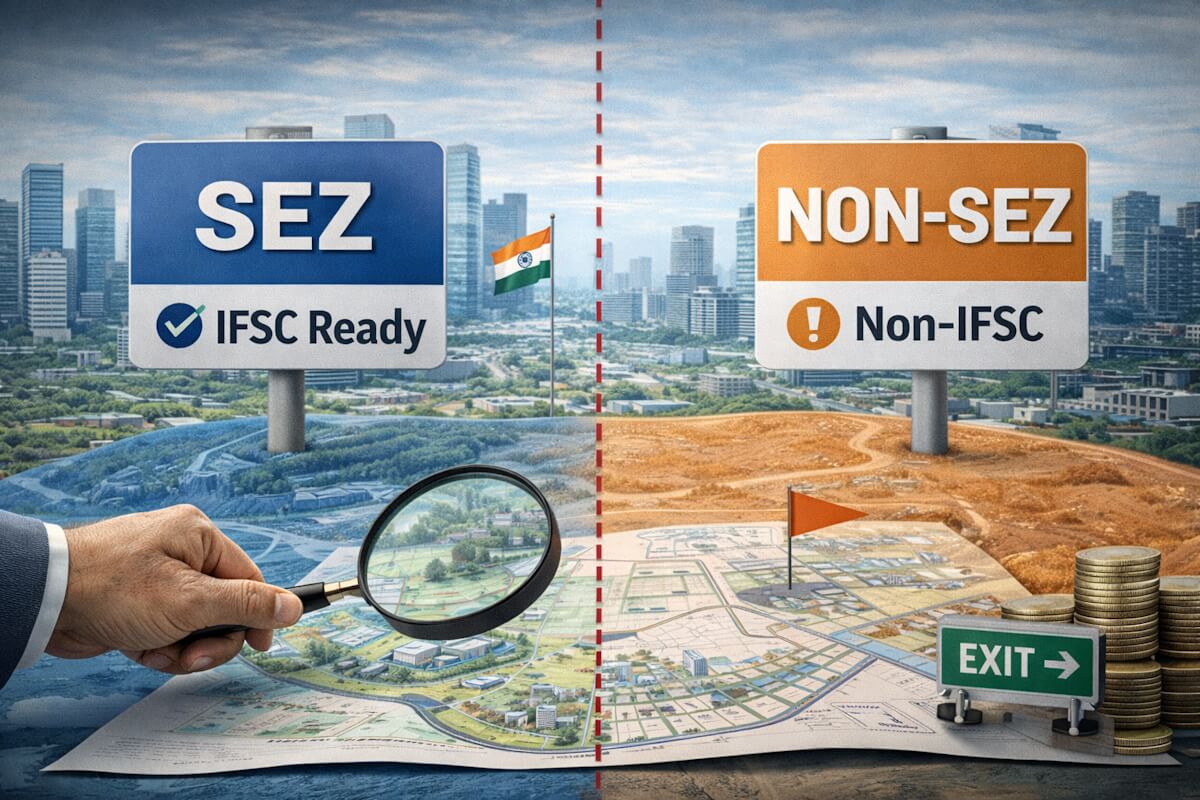
For high-net-worth investors, the decision to enter GIFT City real estate is often justified by the macro narrative: the IFSC status, regulatory stability, and attractive tax regimes. However, sophisticated investment success hinges not on the city’s overall viability, but on minimizing micro-location risk within GIFT City’s master-planned boundaries. Every property, even within a highly controlled environment like this, has inherent locational advantages or disadvantages that profoundly influence rental yield, liquidity, and future appreciation.
The mistake many new investors make is treating GIFT City as a homogenous market. It is not. It is a carefully segmented city with strict zoning, functional clustering, and regulatory divisions (SEZ vs. Non-SEZ) that create significant variance in tenant profiles, demand drivers, and resulting valuations. Ignoring these micro-level differences exposes capital to preventable risk. To secure superior long-term performance, investors must move beyond the skyline view and conduct a granular analysis of how specific geography impacts their asset’s performance and long-term investment justification.
The Foundational Risk: Zoning & Regulatory Boundaries
The most critical determinant of value and risk inside GIFT City is the property’s relationship with the International Financial Services Centre (IFSC) regulatory environment. This environment is physically demarcated by the SEZ (Special Economic Zone) boundary, creating immediate and non-negotiable differences in investment profiles. Understanding these boundaries is the first step in mitigating location-based risk in GIFT City.
SEZ vs. Non-SEZ: The Primary Investment Divide
The regulatory status of your asset location directly dictates the potential tenant pool and the tax benefits available to that tenant pool, fundamentally altering rental negotiation power. An asset located within the SEZ benefits from attracting global and Indian entities that specifically require IFSC registration to access regulatory and fiscal incentives, such as tax holidays on global income.
Investor Impact of SEZ Location:
- Tenant Profile: Heavily weighted towards BFSI (Banking, Financial Services, and Insurance), capital markets, and FinTech. This generally means higher-grade tenants and higher potential rental pressures due to specialized demand.
- Compliance and Liquidity: While the tenant base is deep, the compliance requirements are stringent. Investors must ensure their asset meets the technical standards required by global financial institutions. If the property falls short, the competitive pool widens to non-IFSC locations, increasing GIFT City investment risks by location.
In contrast, the Non-SEZ area hosts non-financial commercial entities, support services, and the bulk of the residential projects. While crucial for the ecosystem, returns here are driven by standard market dynamics rather than regulatory arbitrage.
The IFSC Authority’s Influence on Commercial Clustering
The IFSC Authority (IFSCA) aims to cluster key financial institutions. This intentional clustering means properties immediately adjacent to existing major financial headquarters (the ‘Core Financial District’) command a premium driven by the need for interconnectedness and proximity to regulatory bodies. A building even one block removed can see slightly reduced initial interest, especially from international anchor tenants.
Investors must evaluate: Is the location part of the established core, or is it in a planned expansion zone? The core offers lower initial vacancy risk, while expansion zones offer higher long-term appreciation potential but carry more timeline risk.
Before committing capital based solely on zoning, we advise potential investors to review detailed regulatory maps and future infrastructure development plans. This granular data is essential for assessing micro location risk GIFT City accurately. You can request customized market intelligence through our exclusive investor guide.
Assessing Micro Location Risk GIFT City for Commercial Assets
Commercial assets demand analysis centered on tenant utility, operational efficiency, and prestige. Within the commercial zones, micro-location risks arise from accessibility, co-location, and immediate surroundings.
Proximity to the Financial Core (The “Walking Distance” Premium)
In a dense financial center, the ability to walk quickly between regulatory offices, major banks, and supporting services is invaluable for C-suite executives and high-level staff. Commercial properties within a 3–5 minute walk of the established anchor towers or central business district nodes command the highest effective rents and demonstrate superior resilience during market downturns.
Buildings located on the periphery, even if technically in the SEZ, often require shuttle services or longer walks, subtly increasing the perceived friction for high-value tenants. This impacts the ability to demand peak rental rates. Smart investors quantify this “friction premium” when analyzing potential returns, recognizing that liquidity follows convenience.
Evaluating Co-Location Risk (Tenant Diversification vs. Industry Specificity)
A location’s risk profile is influenced by its current tenant mix. A commercial building relying heavily on a single industry (e.g., exclusively capital markets or only insurance firms) faces higher systemic risk if that segment of the IFSC market faces a slowdown. A location boasting a diversified mix—from FinTech and banking to accounting and law firms—offers greater stability.
When assessing a specific tower’s micro-location risk in GIFT City, ask: How diversified is the occupancy? Is the developer actively curating a diverse tenant base, or is the building destined to become a silo? This strategic tenancy mix significantly mitigates location-based risk in GIFT City.
For investors focused on long-term capital preservation, understanding the developer’s strategy for attracting high-quality tenants is crucial. A strong commercial developer in GIFT City focuses on more than just construction; they focus on community building. We facilitate direct access to verified tenancy roadmaps and future development plans when you Request Property Details.
Infrastructure Gaps: Parking and Accessibility
While often overlooked in city planning discussions, pragmatic operational issues like parking availability, loading dock access, and dedicated visitor entry points translate directly into tenant satisfaction and, therefore, retention. In a high-density zone, inadequate or inconvenient parking facilities can be a surprising source of micro-location risk in GIFT City, leading to tenant attrition or pressure on renewal negotiations.
Furthermore, access to essential supporting infrastructure, such as data centers, reliable power grids, and international connectivity nodes, is concentrated in certain zones. Commercial properties positioned poorly relative to these utilities may suffer operational hurdles that diminish their attractiveness to technology-dependent financial firms.
Analyzing Residential Location-Based Risk in GIFT City
Residential investments in GIFT City are fundamentally driven by end-user demand (the workforce) and lifestyle quality. Here, micro location analysis shifts from regulatory factors to social and logistical convenience.
The Commute-Time Paradox (Residential Clusters vs. Work Clusters)
The promise of GIFT City is the “walk-to-work” lifestyle. The lowest-risk residential micro-locations are those immediately adjacent to the SEZ/IFSC commercial towers, offering a true zero-commute experience. These locations command premium rents because they deliver on the core value proposition of the city.
Residential projects situated further away—even just a few kilometers outside the main hub—face competition from existing high-quality residential areas in Gandhinagar and Ahmedabad. They lose the unique advantage of the GIFT City lifestyle, increasing GIFT City investment risks by location. The investor must determine if their residential asset is serving the primary workforce demographic (who value proximity) or a wider, more price-sensitive pool.
To ensure your residential investment captures the highest workforce demand, review our Schedule an Investment Consultation, where we detail pedestrian path access and commute times across specific projects.
Social Infrastructure Maturity (Retail, Dining, Lifestyle Amenities)
The residential micro-location risk in GIFT City is heavily influenced by the maturity of social infrastructure. A location lacking nearby retail, quality dining, green spaces, or essential services will struggle to attract or retain high-caliber residential tenants, especially NRIs and expatriates who expect international standards of convenience.
Investors should prioritize locations where the social ecosystem is already established or clearly mandated in the next phase of development. Relying purely on speculative future amenities adds unnecessary risk. Look for projects near designated retail plazas or community centers, validating their existence rather than their promise.
Density and Future Supply Risks
Over-concentration of residential development in a specific micro-zone can lead to temporary oversupply, especially if commercial occupancy lags. While demand is projected to be strong, investors need to assess the density of forthcoming supply in their immediate vicinity. A project located in a heavily developed phase might face short-term rental stagnation compared to one in a strategically balanced, lower-density node.
Mitigating this location-based risk in GIFT City involves assessing the specific land parcel utilization, ensuring the surrounding plots are not all slated for simultaneous residential launches. We leverage proprietary development pipeline data to help our clients avoid saturation points. For deeper insights, access our exclusive investor guide which details supply pipeline timelines.
Future-Proofing Against Micro-Level Obsolescence
GIFT City is a long-term investment play. Mitigating micro-location risk requires looking 5, 10, and 15 years ahead, beyond current market conditions, to understand how planned growth affects today’s valuations.
The Planned Expansion Corridors
Where are the logical expansion corridors for both the SEZ and the Non-SEZ zones? Assets positioned near the trajectory of future growth often benefit from higher long-term appreciation as infrastructure expands toward them. Conversely, properties built on the existing edge, which might become isolated as the core moves, could suffer comparative obsolescence.
Strategic investors study the Phase II and Phase III land utilization plans released by the GIFT City authority. Investing today in a location that is slated to become the future center of gravity offers a powerful hedge against stagnation. This proactive approach to assessing micro location risk GIFT City is key.
Connectivity and Transit Hub Integration
The integration of the Metro Rail project is a massive future determinant of value, redefining accessibility both internally and externally (to Ahmedabad and Gandhinagar). A property’s proximity to a planned or existing transit hub significantly lowers its risk profile, regardless of whether it is commercial or residential.
A location 500 meters from a major interchange will inherently be less exposed to GIFT City investment risks by location than one 5 kilometers away, simply because the tenant pool suddenly expands to include commuters from the wider region. This future connectivity justifies premium pricing today.
Developer Track Record and Quality of Building Management
While not strictly a “location” risk, the quality of development and long-term facility management is critical to protecting a location’s premium status. A poorly managed, well-located building will lose value faster than a well-managed building in a slightly less optimal location.
Investors must scrutinize the developer’s experience with high-specification commercial and residential projects and their commitment to long-term maintenance. In GIFT City, maintaining global standards of infrastructure (HVAC, security, data integrity) is non-negotiable for IFSC tenants. We help serious investors Explore GIFT City Projects based on proven management track records.
Successfully navigating GIFT City requires treating the city not as a single asset, but as a collection of specialized micro-markets, each carrying unique reward-to-risk ratios. The sophisticated investor understands that the regulatory umbrella protects the city, but diligent location analysis protects the capital. By systematically evaluating zoning, density, proximity to the financial core, and future infrastructure, you transform generalized market enthusiasm into a focused, low-risk investment thesis.
We specialize in providing the data and objective analysis required to mitigate micro-location risk in GIFT City. If you are ready to move from evaluation to execution with clear, data-driven confidence, we invite you to Speak with a GIFT City Expert today.
Frequently Asked Questions (FAQs)
How does the SEZ boundary affect my residential investment risk?
Residential properties in the Non-SEZ zone are subject to standard Indian property laws and taxes, but their value is driven by proximity to the SEZ workforce. Risk increases if the residential project is too far from the main working towers or lacks adequate social infrastructure to attract premium tenants from the IFSC sector.
What is the biggest location based risk GIFT City for commercial investors?
The primary risk is misjudging the impact of SEZ zoning. Investing in a commercial asset just outside the SEZ boundary means losing access to the high-value, tax-incentivized IFSC tenant pool, significantly impacting potential rental yields and long-term capital appreciation. Ensure you fully understand the specific regulatory status of the floor space you acquire.
Should I invest in Phase I or Phase II/III locations?
Phase I offers immediate income generation, lower vacancy risk, and proven demand, but potentially less capital gain headroom. Phase II/III locations offer potential for higher appreciation as infrastructure matures and demand expands, but carry higher development timeline and initial vacancy risks. The choice depends entirely on your risk tolerance and investment horizon.
How important is proximity to transit hubs in mitigating micro location risk GIFT City?
Extremely important for future-proofing. As GIFT City integrates fully with the Ahmedabad-Gandhinagar metropolitan area via the Metro, assets near transit hubs will benefit from vastly expanded tenant and employee accessibility, providing a critical hedge against potential local micro location saturation or stagnation. Request ROI Estimates incorporating future metro connectivity data.