
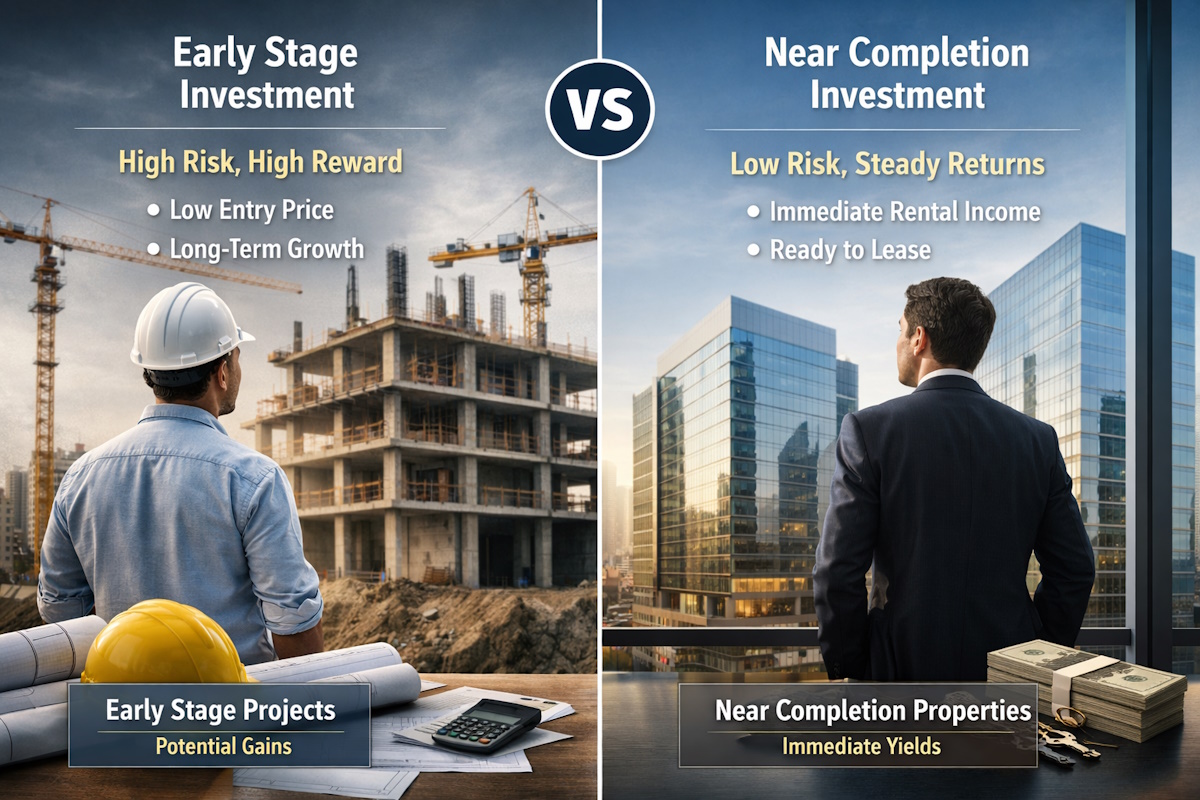
For high-net-worth investors, NRIs, and institutional buyers, the decision to commit capital to GIFT City is fundamentally sound, driven by the unique IFSC framework, tax benefits, and high demand for Grade A commercial and premium residential space. However, a crucial strategic choice remains: Do you seek the highest potential appreciation unlocked by committing to early stage projects GIFT City, or do you prioritize reduced execution risk and immediate rental yields offered by near completion property?
This choice dictates your capital deployment schedule, risk appetite, and the necessary due diligence required. Moving into a nascent development phase offers better price discovery, locking in appreciation potential before structural milestones are met. Conversely, opting for assets nearing completion provides immediate cash flow, certainty on delivery, and a shorter time-to-liquidity. We dissect these two strategies to help you align your investment goals with the right project lifecycle stage.
The Core Investment Thesis: Risk vs. Appreciation in GIFT City Real Estate
Every investment decision involves optimizing the balance between potential return and associated risk. In the context of the rapidly evolving GIFT City environment, timing is highly leverageable. The premium paid for certainty (near completion) must be measured against the discount received for bearing timeline and execution risk (early stage).
Defining “Early Stage”: Securing Capital Gains Potential
In GIFT City, “early stage” typically refers to projects that are either in the planning/regulatory approval phase (pre-launch) or have recently commenced foundation work and initial structural construction, often within the first 15–20% of the planned timeline. Investing at this stage maximizes the potential for capital appreciation as the project de-risks over time. The primary target for investors here is maximizing the percentage growth of their initial capital outlay, anticipating that the project’s market value will increase significantly once possession nears and rental occupancy stabilizes.
Defining “Near Completion”: Prioritizing Yield and Certainty
Near completion property GIFT City typically falls into the 85–95% completion bracket. Structural work is finalized, external finishing is underway, and internal fit-outs are beginning. Crucially, the possession date is generally confirmed and close (often within 6–12 months). The investment focus shifts from pure capital appreciation to immediate monetization through rental income and minimized holding risk. Investors opting for this stage are typically seeking quick deployment of capital into an asset that can almost immediately begin generating strong cash flows from the IFSC/SEZ tenant base.
Evaluating Early Stage Projects GIFT City: The Premium for Patience
Committing to early stage projects GIFT City requires a robust evaluation of the developer’s track record, financial stability, and legal compliance. While the entry price is attractive, the commitment is significantly longer, often requiring capital phasing over three to five years.
Capital Cost Advantage and Entry Price Lock-in
The core incentive for investing early is the substantial discount on the final market price. Developers offer these prices to secure initial capital, which helps fund construction. As an investor, you are locking in today’s rate for an asset that will be valued based on tomorrow’s market reality. Given the current institutional migration and infrastructure buildup in GIFT City, this gap between early purchase price and future stabilized value is often wider than in mature metros.
Impact on Internal Rate of Return (IRR)
Because capital is deployed gradually, the IRR of early-stage investments can often outperform near-completion assets, even if the absolute rental yield is similar upon stabilization. Lower initial purchase price significantly leverages the final valuation, boosting capital appreciation component of the total return.
The Dual Risks: Developer & Timeline Compliance
The primary risks associated with early-stage investment are developer insolvency and prolonged delays. In a controlled environment like GIFT City, regulatory oversight is rigorous, but market forces still apply. An investor must thoroughly vet the developer’s capacity to execute the specific project type (e.g., specialized commercial towers versus standardized residential blocks).
- Mitigating Developer Risk: Focus on established players with a proven delivery record in large-scale commercial real estate across India.
- Mitigating Timeline Risk: Scrutinize the payment schedule against key construction milestones. Avoid schedules that front-load capital heavily before substantial work is visible.
For tailored guidance on vetting developers and securing favorable payment terms, consider scheduling an investment consultation.
Exit Strategy and Liquidity Horizon
Liquidity is constrained during the construction phase. Selling an under-construction asset, while possible, typically attracts a smaller pool of buyers (usually other investors) and may require a price adjustment. The optimal liquidity event occurs post-possession and post-stabilization (high occupancy rate). Therefore, investors must have a longer time horizon—at least 5–7 years—when committing to the early stage.
To further understand the dynamics of investment cycles and market readiness in this specialized economic zone, it is crucial to Get expert insights on GIFT City real estate from those who track the IFSC regulatory changes daily.
Analyzing Near Completion Property GIFT City: Yield & Stability
Choosing near completion property GIFT City is a strategy focused on immediate utility and minimizing time-to-income. While the entry price is higher, the investment provides an almost instantaneous shift from sunk cost to income-generating asset.
Immediate Rental Yield and Cash Flow Generation
The core advantage is speed. Once possession is secured, the asset can be immediately listed for lease, capturing prevailing market rental rates. In GIFT City, demand for plug-and-play commercial space and premium residential units (especially for CXOs and key personnel) remains consistently high, offering robust immediate rental yield prospects.
Yield Verification for Near Completion Assets
When evaluating near completion property, investors must look beyond projected rental yields. Demand verification is paramount. Are comparable units in the immediate vicinity successfully leased? What is the current effective lease rate, and what are the typical vacancy periods? Trusting theoretical projections in a dynamic zone like GIFT City is a common investment mistake.
Proven Project Viability and Lower Execution Risk
By the near completion stage, all significant structural and regulatory hurdles have been cleared. Zoning changes, environmental clearances, and fundamental construction risks are largely mitigated. This certainty drastically lowers the risk premium, justifying the higher upfront cost. The focus shifts entirely to lease-up strategy and property management rather than construction monitoring.
This strategy minimizes the capital exposure to construction cycles, making it particularly appealing for institutional investors or family offices seeking conservative, yield-focused deployment.
Higher Capital Outlay: The Cost of Certainty
Acquiring a near completion asset requires a significant immediate capital deployment, typically 80% to 100% upfront. This impacts the leverage profile and means capital appreciation from construction milestones is largely foregone. Investors must ensure they have access to adequate liquidity or competitive financing to handle this larger, faster outlay compared to the phased payments of early stage projects GIFT City.
Commercial vs. Residential Dynamics at Near Completion
The choice between commercial and residential near completion assets also varies. Commercial assets may require longer lease negotiation periods but typically offer higher yields and longer lock-in periods. Residential assets may lease faster but may experience slightly higher turnover. Your assessment should include a detailed project stage comparison GIFT City based on asset type.
Understanding the interplay between asset type and project stage requires detailed local market knowledge. We encourage investors to Get expert insights on GIFT City real estate to refine their property selection strategy.
Decision Framework: Project Stage Comparison GIFT City
The choice between the two stages hinges not just on the projects themselves, but on the investor’s financial goals, risk tolerance, and time horizon. A direct project stage comparison GIFT City helps highlight where different investor priorities align.
Investor Profile Alignment
- Growth-Focused Investors (Founders, Younger HNIs): Often better suited for early stage projects GIFT City. They have the risk tolerance and time horizon to maximize capital appreciation and withstand potential construction delays.
- Yield-Focused Investors (NRIs, Institutional Buyers, Retired CXOs): Primarily seeking immediate cash flow and stability, making near completion property GIFT City the superior choice. Liquidity is prioritized over deep discounts.
Financing and Payment Schedule Implications
Financing changes dramatically based on project stage. Early-stage investments rely on construction-linked plans (CLP), reducing immediate capital load but increasing interest rate exposure over time. Near completion requires larger, often lump-sum payments, potentially simplifying long-term debt management but demanding greater upfront liquidity.
Pre-Lease Agreements and Valuation
In many near completion commercial properties, developers may have secured pre-lease agreements. This is invaluable, as it substantiates the projected rental yield and significantly boosts the asset’s valuation immediately post-possession. Such validation is impossible in early stage projects GIFT City.
Tax and IFSC Benefits Timing
The attractive tax benefits associated with investing in GIFT City (especially the IFSC/SEZ zone) are typically realized only when the asset is income-generating. Investing in near completion property allows the investor to begin realizing these tax advantages, like exemptions on capital gains or dividend distributions, much sooner. While early-stage investments eventually benefit, the realization is delayed until possession and leasing occur. To explore how this timing affects your annual tax liability, please Get expert insights on GIFT City real estate tailored to your specific status.
Mitigating Risk in Both Investment Stages
While the risk profiles differ, successful investment in GIFT City requires mitigation across the board, regardless of the development phase.
Due Diligence for Early Stage Acquisitions
For investors choosing early stage projects GIFT City, due diligence must be focused primarily on the developer’s past performance, financial backing, and the specific escrow mechanisms protecting investor funds. Ensure that land titles are clear and all necessary RERA and GIFT City Authority approvals are in place before committing the initial booking amount. Do not rely solely on marketing materials; demand physical verification of permits.
Yield Verification for Near Completion Assets
For near completion property, the risk shifts from non-delivery to market absorption. Verify the project’s compliance with Grade A infrastructure standards necessary for high-value IFSC tenants. Assess maintenance costs, service charges, and property management quality, as these can drastically erode advertised rental yields if poorly managed. Detailed analysis helps in securing the expected returns. Investors benefit significantly by engaging with advisors like Gift City Realty who offer pre-vetted market data.
We believe that for the sophisticated investor, the choice between an early stage venture and a near-completion asset in GIFT City is less about which is inherently “better” and more about which strategy perfectly executes the investor’s capital deployment objectives. The long-term trajectory of GIFT City guarantees appreciation; the timing of your entry determines the speed and leverage of that appreciation.
Make your choice based on detailed financial modeling and transparent risk assessment. If maximizing the potential IRR over a 7-year horizon is your goal, the pricing advantage of early stage projects GIFT City is compelling, provided the developer risk is acceptable. If immediate yield, fast liquidity, and certainty are non-negotiable, the certainty of near completion property GIFT City justifies the capital premium.
Final evaluation of your personal risk tolerance versus the project stage comparison GIFT City must be done before capital commitment. Get expert insights on GIFT City real estate today to solidify your decision.
Frequently Asked Questions (FAQs)
What is the typical price difference between early stage and near completion property in GIFT City?
The price difference typically ranges from 15% to 30%, depending on the developer’s brand and project type. This discount compensates the investor for bearing the additional time and execution risk associated with early stage projects GIFT City.
Do I get the same IFSC tax benefits regardless of the project stage?
The entitlement to IFSC tax benefits begins when the asset is operational and income-generating (leased out). While the benefit applies to both, near completion property allows you to start realizing those tax savings much faster than early stage projects GIFT City.
Is financing harder to secure for early stage commercial projects?
Yes. Banks are often more cautious with funding for early stage projects GIFT City, especially commercial ones, until they reach significant structural completion (typically 30–40%). Financing is generally easier and faster for near completion property due to lower perceived risk.
What due diligence should I prioritize for early stage projects GIFT City?
Prioritize verifying the developer’s financial solvency, reviewing the developer’s track record of timely delivery, confirming RERA registration status, and ensuring the land title is clean and unencumbered before signing any agreement.
When does a project transition from ‘early stage’ to ‘near completion’ in investor terms?
A project typically transitions from an early stage risk profile when structural work is finalized, and the possession date is reliably scheduled within 12–18 months. This shift signals that most catastrophic construction risks have been retired.