
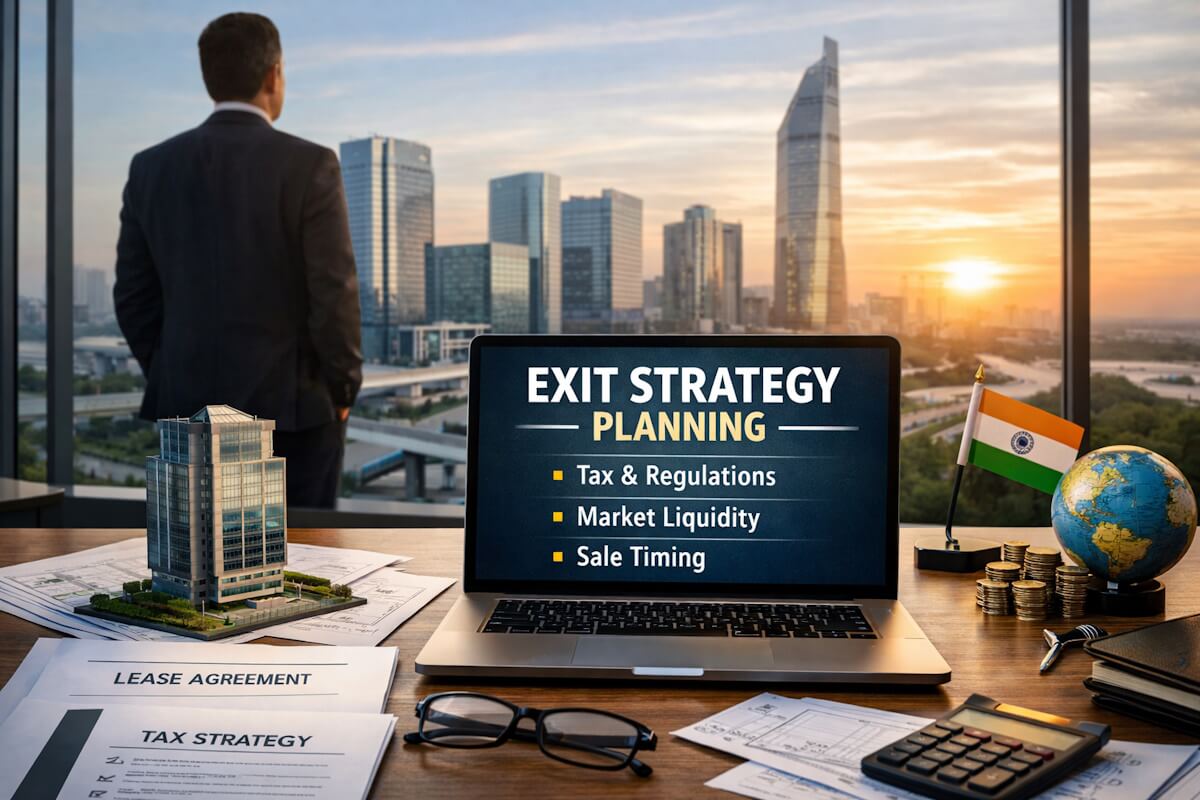
Planning Your Exit Strategy GIFT City: Maximizing Returns on High-Value Real Estate
For high-net-worth investors, founders, and institutional buyers, the moment of entry into a market like GIFT City is exciting, but the eventual exit is what defines the investment’s success. In a regulated, future-forward economic zone like the Gujarat International Finance Tec-City, simply holding and hoping for general market appreciation is insufficient. The complexity introduced by the IFSC (International Financial Services Centre) status means your exit strategy GIFT City property must be planned years in advance, incorporating specific tax, regulatory, and market liquidity factors.
The core challenge in GIFT City lies in its distinct dual structure—the SEZ (Special Economic Zone) and the non-SEZ areas—and the unique leasehold framework. This environment alters the standard real estate playbook, demanding a precise understanding of who your future buyer will be, what regulatory hurdles exist, and how to position your asset for maximum valuation when selling property in GIFT City. We approach this not as a transactional guide, but as a strategic advisory session on securing your capital return.
The Regulatory Foundation: How IFSC Status Impacts Liquidity and Resale
Unlike conventional real estate investment in India, the regulatory framework governing GIFT City directly influences the transferability and valuation of assets. Ignoring these implications until the moment of sale is a critical error that can significantly depress your final capital gains.
Tax Implications When Selling Property in GIFT City
Understanding capital gains taxation is paramount, and it differs significantly based on the property type, the duration of ownership, and the investor’s residency status (NRI, Domestic Company, or Foreign Entity).
Long-Term vs. Short-Term Gains
Investors must precisely track the holding period to qualify for favorable long-term capital gains tax treatment. Given the rapidly evolving regulatory landscape, planning the timing of your sale—often correlating with the full operationalization phase of the IFSC—is crucial. Furthermore, the ability to claim exemptions or indexation benefits varies depending on the specific asset class (commercial vs. residential) and where the asset is located within the GIFT City precincts (SEZ vs. non-SEZ).
NRI and Foreign Investor Considerations
For NRIs, founders based outside India, or funds investing through international vehicles, repatriation of proceeds and applicable TDS (Tax Deducted at Source) rates must be factored into the final ROI calculation. A clean, compliant exit plan ensures minimal friction and maximizes the net realized gain. We advise investors to review the impact of DTAAs (Double Taxation Avoidance Agreements) specific to their country of residence, which often requires specialized tax guidance tailored to the exit strategy GIFT City demands.
Get expert insights on GIFT City real estate before planning your holding period. Navigating tax complexities and regulatory changes requires deep market knowledge to prevent future complications.
Leasehold Structure and Transferability Constraints
GIFT City properties operate primarily on long-term leasehold agreements (typically 99 years), not outright freehold titles. This structure fundamentally impacts the process of selling property in GIFT City.
The Role of the Sub-Lease Transfer
When you sell, you are essentially transferring the remaining period of the sub-lease. This transfer must comply with GIFT City authority regulations. The value of the sub-lease is directly tied to the remaining tenure and the existing lease covenants. Potential buyers, especially institutional ones, will conduct rigorous due diligence on the lease terms, operational approvals, and compliance history of the property. Any regulatory non-compliance acts as a significant liquidity dampener.
Assessing the GIFT City Resale Market and Buyer Profiles
The liquidity of an asset is determined by the depth and nature of the buyer pool. Unlike established metropolitan areas, the GIFT City resale market caters to a highly specific demographic and institutional demand. Your exit strategy must align with these buyer profiles.
Commercial Real Estate: Targeting Institutional and Financial Buyers
Commercial assets in GIFT City—office spaces, institutional hubs, and data centers—are typically acquired by three main groups: established financial institutions expanding operations, multinational corporations establishing an IFSC presence, or funds focused on high-yield, stabilized assets. These buyers prioritize pre-leased assets with proven rental histories and Grade A tenancy.
The Metric of Stabilized Rental Yield
For commercial assets, valuation during resale leans heavily on the current, stabilized rental yield, more so than simple capital appreciation. A successful exit strategy GIFT City involves maintaining high occupancy rates with creditworthy tenants until the sale. The buyer is essentially purchasing a secure income stream, making rental contract quality paramount to the resale price.
Residential Real Estate: Catering to the Executive Class
Residential properties in GIFT City primarily serve the ecosystem’s workforce—CXOs, high-level financial executives, and institutional staff. The demand driver is convenience and exclusivity. While smaller in scale compared to the commercial market, this sector offers strong long-term appreciation potential as the city’s population grows.
Liquidity Driver: Immediate Usability
Resale of residential units is accelerated if the property is move-in ready, well-maintained, and offers premium amenities demanded by this discerning buyer segment. Timing the resale cycle to coincide with major corporate relocations or the completion of new phases of the IFSC development can maximize buyer interest.
Request Property Details and specialized valuation reports tailored to your specific asset class in GIFT City. Understanding current institutional demand is essential for setting realistic resale expectations.
Global Capital Participation and Exit Liquidity
The depth of the resale market in GIFT City is increasingly influenced by participation from globally regulated institutions and cross-border investors. Financial entities and funds connected to jurisdictions such as Australia, Canada, France, Germany, Malaysia, Singapore, United Arab Emirates, United Kingdom, and the United States have either established or evaluated IFSC-aligned operations within GIFT City. This expanding international footprint directly impacts exit liquidity by widening the pool of potential institutional buyers.
For commercial asset holders, global participation strengthens the probability of attracting regulated financial institutions or offshore funds seeking stabilized, yield-generating assets within the IFSC framework. International alignment enhances asset credibility, particularly for pre-leased Grade A offices with long lock-in tenures, thereby improving valuation benchmarks during resale.
From an exit strategy GIFT City perspective, the presence of cross-border capital adds resilience to the resale market. A diversified institutional buyer base reduces dependency on purely domestic demand cycles, supporting stronger pricing during optimal exit windows aligned with regulatory milestones and infrastructure completion phases.
Timing the Exit: Phased Development and Appreciation Cycles
The appreciation curve in a planned city like GIFT City is not linear; it moves in waves corresponding to regulatory milestones and physical infrastructure completion. An informed exit strategy GIFT City capitalizes on these defined phases.
Phase 1: Early Stage Exit (High Risk, High Leverage)
An exit during the first few years, typically involving the sale of under-construction or newly completed assets, often targets early-stage institutional investors seeking bulk discounts or high leverage. The risk is higher, but so is the potential delta between entry price and pre-stabilization sale price. However, this relies heavily on perceived future growth, which can be volatile.
Phase 2: Stabilization Exit (Optimal ROI)
The most favorable exit window typically occurs once the asset is fully stabilized—meaning infrastructure is complete, anchor tenants are operational, and consistent rental income is being generated. This is generally 5–8 years post-launch, or when the overall operational density of the IFSC reaches critical mass. This is where the GIFT City resale market offers the strongest reliable pricing, reflecting actual, rather than projected, cash flow.
The success of the exit strategy GIFT City depends heavily on monitoring the overall GIFT City master plan milestones. For deeper analysis into these appreciation drivers, you should consult our detailed guide on evaluating investment value: Get expert insights on GIFT City real estate.
Evaluating Exit Options: Outright Sale vs. Perpetual Income Strategy
The decision to sell or hold-and-lease is pivotal. It requires a detailed comparison of immediate capital gains (Scenario A) versus long-term net operational income (Scenario B).
Scenario A: Maximizing Capital Gains via Outright Sale
This strategy is ideal for investors seeking immediate capital redeployment or those looking to close their India-based asset positions. Success hinges on rigorous preparation:
- Asset Audit: Ensuring all regulatory approvals, occupancy certificates, and lease agreements are spotless and easily transferable.
- Valuation Benchmarking: Using comparable sales data within the SEZ/IFSC area to justify the price, focusing specifically on assets with similar tenant quality.
- Market Timing: Executing the sale during peak demand cycles, often coinciding with government policy announcements or major institutional inflows into GIFT City.
Scenario B: Perpetual Income via Hold-and-Lease
For investors prioritizing steady, long-term USD-denominated rental income (especially relevant for NRIs), retaining the asset and professionalizing the property management offers a viable, low-friction exit alternative. This effectively treats the asset as a bond-like investment, where the return is the consistent yield. The liquidity risk is managed by generating high cash flow, reducing the urgency of the capital return.
Schedule an Investment Consultation with Gift City Realty to model both sale and hold-and-lease scenarios, allowing you to quantify the projected ROI for your property based on current market dynamics.
Risk Mitigation: Common Pitfalls in the GIFT City Resale Market
When executing an exit strategy GIFT City, sophisticated investors must proactively address potential roadblocks that could delay the sale or force a discount.
Documentation and Compliance Hurdles
The single biggest hurdle when selling property in GIFT City is incomplete or non-compliant documentation, particularly related to the transfer of the lease, adherence to SEZ operational guidelines (if applicable), and clear delineation of common areas and maintenance charges. Buyers will leverage any deficiency to negotiate price reductions.
Dependency on Anchor Tenants
If a commercial property relies heavily on one or two anchor tenants, a potential vacancy or lease expiration shortly before the planned sale date can severely destabilize the perceived value. Risk mitigation involves staggering lease end dates and ensuring a robust mix of tenants, making the property more attractive in the GIFT City resale market.
Navigating the Specialized Buyer Pool
Because the buyer pool is highly specialized (institutional, HNI, or finance-sector focused), the marketing and due diligence process is longer and more intense. Investors require advisory partners who can source these niche buyers effectively, rather than relying on general brokerage channels. This specialized focus is key to realizing premium valuations.
Securing Your Return: A Decision-Oriented Approach to Exit
A successful real estate investment in GIFT City is measured not just by its appreciation, but by the efficiency and compliance of its exit. By establishing your exit strategy GIFT City at the moment of acquisition, you align your investment timeline with the regulatory and infrastructural reality of this unique financial hub. This strategic approach minimizes unforeseen tax burdens, optimizes the holding period for favorable capital gains, and ensures that when the time comes, your asset is positioned to attract the highest value institutional buyer. Consult an expert who understands the technical layers of the IFSC/SEZ framework to turn your potential gains into realized capital.
Explore GIFT City Projects and understand how their specific regulatory status affects future transferability. Speak with a GIFT City Expert today.
Frequently Asked Questions (FAQs)
What is the optimal holding period for commercial property in GIFT City for maximum capital gains?
The optimal holding period generally aligns with the shift from short-term to long-term capital gains classification, typically 24-36 months, but strategically, 5–8 years post-construction often yields the highest ROI. This timeframe allows the asset to stabilize rental income and aligns with increased operational density within the IFSC, strengthening the GIFT City resale market.
Does the leasehold structure reduce the resale value of GIFT City property?
No, the leasehold structure is standard within GIFT City and does not inherently reduce value, provided the remaining lease tenure is substantial (e.g., over 80 years). However, the clarity and transferability of the sub-lease documentation are critically important to securing a premium price when selling property in GIFT City.
Are there restrictions on who can purchase my property in the GIFT City SEZ area?
Yes. If your property is within the SEZ area, the buyer must be an entity that has obtained or is eligible for the necessary approvals to operate within the SEZ regulatory framework. This limits the buyer pool compared to non-SEZ areas, emphasizing the need for a targeted exit strategy GIFT City advisory.
What is the biggest mistake investors make regarding their exit strategy in GIFT City?
The biggest mistake is failing to account for regulatory compliance documentation and associated transfer taxes/fees until the last minute. This lack of pre-planning often leads to delays, legal friction, and forced price concessions in the final sale negotiations.
How does the quality of tenants affect my resale price?
Tenant quality (creditworthiness, stability, and lease term length) is the single most important non-physical factor influencing the valuation of commercial assets in the GIFT City resale market. Institutional buyers pay a premium for properties backed by high-credit, multinational IFSC entities, as this stabilizes the income stream they are acquiring.