
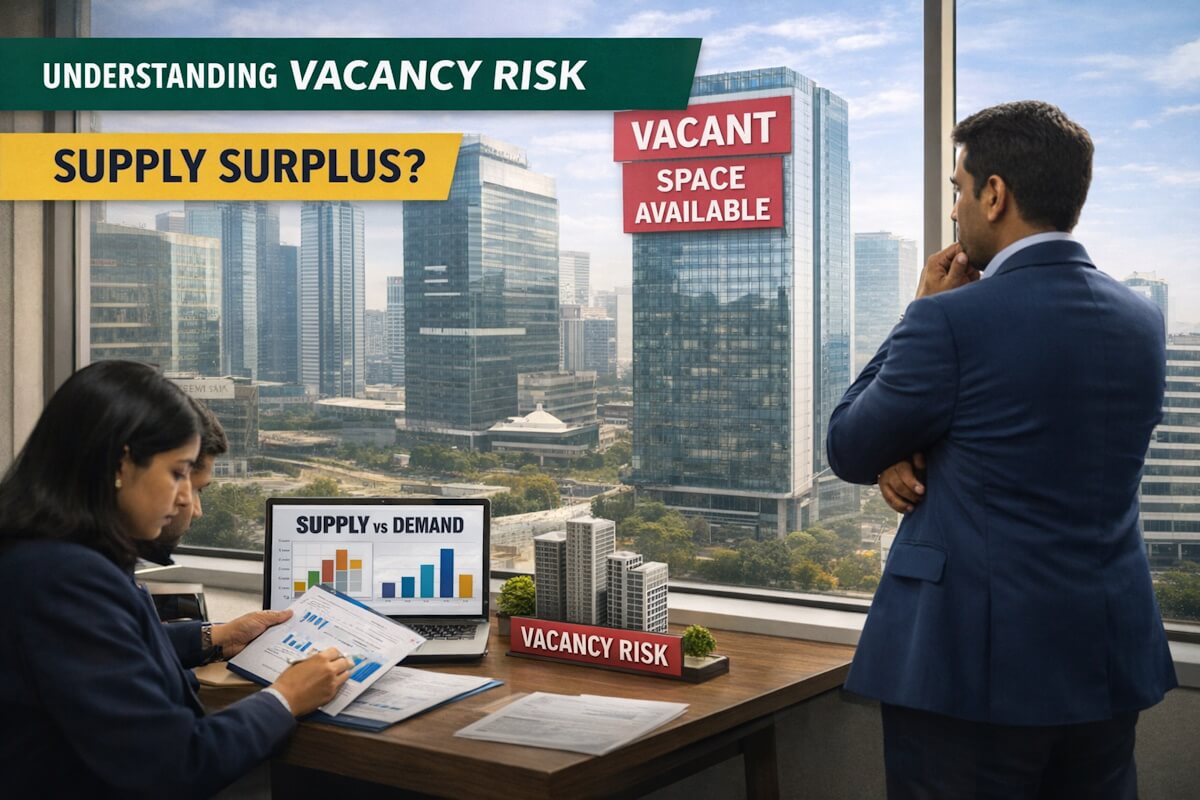
Navigating Supply and Demand: Mitigating the Vacancy Risk GIFT City Presents
The India International Financial Services Centre (IFSC) within GIFT City represents one of India’s most compelling long-term real estate investment narratives. The promise is clear: unparalleled regulatory benefits, exponential growth potential, and a captive ecosystem designed for global finance. Yet, for any sophisticated investor evaluating commercial assets, the primary technical challenge remains the accurate assessment and mitigation of vacancy risk GIFT City offers, particularly in comparison to established metros like Mumbai or Bengaluru.
Investing here requires moving beyond simple per-square-foot comparisons. We are investing in regulatory demand. The potential for outsized rental yields and capital appreciation hinges entirely on whether the physical space absorbs the corporate influx driven by the IFSC framework. Our advisory approach focuses on dissecting the supply pipeline against verified demand indicators, ensuring your capital is positioned defensively against prolonged periods of zero occupancy, which is the singular largest threat to projected ROI in this emerging financial hub.
Deconstructing Commercial Vacancy India IFSC Dynamics
When analyzing commercial property investment, vacancy risk typically reflects macro-economic cycles. In GIFT City, the dynamics are fundamentally different; they are policy-driven. Understanding this distinction is the first step in successful risk mitigation.
The Difference Between GIFT City and Conventional Commercial Markets
Conventional commercial markets react to domestic GDP growth, local infrastructure, and sector-agnostic office demand. The vacancy risk GIFT City faces, however, is tethered to the successful migration of financial services and related ecosystem players (FinTech, InsurTech, ancillary services) into the IFSC and SEZ (Special Economic Zone). If regulatory uptake slows, occupancy suffers, irrespective of broader national economic performance.
The Policy-Driven Demand Curve
GIFT City’s absorption is fueled by mandated relocation or expansion driven by tax holidays and IFSC operational advantages. This creates high-quality, long-term tenants, but the tenant pool is specialized. Investors must closely track IFSC entity registrations and operational setups, as these are the leading indicators for future rental demand, not general commercial leasing data seen across India.
Analyzing Supply-Side Investment Risk
The risk of high vacancy intensifies when supply significantly outpaces absorption. Developers, keen to capitalize on the initial buzz, sometimes launch large projects simultaneously. This creates short-to-medium-term saturation risk, leading to the phenomenon often referred to as empty office risk GIFT City investors must account for.
- Phased Handover Analysis: Evaluate the total Grade A supply scheduled for completion within the next 24 months. How much of this inventory is speculative versus build-to-suit or anchor-tenant committed?
- Developer Track Record: Prioritize developers with a proven history of tenant curation and low post-handover vacancy rates in their initial projects within the city. This often reveals a strong relationship with institutional tenants.
For investors seeking clarity on current absorption rates versus upcoming inventory, objective data analysis is paramount. We provide detailed forecasts and deep-dive comparisons of ready and under-construction assets to help investors quantify and mitigate this risk.
Schedule an Investment Consultation to review current supply pipeline data and absorption rates across various GIFT City commercial sectors.
Demand Drivers: The Only Real Hedge Against Empty Office Risk GIFT City
Mitigating vacancy risk GIFT City assets face is fundamentally about securing the highest quality tenants for the longest possible terms. This requires detailed knowledge of who is moving in and why they are staying.
IFSC Regulations as a Demand Catalyst
The greatest defense against commercial vacancy India IFSC properties experience is the regulatory environment itself. The benefits—such as 100% tax exemption on certain incomes for IFSC units for 10 years, stamp duty exemptions, and relaxation on various foreign exchange controls—are sticky. Once a firm commits to the IFSC framework, the operational cost of moving out is high, ensuring longer lease lock-ins.
The Captive Ecosystem Effect
As anchor financial institutions establish their presence, a secondary demand wave follows, consisting of support services: legal, auditing, consulting, and specialized FinTech firms. These firms need proximity to their primary clients, creating self-sustaining demand that gradually reduces the overall vacancy risk GIFT City confronts.
To further understand the long-term drivers of this ecosystem, we recommend downloading our comprehensive market analysis. This guide dives into the regulatory incentives that compel global firms to choose GIFT City over other jurisdictions. For serious investors, understanding the underlying policy is as critical as understanding the real estate itself. You can find detailed projections in our resource library after you
get investor guide.
Growing International Participation Strengthening IFSC Demand
An increasingly important factor supporting long-term absorption in GIFT City is the expanding participation of international institutions operating under the IFSC framework. Financial entities and ecosystem players connected to jurisdictions such as Australia, Canada, Fiji, France, Germany, Malaysia, New Zealand, Singapore, South Africa, Spain, Thailand, United Arab Emirates, United Kingdom, and the United States have evaluated or established IFSC-aligned operations within GIFT City. This widening geographic footprint strengthens the structural demand base beyond purely domestic corporate migration.
The presence of globally regulated banks, fund managers, insurance firms, and FinTech entities enhances tenant quality and supports longer lease lock-ins. International participation contributes to diversified sectoral demand, reinforces SEZ occupancy stability, and accelerates the development of ancillary services such as legal, compliance, and advisory firms.
From a vacancy-risk perspective, this cross-border integration expands the eligible tenant universe within the regulatory framework, supporting sustained commercial absorption. While policy-driven demand remains central, international alignment adds depth and resilience to GIFT City’s evolving office market ecosystem.
Sector-Specific Absorption Trends
Not all tenants are created equal. The stability of your rental income depends on the health and commitment of the sector your tenant operates in.
- Banking & Insurance (The Anchors): Large public and private banks, along with insurance majors, act as the stabilizing force. They typically require large floor plates and sign 5–10 year lock-in leases, providing excellent long-term security against empty office risk GIFT City.
- FinTech & Startups (The Growth Engine): While essential for ecosystem growth, these companies are often smaller and more mobile. Investment in properties primarily targeting this segment requires higher vigilance on lease renewal clauses and deposit structures.
Identifying Tier-1 vs. Tier-2 Tenant Profiles
A Tier-1 tenant is a globally recognized institution with a clear, long-term operational mandate in the IFSC. Their presence validates the property and attracts ancillary businesses. Before purchasing, investors should request verified data on existing and committed tenancy profiles of the building. High exposure to unverified startups or temporary service providers increases exposure to vacancy risk GIFT City investors should strive to avoid.
Evaluating Actual Commercial Vacancy India IFSC Rates
Published real estate data on GIFT City can be misleading due to the unique regulatory segregation (SEZ vs. Non-SEZ) and the phased development. Investors must apply a critical lens to occupancy statistics.
Understanding Lease Structures and Lock-in Periods
The lock-in period is the true measure of occupancy stability. A five-year lease with a three-year lock-in fundamentally differs from a seven-year lease with a five-year lock-in, especially concerning the future renewal cycle and the inherent risk of mid-term tenant departure. When assessing potential yields, always base projections on conservative lock-in periods, not the full lease term, to account for unforeseen regulatory shifts or corporate strategy changes.
Due Diligence on Developer Occupancy Claims
A common pitfall is accepting developer-provided “committed occupancy” figures without verification. Ask precise questions:
- Are these tenants currently operational or only signed letters of intent (LOI)?
- What is the balance sheet strength of the committed tenants?
- What is the average remaining lock-in period for current tenants?
If you need assistance in verifying these sensitive details and conducting comprehensive due diligence on specific projects, we encourage you to
get investor guide, which outlines our proprietary due diligence framework designed specifically for GIFT City commercial assets.
Explore GIFT City Projects that have demonstrably high anchor tenancy and verified long-term lease lock-ins, specifically structured to minimize your vacancy exposure.
Advanced Strategies for Mitigating Vacancy Risk GIFT City
Mitigation is not passive; it involves intentional investment choices tailored to the GIFT City environment. Our strategy involves prioritizing properties that naturally appeal to high-quality institutional tenants.
Location and Micro-Market Selection
Within GIFT City, location primarily means proximity to established infrastructure and, crucially, regulatory status. Properties located in the SEZ section attract IFSC units due to the associated tax benefits, creating immediate, high-certainty demand. Non-SEZ properties cater more to residential, support services, and general corporate needs.
The SEZ Premium and Vacancy Hedge
While SEZ properties may command a slight premium on purchase price, this premium acts as a powerful hedge against vacancy risk GIFT City properties face. The specific regulatory incentives guarantee a consistent, if limited, pool of eligible tenants, reducing competition for quality space compared to general commercial real estate across India.
Size and Configuration Strategy
Matching the property size to expected tenant demand is vital. While large floor plates (5,000+ sq ft) attract anchor tenants, they carry higher risk during periods of vacancy, as finding another tenant requiring the exact same expansive space can take longer, exacerbating empty office risk GIFT City investors dread.
- Modular Design: Investment in properties allowing flexible, modular configuration (e.g., 1,500–2,500 sq ft) often proves easier to lease out, attracting a wider range of FinTech and specialized support services.
- Customization Avoidance: Avoid buying highly customized interiors unless a long-term anchor tenant is already secured. Excessively custom features limit the marketability when the tenant eventually vacates.
Pricing Strategy and Competitive Yields
If your property remains unleased for 6–12 months post-handover, the optimal strategy might involve slight rental yield moderation to quickly secure a high-quality tenant. A slightly lower initial yield with zero vacancy is always superior to a theoretical high yield offset by prolonged zero-income periods.
Understanding the current competitive environment is key. Gift City Realty’s advisory services include up-to-the-minute analysis of prevailing competitive rental rates, ensuring your leasing strategy is optimized to absorb demand rapidly, thereby minimizing the impact of the vacancy risk GIFT City environment presents.
Request ROI Estimates based on verified comparable rental data and projected absorption timelines for high-performing commercial assets in GIFT City.
We believe that successful investing in this market involves a consultative partner who provides more than just access to inventory. It requires foresight on regulatory changes and a practical understanding of market absorption rates. We integrate real-time compliance updates with hard real estate data to deliver clear, actionable investment advice. For an exhaustive breakdown of the current investment climate, don’t forget to
get investor guide.
Residential Vacancy: A Secondary, Yet Critical, Risk Factor
While the primary focus is commercial, residential investment in GIFT City is intrinsically linked to commercial success. High commercial occupancy translates directly into demand for executive housing and secondary staff accommodation, mitigating residential vacancy risk.
Correlating Commercial Occupancy to Residential Demand
Residential rental yields will track the speed at which IFSC units require physical staff presence in Gujarat. If the core commercial vacancy India IFSC rate remains low and stable, expect a steady, predictable demand for high-quality residential units near the business district. Conversely, if commercial absorption stalls, residential demand will lag significantly, creating dual exposure for hybrid investors.
The Investor’s Path to Confident Commitment
The unique regulatory advantages of GIFT City shield investors from many of the macro risks plaguing other Indian commercial markets. However, they introduce a distinct set of supply-side and regulatory reliance risks. Managing the vacancy risk GIFT City offers means committing to rigorous, data-driven due diligence, focusing on high-quality, regulation-bound tenants, and carefully analyzing the pace of the supply pipeline.
Choosing the right asset and the right developer—one who aligns with IFSC’s growth trajectory—is the ultimate long-term risk mitigation strategy. By partnering with experts who specialize only in this ecosystem, you gain access to the granular insights necessary to navigate these early-cycle market dynamics and secure robust, long-term ROI.
Frequently Asked Questions (FAQs)
How does SEZ status impact commercial vacancy risk?
SEZ (Special Economic Zone) status significantly lowers vacancy risk because it limits the tenant pool almost exclusively to IFSC entities seeking specific tax incentives. This captive demand, driven by policy, makes SEZ spaces highly desirable and stabilizes occupancy far better than non-SEZ spaces.
Is empty office risk GIFT City higher than in Mumbai or Pune?
The risk profile is different. Traditional markets face general economic slowdowns, but GIFT City faces regulatory slowdowns or oversupply from developers. While the initial regulatory risk is unique, the quality of institutional tenancy in GIFT City often ensures better long-term stability once absorption takes hold, hedging against general commercial vacancy India IFSC issues.
What is a good benchmark absorption rate to evaluate a new project?
For a newly completed project in GIFT City, a healthy sign is achieving 40-50% operational occupancy within the first 12–18 months, primarily driven by anchor tenants. Anything slower warrants a deeper investigation into the developer’s leasing strategy and the building’s regulatory status. To conduct this level of investigation efficiently, we suggest you get investor guide.
How do I verify the actual tenants occupying a commercial space?
Serious investors should request certified tenancy schedules, often requiring a non-disclosure agreement (NDA), which list tenant names, committed space, and remaining lock-in periods. Relying solely on marketing materials increases your exposure to vacancy risk GIFT City assets may hide.