
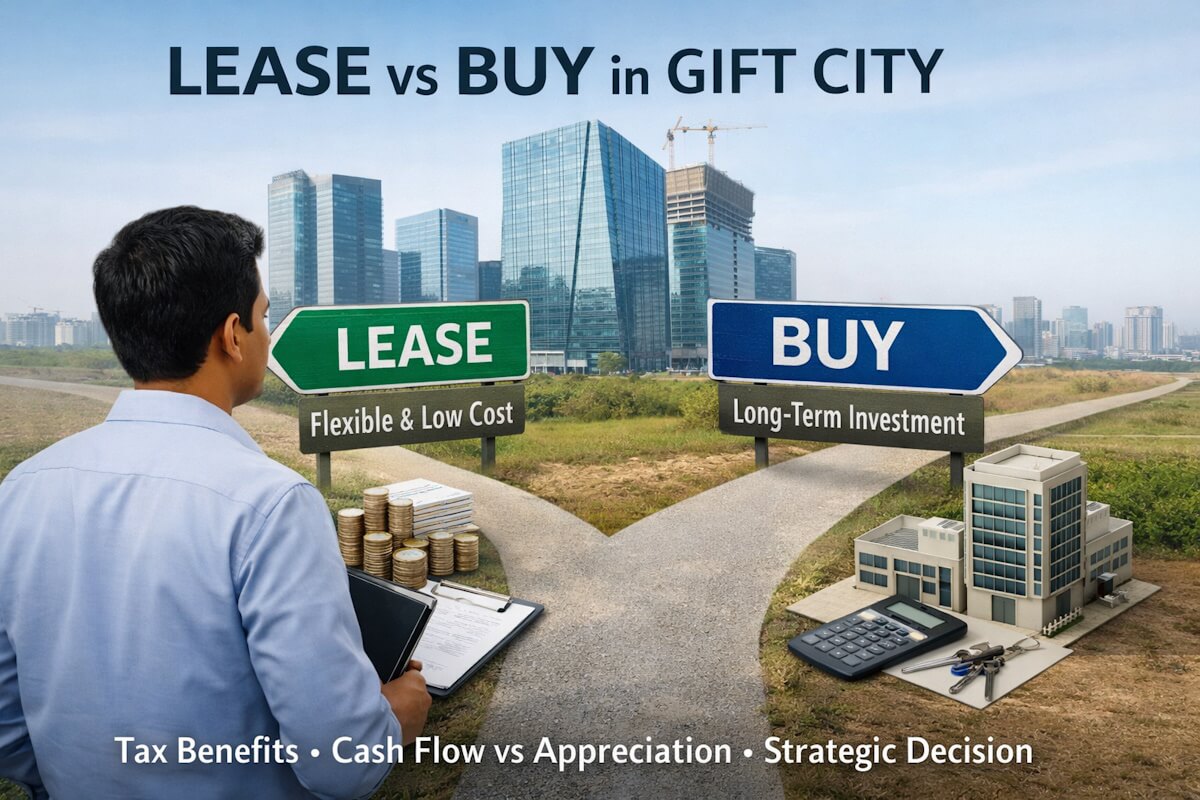
The Strategic Imperative: Leasing vs. Buying Office Space in GIFT City
For multinational corporations, financial institutions, and specialized firms setting up operations within the Gujarat International Finance Tec-City (GIFT City), establishing a physical footprint is a foundational decision. Yet, unlike conventional metropolitan markets, the choice between leasing and owning property here is fundamentally different.
This decision is not merely about managing cash flow; it’s a long-term strategic calculation tied directly to regulatory compliance, capital repatriation rules, tax incentives, and the anticipated appreciation unique to an IFSC (International Financial Services Centre) and SEZ (Special Economic Zone). Getting the foundational strategy right dictates not only immediate operational costs but also your capital appreciation potential over the next decade. We help serious investors and occupiers analyze the optimal path when faced with the critical choice of lease vs buy office GIFT City.
The Regulatory Layer: Why GIFT City Demands Custom Analysis
When evaluating lease vs buy office GIFT City, standard real estate metrics often fall short. The area’s unique status means real estate assets are deeply interwoven with the regulatory framework governing the businesses operating within them.
The IFSC/SEZ Regulatory Context
The primary driver of demand in GIFT City is the IFSC status, which grants significant tax holidays and regulatory relaxations for permitted activities. For a corporation, owning property within the SEZ/IFSC limits can unlock specific balance sheet and tax advantages that leasing may not fully capture.
IFSC Tax Benefits and Capital Depreciation
Companies setting up units in the IFSC are eligible for a 100% tax exemption on profits derived from IFSC business for any ten consecutive years out of the first 15 years. While this benefits profits regardless of whether you lease or own, ownership introduces depreciation as a direct business expense. If you opt for buying office space IFSC, the ability to claim higher depreciation rates on commercial property can significantly impact your effective tax rate, especially once the initial 10-year holiday expires or if your operations expand beyond the scope of the tax holiday.
This nuanced financial planning requires specialized expertise that understands both property cycles and regulatory compliance. Get expert insights on GIFT City real estate before finalizing your financial structure.
Defining the Corporate Office Strategy GIFT City Needs
The optimal decision hinges on your organization’s mandate and investment horizon:
Operational Capital vs. Investment Capital
Does your firm view its office space as a core operational expenditure (OpEx) or as a strategic asset class (CapEx)?
- Leasing (OpEx focus): Prioritizes flexibility, minimum upfront capital outlay, and immediate cash flow preservation. Ideal for firms uncertain about long-term headcount growth or market exposure.
- Buying (CapEx focus): Prioritizes long-term asset value, hedge against rental inflation, and maximum utilization of balance sheet assets. Essential for institutional players with established long-term strategies in India.
This strategic choice directly influences liquidity and the total cost of ownership (TCO) over a 15–20 year period, making the lease vs buy office GIFT City decision one of the most critical early choices for any enterprise establishing a base here.
We advise multinational firms daily on navigating this exact dilemma, aligning the physical space acquisition strategy with global balance sheet goals. If your team is seeking customized financial modeling based on projected growth and IFSC benefits, we encourage you to connect with our advisory team. We can provide detailed TCO and IRR projections based on current market dynamics.
Detailed Breakdown: Buying Office Space in GIFT City
For firms committed to a minimum 10-year presence in India’s financial hub, ownership typically emerges as the financially superior option, provided capital allocation aligns with the strategy. Buying office space IFSC is essentially a two-fold investment: securing operational space and acquiring a high-potential institutional asset.
Capital Allocation and Long-Term Appreciation
GIFT City is still in a phase of rapid development and institutional onboarding. While rental yields are respectable, the core long-term investment opportunity lies in capital appreciation. Unlike mature markets where capital values stabilize, GIFT City’s value is driven by successful policy implementation and increasing institutional density.
Hedge Against Rental Inflation
Owning property locks in your occupancy cost today, providing a crucial hedge against projected rental inflation. As demand for prime, SEZ-compliant commercial space continues to outstrip supply—a key dynamic in the initial growth phase—rental costs are expected to escalate steadily. Firms that own their space eliminate this variable cost risk from their future balance sheets. Get expert insights on GIFT City real estate, particularly concerning projected supply-side constraints impacting future lease rates.
Direct Tax and Depreciation Benefits
The ability to use real estate depreciation as a write-off against taxable income is a powerful incentive for ownership. This benefit is particularly potent for parent companies operating in jurisdictions that allow cross-border consolidation of assets and depreciation claims.
Tax Planning and Wealth Management
For Founder-led firms or High Net Worth Individuals (HNIs) using a holding structure to acquire the office space and then lease it back to their own IFSC operating unit, ownership allows sophisticated tax planning, utilizing both corporate depreciation and personal wealth appreciation from the underlying asset. This makes buying office space IFSC an attractive proposition for those integrating corporate and personal wealth strategies.
Mitigating Risk in Long-Term Ownership
The primary risk in ownership is lack of flexibility. However, in a strategic location like GIFT City, liquidity for commercial assets is projected to be high due to continuous institutional interest and the regulated nature of the market.
- Liquidity Management: If operational needs change, selling or leasing out commercial space in prime GIFT City towers is often easier and faster than exiting leased space with penalty clauses.
- Customization Control: Ownership provides complete control over fit-outs, infrastructure upgrades, and compliance requirements, which is vital for high-security financial institutions.
Before proceeding with purchasing commercial space, ensure you conduct thorough due diligence on the developer’s track record in SEZ/IFSC compliance and the project’s institutional appeal. This diligence is crucial for maintaining future liquidity if you need to offload the asset. Get expert insights on GIFT City real estate—we provide vetted property lists focusing on regulatory adherence and long-term asset quality.
Detailed Breakdown: Leasing Office Space in GIFT City
Leasing remains the preferred path for firms prioritizing speed, flexibility, and minimal upfront capital expenditure. It is a viable corporate office strategy GIFT City firms adopt, especially during initial setup phases or when global headquarters mandate stringent CapEx restrictions.
Flexibility and Initial Cash Flow Management
The primary advantage of leasing is the preservation of capital. By avoiding the significant down payment and immediate debt obligation associated with ownership, firms can dedicate resources to core business growth and immediate operational needs.
Scaling Operations Quickly
Firms in high-growth, high-variability sectors (e.g., FinTech start-ups, boutique advisory services) benefit significantly. Leasing allows for easier scaling—moving from 5,000 sq ft to 15,000 sq ft by negotiating adjacent space or moving to a different building entirely without the hassle of property disposal. This operational agility is often non-negotiable for hyper-growth entities.
Regulatory Compliance and Operational Ease
While ownership mandates a full understanding of property laws, leasing transfers much of the maintenance, property tax, and building compliance burden to the landlord or developer. This simplifies the operational load for foreign entities unfamiliar with local regulations in Gujarat.
Transfer and Exit Clauses
A well-negotiated lease agreement provides clearly defined exit pathways. While most leases include lock-in periods and penalty clauses, these terms are predictable costs, unlike the unpredictable nature of realizing capital value in a sudden property sale. For a corporate office strategy GIFT City focused on minimum commitment, leasing is often the safer, faster entry mechanism.
However, be aware of “hidden costs” in leasing, particularly escalating CAM (Common Area Maintenance) charges and rigid fit-out restrictions. Reviewing these clauses requires an expert eye familiar with the local commercial lease environment. Get expert insights on GIFT City real estate lease structuring before signing long-term agreements.
The Hidden Cost of Opportunity
The main drawback of leasing is forgoing long-term capital appreciation. While lease payments are tax-deductible expenses, they do not contribute to asset creation. In a market projected to grow rapidly, the cost of not owning could far exceed the savings realized on initial CapEx.
- Lost Equity: Every rental payment contributes to the landlord’s equity, not yours.
- Rising Renewal Costs: Lease renewals are typically subject to market rates, meaning if the GIFT City market matures successfully, your occupancy costs will substantially increase every few years.
If your long-term plan (15+ years) includes permanent residency and expansion in India, the financial opportunity lost by leasing may overshadow the immediate flexibility gained. This is a crucial calculation in the lease vs buy office GIFT City equation.
Request Property Details and Custom ROI Estimates for both Buying and Leasing options in GIFT City Commercial Towers.
Quantitative Evaluation: ROI, IRR, and Investment Horizons
The final decision between lease vs buy office GIFT City must be grounded in net present value (NPV) analysis and the internal rate of return (IRR) over your planned investment horizon.
Calculating True Cost of Capital (TCC)
When you buy, you must factor in the opportunity cost of the capital tied up in the down payment, property taxes, maintenance, and insurance. When you lease, you must factor in the rental escalation and the potential for residual value at the end of the term (which is zero for the tenant).
Sensitivity Analysis
We typically run three scenarios for clients:
- Worst-case scenario (Low appreciation, high financing cost).
- Mid-range scenario (Steady GIFT City growth, stable interest rates).
- Best-case scenario (High institutional adoption, premium appreciation).
If ownership proves resilient even in the worst-case scenario, the decision shifts strongly toward buying office space IFSC. This rigorous financial modelling ensures that the property decision aligns with treasury risk management protocols. Get expert insights on GIFT City real estate financial modeling customized for your firm’s capital structure.
Future Demand Drivers
Future value for owned commercial property in GIFT City will be primarily driven by the success of the IFSC in attracting global banks, insurance companies, and capital market players. The demand profile is highly institutional, which supports stable, long-term asset value. Property located within the core operational SEZ area is likely to see premium appreciation compared to non-SEZ areas within GIFT City.
Investor Profile Match: Who Should Lease and Who Should Buy?
While the numbers provide clarity, the final decision often reflects the risk appetite and global footprint of the firm.
The Institutional Investor Perspective
Large banks, asset managers, and established multinational corporations (MNCs) tend to favor ownership. They have access to competitive institutional financing, view real estate as a balance sheet asset (often managed by a separate group), and have investment horizons that typically exceed 15 years. For these players, buying office space IFSC is a natural extension of their long-term commitment to the market.
The Founder/CXO Perspective
Mid-sized enterprises, FinTech start-ups, and specialized service providers often lean towards leasing initially. Their focus is rapid market entry and low latency. They may view their capital as better deployed in technology, talent acquisition, or core product development rather than illiquid real estate. However, if the founder plans to use the GIFT City base as a permanent anchor in India, purchasing a smaller, strategic asset should be considered simultaneously with their leasing decision.
Speak with a GIFT City Expert about blending ownership and leasing strategies for optimal financial benefit.
How the Lease vs Buy Decision Varies by Country of Origin
If you are setting up in GIFT City from outside India, the lease vs buy office GIFT City decision is often shaped less by local rules and more by how capital is typically deployed in your home market. Firms and NRIs from the United States, United Kingdom, Canada, Germany, and France often start with leasing due to internal CapEx controls and compliance reviews, even when long-term ownership is planned. Leasing helps validate headcount, regulatory comfort, and operational stability before committing capital.
Buyers and promoters from the United Arab Emirates, Singapore, Malaysia, Australia, and New Zealand are generally more open to early ownership, especially when the GIFT City entity is intended as a long-term India base. For this group, buying office space IFSC is often evaluated alongside wealth structuring, depreciation planning, and protection against future rental escalation.
NRIs and family offices from South Africa, Spain, Thailand, and Fiji typically compare GIFT City ownership with opportunities back home. If India exposure is already part of their long-term plan, ownership is often considered earlier. If the presence is exploratory, leasing remains the safer entry. In practice, country of origin does not change the rules in GIFT City, but it strongly influences how risk, flexibility, and capital lock-in are perceived.
Finalizing the Corporate Office Strategy
The debate over lease vs buy office GIFT City is ultimately a proxy for an organization’s confidence in the GIFT City vision. Leasing offers immediate tactical flexibility, while ownership offers strategic, long-term financial leverage underpinned by unique IFSC regulations and capital appreciation potential.
We have found that for firms with robust financing options and a long-term plan exceeding 12 years, the financial benefits of ownership—including depreciation, capital gains, and eliminating rental risk—significantly outweigh the benefits of capital preservation offered by leasing. However, for fast-moving firms prioritizing immediate scaling and minimal regulatory entanglement, a short-term lease followed by a phased acquisition plan is often the most prudent corporate office strategy GIFT City allows.
Regardless of your decision, structure your agreement (whether lease or purchase) with a deep understanding of the SEZ/IFSC compliance requirements. Mistakes in this area can nullify potential tax benefits. Ensure your advisors are proficient not only in real estate transactions but also in IFSC regulatory adherence.
Frequently Asked Questions
Can an NRI or Foreign Entity own commercial space in GIFT City SEZ?
Yes. Foreign entities and Non-Resident Indians (NRIs) are generally permitted to acquire and hold commercial property within the GIFT City SEZ, subject to standard Foreign Exchange Management Act (FEMA) guidelines and specific regulatory requirements related to property utilization within the SEZ. This makes buying office space IFSC accessible to global investors.
Are property transfer taxes higher for buying office space IFSC compared to conventional markets?
Stamp duty and registration fees are regulated by the Gujarat government. While they generally align with state norms, specific incentives or reduced fees may apply in certain GIFT City areas, primarily to attract large-scale institutional investment. Investors should consult current state mandates for precise figures.
What are the key disadvantages of leasing in GIFT City?
The primary disadvantage is the loss of control over the asset. You lose the benefit of capital appreciation and are subjected to escalating rent upon renewal. For IFSC firms, leasing also prevents them from fully utilizing potential depreciation write-offs on the asset itself.
Does the lease vs buy decision affect my IFSC business approval status?
No, your status as an IFSC unit is based on your permitted activities and regulatory compliance, not whether you lease or own the property. However, ownership provides greater security for demonstrating long-term operational commitment to the regulators.
What is the typical investment horizon for buying office space in GIFT City?
For strategic investors and owner-occupiers, the recommended investment horizon is 10 to 15 years. This aligns well with the long-term tax benefits provided by the IFSC and maximizes the potential for capital appreciation during the market’s maturation phase.