
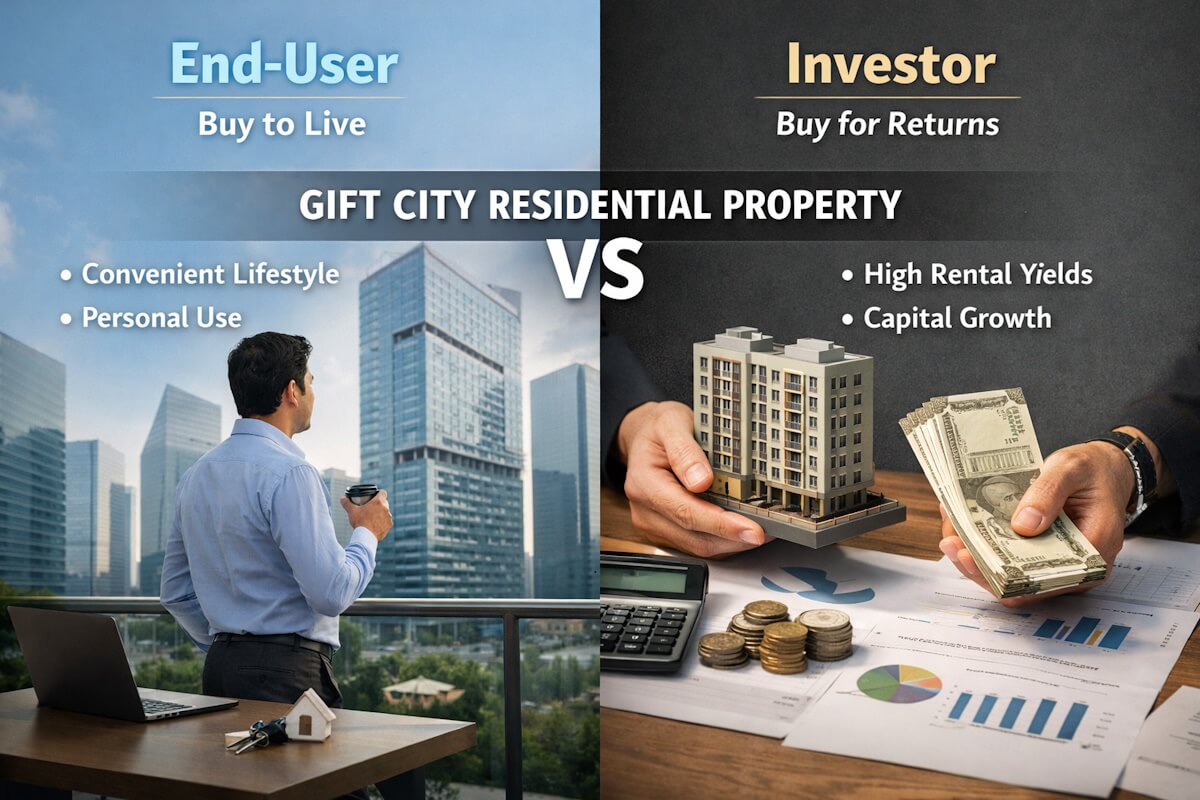
The Strategic Choice: End-User vs. Investor in GIFT City Residential Real Estate
For high-net-worth individuals, founders, and NRIs evaluating India’s prime assets, GIFT City presents a unique opportunity set, largely defined by its IFSC and SEZ status. Unlike traditional metropolitan markets where the line between an end-user purchase and an investment property is often blurred, in GIFT City, that distinction is sharp, regulatory-driven, and fundamentally impacts long-term return on investment (ROI).
The core challenge for any potential buyer is aligning personal need (the desire to Start your investment journey in GIFT City) and regulatory compliance with financial objectives. Are you truly looking for an end user property GIFT City, or is your primary goal capital preservation and high rental yields? Understanding these competing mandates is the first step toward optimizing your portfolio in this globally focused financial center.
The Core Difference: Intent Drives Regulation and Yield
In most real estate markets, an investor can easily transition an end-user property into a rental asset. GIFT City’s environment, specifically the interplay between the Domestic Tariff Area (DTA) and the Special Economic Zone (SEZ), complicates this fluidity. The intended use of the property directly influences compliance, taxation, and potential tenant pool.
Defining the GIFT City End-User Profile
The genuine end-user buyer typically falls into a specific demographic: an executive, a CXO, or an employee working within one of the IFSC institutions who seeks accommodation proximate to their workplace. Their decision criteria prioritize convenience, safety, quality of life, and reduced commuting time. They want to buy to live GIFT City.
- Priority: Lifestyle and proximity to SEZ/IFSC office towers.
- Trade-off: They often accept slightly lower potential long-term returns in exchange for immediate access and reduced personal expense (rent).
- Risk Profile: Tied directly to their professional commitment within the zone. If they move, the unit must quickly transition to a rental or be sold.
The Pure Residential Investor Mandate
The pure investor approaches GIFT City residential assets strictly through the lens of financial performance—namely, rental yield, appreciation, and favorable tax structures associated with the location. Their goal is a strategic residential investment GIFT City that acts as a secure, high-performing passive asset.
- Priority: Maximize annualized return, minimize vacancy risk, and optimize for long-term capital gains facilitated by the SEZ framework.
- Trade-off: They are less concerned with the specific unit layout or personal preferences and more focused on features desirable to the key target demographic (IFSC professionals).
- Key Metric: Analyzing the demand pipeline stemming from firms establishing a presence in GIFT City. Investors need to monitor the corporate influx.
Before proceeding, ask yourself if your need to occupy the space outweighs the potential investment upside of a purely managed, yielding asset. If you are leaning toward maximizing yields, we recommend you Start your investment journey in GIFT City by getting the latest rental forecasts.
Evaluating Investment Trade-offs for End-Users
While the convenience of purchasing an end user property GIFT City is undeniable, it carries intrinsic financial trade-offs that pure investors avoid. These trade-offs primarily relate to liquidity and opportunity cost.
Liquidity and Exit Strategy Implications
An occupied property, particularly one customized for personal use, can sometimes take longer to exit than a professionally managed, standardized rental unit. When an end-user decides to sell, they are competing with units that are immediately available for possession or that are already cash-flow positive for a new investor.
Customization vs. Broad Market Appeal
End-users often invest heavily in bespoke interiors or specific amenities. While enjoyable, these customizations may not align with the next buyer’s preference, potentially narrowing the target market and slowing down the sale. A professional residential investment GIFT City unit often remains neutral, appealing to the widest possible tenant or buyer pool.
The Cost of Immediate Occupancy (Opportunity Cost)
The moment an end-user occupies a property, they forgo immediate rental income. This opportunity cost must be weighed against the saved rent. For an HNI focusing on wealth multiplication, the cash flow generated by a prime investment property could fund the rent elsewhere, often maximizing the overall financial position.
Tax Benefits vs. Usage Constraints
While the overall tax framework in GIFT City is highly favorable, utilizing the residential property personally might affect how certain deductions or advantages are claimed compared to an asset held purely for income generation. Investors must consult expert advice to ensure compliance with the specific tax regime governing residential assets within or adjacent to the SEZ/IFSC area. This is a crucial distinction when deciding to buy to live GIFT City.
Do you need tailored advice on how occupancy affects your tax position? Start your investment journey in GIFT City and schedule an Investment Consultation with our tax-aware advisory team.
How Country of Residence Shapes the End-User vs Investor Decision
For NRIs, the choice between an end user property GIFT City and a pure investment is rarely theoretical. It is shaped by where life currently operates and how permanent a return to India really is.
Buyers based in the United Arab Emirates, Singapore, Malaysia, and Thailand often sit closest to the fence. Geographic proximity makes frequent travel easy, and many maintain active professional or business ties in India. For this group, buying to live GIFT City can make sense only when employment within the IFSC is stable and family relocation is planned within a short horizon. Otherwise, the investor route offers flexibility without forcing lifestyle decisions too early.
NRIs in the United States, Canada, United Kingdom, Germany, France, Spain, Australia, and New Zealand usually approach GIFT City with a clearer separation between use and investment. The distance creates friction for part-time occupancy, making end-user purchases less practical unless the move back to India is decisive and timed around schooling or retirement. In these cases, residential investment GIFT City assets work better as income-generating holdings rather than personal homes waiting to be used.
Families returning from South Africa and Fiji often prioritize stability over optimization. Security, governance, and predictability matter more than marginal yield differences. Some choose to buy to live GIFT City earlier than others, even if rental economics would favor an investor-first strategy, simply to lock in a controlled living environment and avoid metro volatility.
Across all countries, one pattern repeats. Overseas buyers who misjudge the timing of personal occupancy often regret buying as end-users too early. Those who enter as investors first retain optionality. They can convert later, once professional alignment and family readiness are certain.
For investors, this matters because rental demand in GIFT City is not driven by casual tenants. It is driven by professionals making deliberate, career-led moves. Understanding where those tenants are coming from helps determine whether a project should be positioned as a flexible investment asset or a long-term end-user residence.
Maximizing ROI for Pure Residential Investment GIFT City
For investors focused solely on yield and appreciation, the strategy shifts entirely to identifying high-demand properties and structuring the acquisition to benefit maximally from the developing ecosystem.
Rental Yield Drivers in the IFSC/SEZ
The primary driver of yield is the captive, high-paying, professional workforce. Rental demand is inelastic and largely immune to local market fluctuations outside of GIFT City. Investors should look for projects with premium specifications and professional property management infrastructure, as IFSC executives demand international-grade facilities.
What specific features drive the highest rents?
- Proximity to the commercial towers (walk-to-work culture).
- Availability of comprehensive social amenities (clubs, fitness centers, curated retail).
- Dedicated security and maintenance standards aligned with global financial centers.
Analyzing Supply Chain and Density Limits
GIFT City is a master-planned zone with finite residential permissions tied to the growth of commercial activity. This controlled supply environment mitigates the risk of residential oversupply, a common pitfall in adjacent urban centers. Investors benefit from this managed density, which acts as a protective layer for capital appreciation.
We monitor the residential property release schedule meticulously to help clients execute strategic entries. If you are serious about capitalizing on the rental boom, Request Property Details for projects with high occupancy forecasts.
Choosing the Right Asset Class
Investors must choose wisely between standard apartments and serviced apartments. Serviced apartments often command higher per-square-foot rents and cater specifically to short-term assignments or senior executives requiring hassle-free living. They represent a distinct, higher-yield form of residential investment GIFT City, though they often require specialized management contracts.
Compliance and Regulatory Factors That Bind End User Property GIFT City
Regulatory adherence is paramount in GIFT City. The nature of the financial hub means that all operations, including residential ownership, must align with the spirit of the project: creating a functional, world-class business environment.
The Mandate for IFSC/SEZ Employees
While the government actively encourages IFSC/SEZ employees to reside within or near the zone to enhance productivity and reduce friction, end-users must be cognizant of the long-term changes in their professional status. If an executive leaves their GIFT City job, the logic underpinning their decision to buy to live GIFT City diminishes rapidly.
For individuals considering an end user property GIFT City purchase, it is prudent to establish a clear contingency plan. This plan should detail how the property will be monetized (rented or sold) quickly if employment conditions change, ensuring the asset doesn’t become a liability.
Long-Term Maintenance and Management Dynamics
High-quality urban development requires rigorous maintenance. Residential units within GIFT City often carry higher common area maintenance (CAM) charges compared to suburban housing, reflecting the premium services provided (integrated smart city infrastructure, district cooling, 24/7 power). Investors see this as a necessary cost to maintain high rental yields and secure appreciation; end-users must budget for it alongside their mortgage.
Understanding these financial requirements is essential. Speak with a GIFT City Expert to compare projected CAM fees across different residential projects and understand the true cost of ownership.
Future-Proofing Your Investment Decision
Whether you choose an end user property GIFT City or a dedicated rental asset, the long-term value rests on the strategic growth of the zone itself. Evaluating future appreciation requires looking beyond current rental yields.
Appreciation Drivers Beyond Rental Income
The primary driver of capital appreciation in GIFT City is the continued influx of financial institutions, FinTech companies, and specialized global services attracted by the IFSC tax incentives. As commercial occupancy rises, the housing supply remains finite, creating sustained pressure on capital values. This fundamental supply-demand dynamic secures the long-term viability of residential investment GIFT City.
Infrastructure Multipliers
Future infrastructure projects, including enhanced connectivity to Ahmedabad and the planned social infrastructure additions (schools, hospitals), act as powerful value multipliers. Investors should prioritize projects positioned to benefit most immediately from these upgrades.
The Role of Social Infrastructure Growth
The transition of GIFT City from a nascent business district to a thriving, integrated ecosystem is key. As schools, entertainment zones, and comprehensive healthcare facilities are established, the attraction for high-caliber IFSC employees to buy to live GIFT City will increase, pushing both rents and capital values higher. We advise investors to favor developers with proven track records in delivering not just towers, but integrated ecosystems. Start your investment journey in GIFT City by analyzing developer credibility.
If you are struggling to quantify the long-term appreciation potential against current yields, Request ROI Estimates for select premium residential units.
Making the Confident Decision: Investor or Occupier?
The choice between purchasing an end user property GIFT City and committing to a pure residential investment GIFT City hinges entirely on your financial planning horizon and operational intent. If your professional commitment to the IFSC is secure and long-term, and the convenience of immediate occupancy outweighs foregone rental income, the end-user path is justifiable.
However, for the vast majority of sophisticated NRIs and HNIs, GIFT City residential property functions best as a high-yield, professionally managed asset insulated by the SEZ regulatory environment. The highest financial returns are typically realized when the property is viewed as a strategic business asset optimized for passive income and compounded appreciation, rather than a personal dwelling. This requires a dedicated focus on tenant profiling, project vetting, and regulatory compliance—expertise that Gift City Realty specializes in providing.
If maximizing your portfolio returns is the priority, let us guide you through the projects best structured for capital growth and high yield. Explore GIFT City Projects vetted specifically for serious investors.
Frequently Asked Questions (FAQs)
What is the typical rental yield difference between an investor property and an end user property GIFT City?
While yields vary by location and project quality, investor properties optimized for the IFSC demographic often target 4%–6% gross rental yield. An end user property GIFT City that is personally occupied yields 0% income, making the comparison about saved rental expense versus opportunity cost.
Can I convert an investor unit into my personal home later?
Yes, property conversion is generally possible, but investors must be aware of any regulatory or tax implications arising from the change in status, especially if the asset has previously benefited from investment-specific tax treatment. Always verify compliance before converting a pure residential investment GIFT City asset to buy to live GIFT City.
Is the demand to buy to live GIFT City increasing?
Yes. As social infrastructure improves and more global firms establish operations, the appeal of residing within the zone increases, driving greater interest from genuine end-users and pushing up the value of all residential assets.
How does the SEZ status impact the resale of residential property?
The SEZ status primarily dictates the tenant pool (IFSC/SEZ professionals) and the tax regime for investment income. The controlled, high-demand environment generally ensures healthy capital appreciation, making both an end user property GIFT City and investor units highly liquid upon resale.
What is the biggest risk in making a residential investment GIFT City?
The biggest risk lies in choosing projects outside the core high-demand corridors or selecting developers lacking the financial bandwidth to deliver the promised international-standard infrastructure. Vetting the developer and project location is paramount to mitigating risk.