
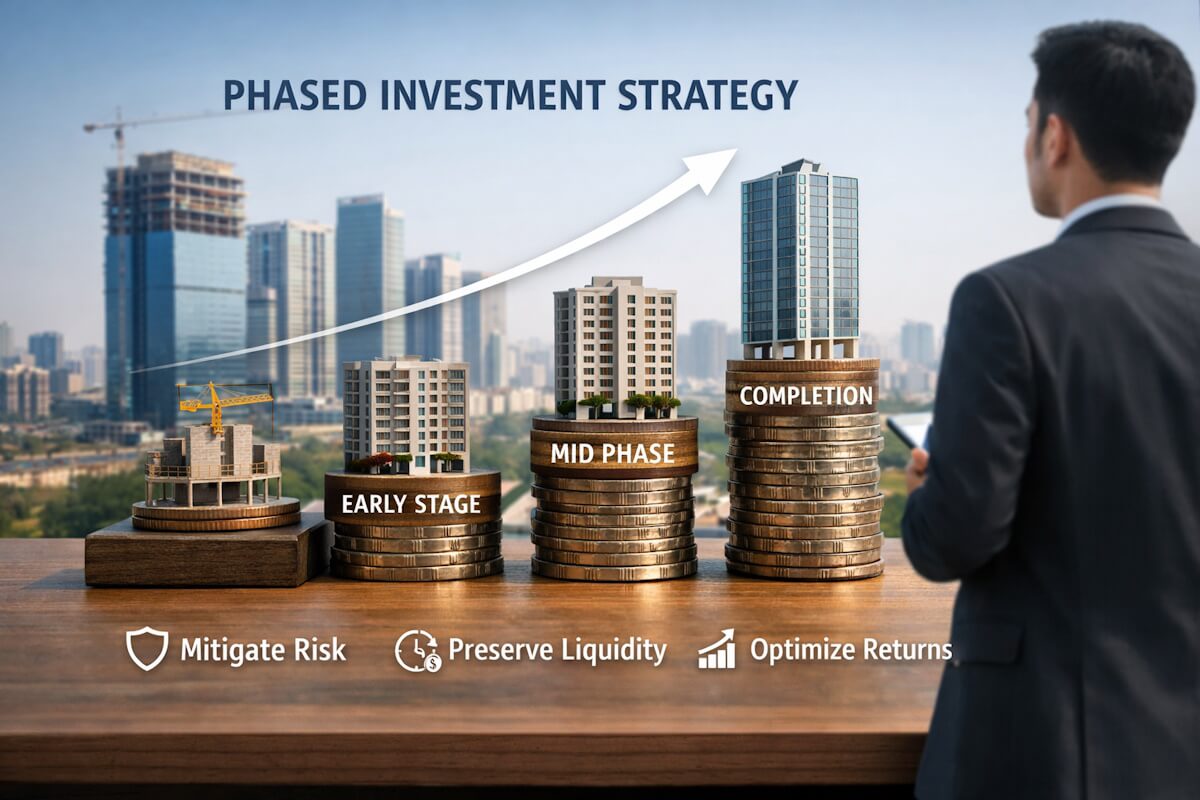
The Strategic Case for Staggered Investment Real Estate in GIFT City
For high-net-worth investors, founders, and institutional buyers, entering a rapidly developing market like GIFT City requires more than just capital; it demands precise timing and structured risk mitigation. While the long-term growth trajectory driven by the IFSC framework is undeniable, deploying capital as a single lump sum exposes an investor to unnecessary market timing risks, particularly in early-stage, high-growth ecosystems.
The concept of staggered investment real estate moves beyond mere payment schedules; it is a sophisticated capital allocation strategy designed to maximize exposure to different growth phases of GIFT City while simultaneously reducing vulnerability to short-term cyclical shifts or construction delays. This approach is paramount for ensuring sustainable returns and achieving genuine risk reduction real estate India investments require, especially when betting on regulatory and infrastructural timelines.
The Imperative for Phased Investment GIFT City Strategies
Why should a sophisticated buyer avoid the temptation of deploying all available capital upfront? The unique regulatory environment and development pace of India’s first operational Smart City introduce specific complexities that reward patience and strategic phasing.
Market Timing Risk and Opportunity Cost
Lump-sum investment assumes the current moment is the optimal entry point. In a market where regulatory approvals (IFSC licenses) and infrastructure activation happen sequentially, this assumption is inherently risky. A well-designed staggered investment real estate plan allows you to commit capital only when predefined market milestones are achieved, validating the initial investment thesis before the next tranche is deployed. This strategy inherently manages opportunity costs by keeping dry powder ready for unexpected superior opportunities that may emerge in subsequent phases.
Capital Preservation and Liquidity Management
Large capital commitments tie up funds that could be earning returns elsewhere or serving as a buffer against market downturns. By employing a phased investment GIFT City approach, investors maintain superior liquidity. This is particularly relevant given the extended gestation period required for deep infrastructure projects to mature and fully stabilize rental yields. Prudent investors use this phasing to align their real estate capital commitments with their broader portfolio liquidity needs.
Regulatory Phasing and IFSC Tenant Adoption
GIFT City’s success hinges on the adoption rate of the International Financial Services Centre (IFSC). Early-stage investment relies heavily on projected growth; later tranches can capitalize on proven growth, confirmed tenant commitments, and established rental yields. Using phasing allows investors to shift from speculative bets on potential demand to calculated bets based on demonstrated tenancy and license approvals, significantly bolstering risk reduction real estate India demands.
If you are currently evaluating the initial capital commitment versus the projected timeline for IFSC maturity, it is critical to consult experienced advisors. For a deeper breakdown of current and projected IFSC tenant density and how it impacts commercial property valuation, request our exclusive investor guide today.
How Country of Residence Influences a Staggered Investment Strategy in GIFT City
A staggered investment real estate strategy in GIFT City does not exist in isolation. Your country of residence materially affects how and why phasing makes sense for you.
NRIs and global investors often assume that staggered investing is only about construction timelines. In practice, it is just as much about currency exposure, tax timing, regulatory comfort, and how capital is already allocated outside India.
Certain countries consistently produce investors who prefer phased entry into GIFT City rather than lump-sum deployment.
Investor Behaviour Patterns by Country
Australia and New Zealand
Investors from these markets typically prioritize capital protection and income visibility. A staggered approach allows them to test commercial leasing strength first, then add residential exposure once workforce migration becomes visible. Currency averaging is often an unspoken benefit.
Canada, United Kingdom, and United States
These investors are accustomed to disciplined capital deployment across asset cycles. They tend to favor milestone-based tranches tied to IFSC license growth and rental absorption, rather than calendar-based payments. Staggering helps them manage India exposure alongside equities, REITs, and private credit back home.
Singapore and Malaysia
Buyers from these regions are usually comfortable with structured real estate markets but cautious about early-stage execution risk. Phasing capital across commercial, then residential or serviced apartments, aligns with how they typically invest across Southeast Asia.
United Arab Emirates
UAE-based NRIs frequently balance liquidity across multiple geographies. A staggered investment GIFT City strategy allows them to avoid locking large capital upfront while maintaining flexibility against opportunities in Dubai or Abu Dhabi. Many intentionally delay later tranches until rental income visibility improves.
Germany, France, and Spain
European investors often adopt a conservative, data-driven approach. They prefer smaller initial exposure, followed by larger tranches once regulatory clarity and tenant stability are demonstrated. Phasing suits their preference for validation over speculation.
South Africa and Fiji
Investors from these markets often use GIFT City as a long-term capital preservation and currency hedge. Staggering entry helps manage currency volatility and reduces the impact of committing at a single exchange-rate peak.
Thailand
Thai investors typically compare GIFT City with other Asian growth hubs. They often phase investments across asset types, entering early with commercial exposure and adding mixed-use or residential assets once occupancy patterns are established.
Why Phasing Matters More for International Investors
For overseas buyers, staggered investment real estate strategies serve four practical purposes:
- Reducing exposure to a single currency conversion point
- Allowing tax planning to align with home-country reporting cycles
- Creating exit optionality before full capital deployment
- Testing regulatory and developer execution before scaling exposure
This is why many global investors deliberately treat GIFT City as a multi-stage commitment rather than a one-time allocation.
GIFT City as a Controlled Entry, Not a Leap of Faith
For investors based outside India, staggered investing turns GIFT City from a high-conviction bet into a measured, controllable exposure.
The market rewards patience. Regulatory milestones, tenant onboarding, and infrastructure activation all happen in phases. Matching your capital deployment to that reality is often the difference between disciplined growth and avoidable stress.
If you are investing from overseas, the right question is not how much to invest in GIFT City. It is how much to commit now, and what conditions must be met before committing more.
Designing Your Staggered Investment Real Estate Roadmap
A true staggered strategy involves more than splitting payments; it involves deploying capital across different *points in time* and potentially different *asset classes* within the GIFT City jurisdiction.
Defining Tranches: Milestone-Based Capital Deployment
The most effective strategy ties capital deployment not to arbitrary dates, but to verifiable project or city-wide milestones. This links investment directly to performance indicators.
Tranche 1: Early-Stage Commercial Pre-Lease (Validation Phase)
This initial allocation should target high-potential commercial assets, often where developers have already secured strong anchor tenants or pre-leases. This tranche carries the highest initial risk but offers the maximum early appreciation potential due to favorable early-bird pricing. Success here validates the core demand premise for the location.
- Evaluation Focus: Developer track record, anchor tenant quality, regulatory compliance status.
Tranche 2: Mid-Cycle Residential/Service Apartments (Proof of Concept)
Once Phase 1 validates commercial demand and the workforce begins migrating to the city, the residential demand thesis becomes stronger. Tranche 2 should target residential properties or high-yield service apartments. At this stage, the market has established basic utility, moving beyond pure infrastructure speculation.
This intermediate phase is crucial for executing effective phased investment GIFT City strategies, as it allows capital to be directed towards sectors proving their viability based on early commercial absorption rates. Investors focused on long-term appreciation often find this tranche highly appealing.
Tranche 3: Near-Completion and Stabilized Yield Focus (Risk Aversion)
The final tranche targets properties nearing completion or already yielding rental income. The goal here shifts from capital appreciation to stable cash flow. While the entry cost will be higher, the execution risk is minimal. This tranche helps balance the portfolio, providing immediate income streams.
- Investment Goal: Immediate rental yield and capital stability.
Asset Class Diversification within a Staggered Plan
A sophisticated staggered investment real estate strategy doesn’t necessarily commit all tranches to the same type of property. Instead, you might invest in commercial space in Tranche 1, residential in Tranche 2, and then specialized assets (like a data center space or a logistics hub property if applicable) in Tranche 3.
This internal diversification within GIFT City insulates the overall portfolio against single-sector headwinds. For example, if commercial leasing temporarily slows, the stabilized residential rental yields from a later tranche provide essential operational cushion.
Deciding the precise mix requires granular data on projected sector growth within the SEZ/Non-SEZ areas. Schedule an investment consultation with Gift City Realty advisors to map out a precise deployment strategy that aligns with your capital availability and long-term ROI goals.
Practical Risk Reduction Real Estate India through Phasing
The core benefit of phasing is active risk management. By deploying capital incrementally, the investor gains continuous data points to adjust the subsequent investment thesis, a methodology often overlooked by those treating real estate like a simple commodity purchase.
Averaging Entry Costs and Managing Volatility
Just as dollar-cost averaging works in equities, phasing deployment helps average the entry cost across market cycles. If the market experiences rapid appreciation after Tranche 1, subsequent tranches will buy at higher prices, but the initial exposure is still locked in at a low rate. Conversely, if prices temporarily dip, later tranches benefit from the lower acquisition cost. This systematic approach inherently optimizes the overall portfolio valuation, delivering superior long-term results compared to a single large entry point.
Stress Testing Market Assumptions
Every investment plan is built on assumptions about future demand, regulatory stability, and infrastructure delivery. A phased investment GIFT City approach builds in mandatory checkpoints. Before executing Tranche 2, investors must ask: Did the assumptions made for Tranche 1 materialize? Did the developer hit their milestones? Has the IFSC delivered the promised regulatory environment? This mandatory re-evaluation is the most powerful tool for risk reduction real estate India strategies can offer.
Optimizing Tax and Compliance Timeline
In GIFT City, tax benefits and compliance obligations (especially for NRIs and foreign entities operating within the IFSC/SEZ) can be complex. The timing of property possession, rental income generation, and capital gains realization directly impacts the applicable tax year benefits. Phasing allows investors to strategically time these events, optimizing the utilization of tax holidays, depreciation benefits, and compliance filing deadlines.
Understanding these time-sensitive regulatory impacts is essential for maintaining superior ROI. When considering properties, always request a projection showing the regulatory and tax implications tied to the expected completion date and phased investment schedule. This information is available through a detailed review of our exclusive investor guide.
Key Evaluation Metrics for Sustained Phased Investment
Successful phasing requires ongoing monitoring. The investor must move from general market sentiment to quantifiable metrics that justify the next capital deployment.
Monitoring IFSC License Growth and Sectoral Shifts
The foundational driver of GIFT City real estate value is the growth of the IFSC ecosystem. Before committing the next tranche of a staggered investment real estate plan, investors should evaluate the pace and quality of new IFSC entity licenses issued. Specifically, monitor the sectoral mix: growth in banking (driving commercial demand) versus growth in fintech or services (driving specialized office/residential demand).
Evaluating Rental Absorption Rates and Yield Stabilization
For Tranche 2 and 3 deployment, the primary metric shifts to proven performance. What are the current rental absorption rates in comparable buildings? Are developers offering realistic yield projections or aggressive estimates? A high absorption rate combined with stable or increasing lease rates confirms that the projected demand has materialized, justifying further commitment under the phased investment GIFT City strategy.
Developer Performance and Milestone Adherence
In a long-term development strategy, the financial health and execution capability of the developer are non-negotiable. Before releasing the next tranche, verify that the developer has met previous construction, regulatory, and financial milestones. Consistent adherence provides confidence; significant delays or structural changes necessitate a fundamental re-evaluation of the entire strategy and potentially, the deployment location.
Protecting your capital through diligent risk assessment is our priority. If you are struggling to quantify developer risk or need third-party verification of project timelines, speak with a GIFT City Expert today to ensure your next investment phase is secure.
FAQ: Staggered Investment Strategies in GIFT City
What is the difference between a staggered investment and simple installment payments?
A staggered investment strategy is a dynamic capital allocation plan where subsequent payments (installments) are strategically tied to market performance, regulatory milestones, or diversification goals, not merely a fixed schedule. It is about strategic timing for risk reduction real estate India opportunities.
How does a phased investment GIFT City plan manage market volatility?
By averaging the entry cost over time and allowing the investor to pause or adjust the investment thesis based on real-time market data, phasing protects the total committed capital from significant swings or unexpected downturns that occur early in the development cycle.
Should I use a staggered approach for both commercial and residential property?
Yes. The strategy is highly effective for both asset classes, but the milestones differ. For commercial, focus on IFSC license growth and anchor tenants; for residential, focus on workforce migration and the opening of social infrastructure.
What is the biggest risk of a poorly executed staggered investment real estate strategy?
The biggest risk is indecision. If an investor delays tranches despite positive market validation, they risk missing crucial appreciation periods, resulting in higher entry costs later, defeating the purpose of the initial lower-risk entry.
How can Gift City Realty help me structure my phased investment?
We provide proprietary market intelligence, developer risk assessments, and structured planning that links your capital tranches directly to verifiable market and regulatory milestones, ensuring your staggered investment real estate strategy is optimized for ROI and compliance.