
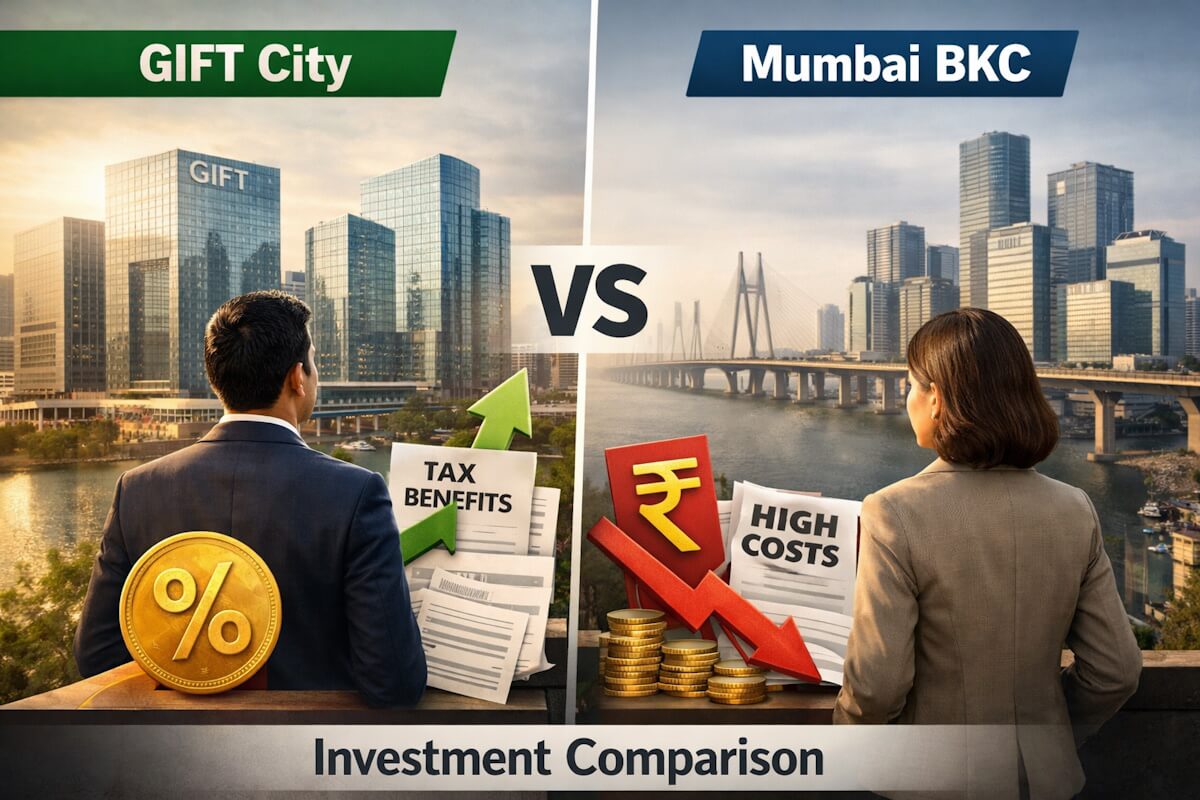
The Definitive Investment Guide: GIFT City vs BKC
For decades, Bandra Kurla Complex (BKC) in Mumbai has stood as the undisputed heavyweight champion of commercial real estate in India. It represented legacy, liquidity, and proximity to India’s established financial infrastructure. However, the emergence of Gujarat International Finance Tec-City (GIFT City), purpose-built as an International Financial Services Centre (IFSC), introduces a formidable and fundamentally different competitor to this dominance.
Serious investors, ranging from NRIs and HNIs to institutional funds, are no longer asking if GIFT City is viable; they are asking: GIFT City vs BKC, which offers a superior risk-adjusted return profile over the next decade? The answer hinges not merely on square footage rates but on regulatory arbitrage, tax efficiency, and government commitment. This guide provides the high-level financial and strategic comparison necessary to inform your next major real estate decision in India.
The Core Investment Thesis: Legacy vs. Regulatory Arbitrage
The decision between investing in Mumbai BKC and GIFT City is a choice between a mature, domestic-focused market and an emerging, internationally-aligned regulatory hub. Both offer premium commercial spaces, but the demand drivers and resultant capital appreciation factors are distinct.
Defining the Markets: Maturity vs. Genesis
BKC is a proven asset class. Its maturity means investment risk is largely stabilized, offering predictable if often constrained rental yields. The market is driven by domestic demand, proximity to ultra-high-net-worth residential areas, and historical business inertia. It has absorbed years of capital inflow, leading to high capital values and a low entry barrier for established companies seeking prestige addresses.
GIFT City, conversely, is in the genesis phase. Its commercial viability is primarily driven by the migration of international and offshore financial services attracted by the IFSC framework. Investing here is buying into the rapid regulatory scaling and subsequent job creation. The inherent risk is higher, but the scalability and potential for exponential appreciation far exceed that of a saturated financial district.
The Regulatory Edge: IFSC and Tax Structure
This is the central pillar of the GIFT City vs BKC investment analysis. BKC operates under standard Indian corporate and property tax regimes. GIFT City, specifically the SEZ area, offers profound, legally backed tax advantages that fundamentally alter the net return calculation for both developers and tenants.
- Tenant Incentives: IFSC entities operating within GIFT City benefit from significant tax holidays (up to 100% tax exemption for 10 years). This regulatory saving translates directly into a higher capacity for tenants to pay premium rents, bolstering long-term rental yield stability for investors.
- Investor Incentives: Specific tax exemptions on capital gains and stamp duty, depending on the investor type (especially NRIs), can dramatically improve the effective ROI compared to a traditional Mumbai BKC office investment.
- Operational Ease: The single-window clearance system within the SEZ reduces regulatory friction, ensuring faster operational readiness for tenants, which in turn reduces vacancy risk for property owners.
If you are prioritizing tax-efficient returns and seeking exposure to India’s international financial services growth story, the regulatory framework of GIFT City provides a structural, non-replicable advantage. Get expert insights on GIFT City real estate tailored to your specific tax situation before committing capital in either location.
Investor Action Point: Comparing Net Returns
When comparing a property in GIFT City and BKC, look beyond the gross capital price. Calculate the post-tax, post-compliance net rental yield. In many scenarios involving IFSC tenants, the effective net yield in GIFT City properties surpasses the achievable yield in BKC due to regulatory savings passed through to property valuations.
Analyzing Financial Metrics and ROI Drivers
Understanding the immediate financial comparison—capital costs, rental projections, and appreciation potential—is crucial for this financial district comparison India.
Capital Values and Barrier to Entry
The upfront capital requirement is perhaps the most obvious difference. Due to decades of demand and limited supply expansion, capital values per square foot in BKC are exponentially higher than those currently observed in GIFT City. An investor buying 10,000 sq. ft. of Grade A commercial space in BKC will likely spend several times more than for an equivalent Grade A space in GIFT City’s IFSC zone.
- BKC: High barrier to entry; established asset class suitable for stabilizing large portfolios.
- GIFT City: Relatively lower initial capital outlay, offering greater opportunity for diversification and scalability within a portfolio dedicated to high-growth emerging assets.
The lower barrier to entry in GIFT City allows HNIs and family offices to secure larger assets or a diversified portfolio of smaller units, maximizing exposure to the early growth phase without the massive capital locking required in prime Mumbai assets.
Rental Yield Dynamics: Stability vs. Growth Potential
Rental yields in BKC are characterized by stability. While the absolute rent per square foot is high, the yield percentage relative to the capital value is often compressed, typically falling into the 5-6.5% range for premium commercial properties, fluctuating based on the specific micro-market and economic cycle. This is the inherent challenge of Mumbai BKC office investment—high capital cost depressing yield percentages.
GIFT City rental yields, while currently competitive with BKC in percentage terms, possess explosive growth potential. As the occupancy rates in the IFSC zone climb, rental rates are expected to appreciate sharply due to:
- Fixed supply constraint within the SEZ/IFSC area.
- Increasing demand fueled by government mandates and regulatory scaling.
- The high-value nature of financial tenants (banks, hedge funds, insurers) who prioritize compliance and location over cost sensitivity.
This anticipated rental appreciation drives much of the long-term investment justification for GIFT City vs BKC.
Appreciation Trajectory and Long-Term Value
Appreciation in BKC is cyclical and incremental. While assets maintain value, double-digit annual appreciation is rare and highly dependent on national economic booms. The market is mature, meaning most of the low-hanging appreciation fruit has been harvested.
GIFT City, being a planned city driven by geopolitical and regulatory forces, offers structural appreciation. The value of commercial real estate here is tied directly to the success of the IFSC project. As more global banks, fintech companies, and aircraft lessors establish offices (a mandatory requirement for availing IFSC benefits), the scarcity value of the real estate increases rapidly. Investors are essentially betting on the sustained political will to make GIFT City India’s primary global financial hub. This makes the property acquisition highly leveraged to policy success.
Analyzing Tenant Profile Risk
In BKC, tenant risk is diversified across corporate headquarters, legal firms, and consultancies. In GIFT City, the tenant profile is concentrated among high-grade IFSC entities, often global financial institutions. While concentration brings higher potential yield, it also requires specialized knowledge of the IFSC ecosystem. Get expert insights on GIFT City real estate regarding tenancy agreements and IFSC compliance to properly vet opportunities.
Operational Ecosystem: Infrastructure, Talent, and Compliance
Real estate value in major financial districts is intrinsically linked to the operational efficiency they provide to tenants. While both GIFT City and BKC offer premium infrastructure, the underlying planning and future scalability differ significantly, impacting long-term investment confidence.
Infrastructure Density and Scalability
BKC’s infrastructure is retrofit into an existing, bustling metropolitan area, leading to inherent challenges regarding congestion, traffic flow, and utility management during peak hours. Scalability for new, large-scale developments is limited and comes at a tremendous cost.
GIFT City was engineered from the ground up as a smart city. It boasts a district cooling system, automated waste management, and highly redundant power infrastructure designed specifically for high-frequency financial operations. This specialized infrastructure reduces operating costs for tenants and assures investors that the real estate is future-proofed against common urban sprawl issues. The density is managed, ensuring a superior working environment that enhances tenant retention.
Talent Pool Access and Lifestyle Factors
Mumbai BKC’s primary advantage is its access to Mumbai’s vast and established talent pool and the mature lifestyle ecosystem (housing, entertainment) that supports it. Financial professionals are already embedded here.
GIFT City is rapidly developing its ecosystem. While connectivity to Ahmedabad and Gandhinagar provides a strong regional talent base, the city is aggressively developing integrated residential zones (like the highly-sought-after residential offerings near the commercial tower areas) to minimize commute times for CXOs and specialized staff. This integrated approach, which is unique in any financial district comparison India, enhances the city’s appeal to global talent seeking a better work-life balance than the typical metropolitan sprawl.
The residential component is critical for investors. Successful commercial real estate depends on people being willing to work there. GIFT City’s focus on walk-to-work culture, supported by premium housing, directly influences the long-term occupancy rate and rental health of the commercial properties.
Investment Due Diligence: Developer Track Record
Given the complexity and scale of development in both markets, especially in an emerging hub like GIFT City, robust due diligence on the developer’s financial stability, timely delivery, and compliance record is paramount. At Gift City Realty, we focus on vetted projects with institutional-grade developers who understand the specific requirements of IFSC tenants. Get expert insights on GIFT City real estate on developer vetting.
Risk Mitigation and Investment Horizon
All investments carry risk. The nature of risk in an established market like BKC differs fundamentally from that in a policy-driven market like GIFT City. A senior investor needs to weigh these profiles carefully.
Market Saturation and Liquidity Risks
In Mumbai BKC, the primary risk is market saturation and overpricing. While the property is highly liquid—meaning it is easy to sell—the capital appreciation may be muted due to the maturity of the pricing cycle. Investors may face the challenge of finding substantial capital growth opportunities without taking excessive leverage.
In the GIFT City vs BKC analysis, GIFT City’s risk profile includes regulatory dependence. The value is tied to the continued success and support of the IFSC framework. However, this risk is mitigated by the Indian government’s substantial political and financial capital already invested in the project. Liquidity is currently lower than BKC simply because the market is younger, but as institutional players and REITs enter the ecosystem, liquidity is projected to climb rapidly.
Mitigating Political and Policy Risk
For an investor evaluating a long-term commercial commitment, the assurance of government continuity is key. BKC’s operational value is organic; GIFT City’s is policy-engineered. The clear commitment by the Indian government to make GIFT City the sole jurisdiction for international financial services means regulatory changes are likely to favor, rather than hinder, its growth. This regulatory protection acts as an anti-cyclical shield for real estate value within the SEZ/IFSC area.
The strategic intent behind GIFT City—to repatriate offshore financial activity—provides a highly stable, long-term demand driver that is impervious to typical domestic real estate fluctuations. This foundational demand is a crucial factor when justifying a Mumbai BKC office investment vs. a regulatory-advantaged GIFT City asset.
Framing the Final Investment Decision
The decision between GIFT City vs BKC hinges on your investment objective. If your goal is capital preservation in a stable, highly liquid, but expensive market with moderate, consistent returns, BKC remains a viable choice.
However, if your objective is high-growth, high-leverage exposure to India’s international financial future, coupled with significant tax arbitrage opportunities (especially critical for NRIs), GIFT City presents an asymmetrical opportunity. It offers the chance to acquire premium Grade A office space at capital values significantly lower than comparable Mumbai assets, benefiting from structural rental appreciation driven by regulatory scarcity and rapid tenant absorption.
This is not merely a choice between two cities; it is a choice between two investment methodologies: one based on legacy asset class, and one based on regulatory advantage and future potential. Our senior advisors at Gift City Realty specialize in translating the complex regulatory benefits of the IFSC into clear, measurable real estate investment strategies.
Frequently Asked Questions (FAQs)
What are the key tax benefits for NRIs investing in GIFT City commercial property compared to Mumbai BKC?
The primary benefit is related to the IFSC framework. NRIs may avail specific exemptions on capital gains, and properties leased to IFSC entities benefit from the 10-year corporate tax holiday, which stabilizes high rental payments and increases the effective net yield, a benefit unavailable for typical Mumbai BKC office investment.
Is commercial space in GIFT City only suitable for financial companies?
While the IFSC SEZ area is restricted primarily to financial services and ancillary support (Fintech, Insurance, Banking, Captive units), the non-SEZ area (Domestic Tariff Area or DTA) is open to general IT, back-office, and service industries, offering diversified investment opportunities adjacent to the main financial hub.
How does liquidity compare between GIFT City and BKC properties?
BKC is a mature market with high intrinsic liquidity. GIFT City is emerging, and while current liquidity is lower, it is rapidly increasing as institutional funds and REITs allocate capital here. The high-grade nature of the tenants and clear title structure make GIFT City properties increasingly attractive to high-net-worth buyers and long-term investors.
What is the typical investment horizon recommended for GIFT City assets?
Given the asset class is leveraged to the long-term success of the IFSC project, a horizon of 7 to 10 years is generally recommended to maximize benefits from capital appreciation driven by policy maturation and full tenant absorption. This ensures optimal realization of the structural growth that differentiates the GIFT City vs BKC investment profile.