
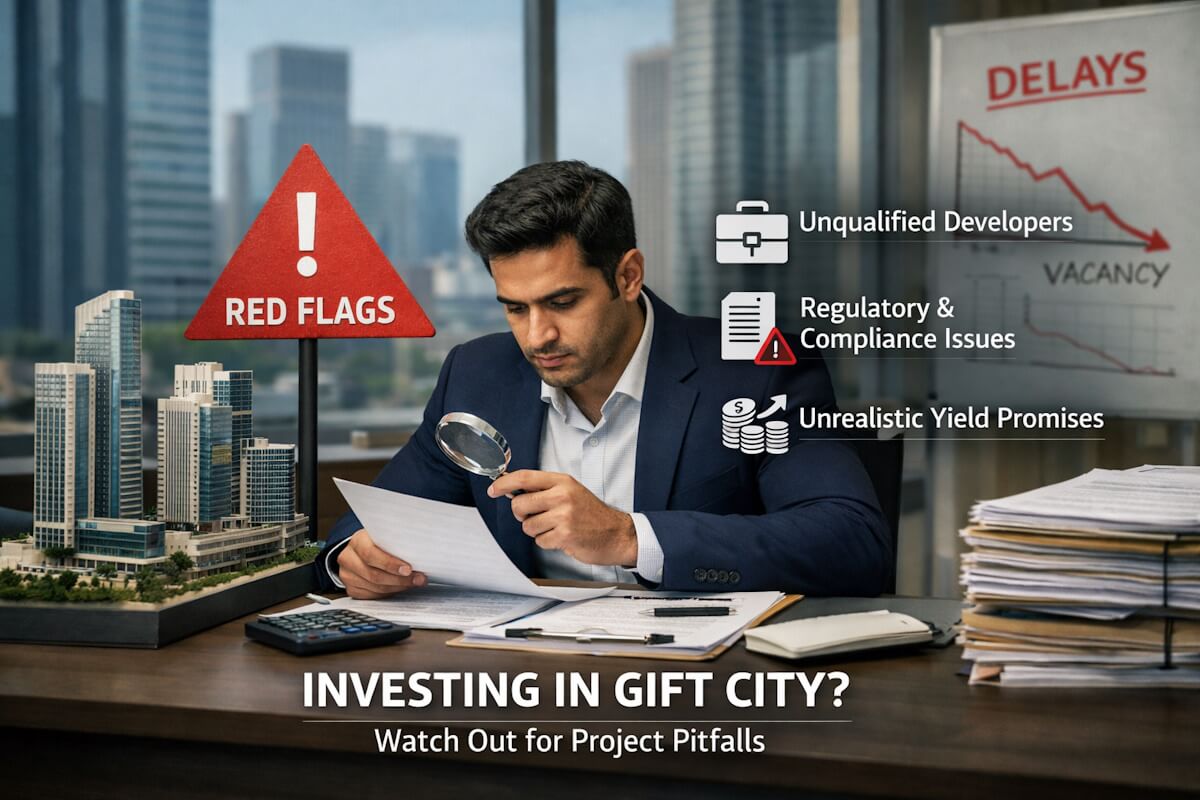
Navigating the Critical Investment Filters: Identifying GIFT City Project Red Flags
Investing in GIFT City is fundamentally different from purchasing standard real estate elsewhere in Gujarat or India. It is a highly specialized financial and technology ecosystem governed by IFSC (International Financial Services Centre) and SEZ (Special Economic Zone) regulations. This regulatory complexity, combined with the promise of unprecedented long-term growth, attracts high-value capital but also creates unique blind spots for inexperienced investors.
For serious investors—NRIs, HNIs, founders, and institutional funds—the primary objective isn’t just securing a property; it’s mitigating risk to ensure superior ROI and regulatory compliance. Identifying GIFT City project red flags early in the due diligence process is the firewall against costly property buying mistakes GIFT City. We look beyond glossy brochures to evaluate the factors that truly drive investment success and spot the warning signs that separate robust opportunities from exclusive investor guide high-risk speculation.
Evaluating Developer Credibility and Specialized Experience
The single biggest factor dictating project success in a high-stakes environment like GIFT City is the developer’s capacity and commitment. Developers entering the zone require more than just capital; they need deep understanding of SEZ documentation, operational requirements, and the specific needs of IFSC tenants (banks, insurers, fintech firms).
Lack of IFSC/SEZ Specific Experience
A significant red flag is a developer whose portfolio primarily consists of generic residential or retail projects outside of regulated zones. GIFT City is not a typical urban center; it operates under specific governmental and financial mandates. If a developer lacks experience navigating SEZ compliance, acquiring specialized licenses, or delivering “plug-and-play” ready infrastructure demanded by IFSC institutions, timelines and project viability become instantly questionable.
What to Evaluate: Investors must scrutinize the developer’s past projects within regulated economic zones, or at least highly complex commercial environments. Ask for a list of existing institutional tenants they have attracted in previous commercial ventures. A lack of specific regulatory execution history is one of the clearest GIFT City project red flags.
Financial Instability and Delivery Delay Track Record
Delays in a standard residential project are frustrating; delays in a specialized SEZ project are financially devastating. The holding cost of capital within a structured investment vehicle can quickly erode projected returns if the asset is not operational on schedule. Reviewing a developer’s delivery history, especially their debt-to-equity ratio and how they handled previous market pressures, is non-negotiable.
Investment Impact: Delivery delays push back the rental commencement date, directly impacting the anticipated rental yield calculation. Furthermore, institutional tenants require absolute certainty; repeated delays can scare off premium IFSC occupants, forcing the developer to lease to lower-tier clients, diminishing long-term appreciation.
We provide comprehensive developer risk assessments derived from years of analyzing GIFT City’s internal supply chain and execution metrics. If you’re questioning the viability of a specific project, it’s time to schedule an investment consultation.
Schedule an Investment Consultation
Regulatory and Compliance Gaps: Identifying Risky Real Estate Projects GIFT City
The core value proposition of GIFT City real estate stems from its regulatory environment—the tax incentives, repatriation ease, and specialized operational benefits of the IFSC. When promises regarding these benefits are vague, contradictory, or overly simplistic, it signals potential risky real estate projects GIFT City.
Missing or Ambiguous Regulatory Approvals
Every phase of a GIFT City project requires layered approvals from the SEZ Authority, IFSC Authority, and standard state authorities. A major red flag is the project being marketed before securing crucial environmental clearances, land use conversion (especially within the SEZ boundary), or the formal letter of allotment for the built-up area.
Investor Due Diligence: Demand verifiable documentation proving the developer has acquired all necessary SEZ and town planning approvals. Be cautious if the developer provides only generic state-level approvals without specific mention of IFSC/SEZ compliance. These missing pieces are common property buying mistakes GIFT City investors overlook. We offer an exclusive investor guide detailing all mandatory compliance documents you must inspect before signing any commitment.
Misinterpretation or Exaggeration of Tax Benefits
The tax landscape for investments in GIFT City is highly specific to the investor type (NRI, Indian resident) and the property use (commercial vs. residential, IFSC vs. non-IFSC). Red flags appear when developers make sweeping, generalized claims about guaranteed tax exemptions without detailing the specific compliance requirements and tax residency status needed to avail them.
Financial Warning Sign: If a developer promises a complete tax holiday on rental income or capital gains without asking specific questions about your financial structure or residency, they are potentially overpromising. This can lead to unexpected tax liabilities down the line, drastically reducing the effective ROI and characterizing the deal as one of the risky real estate projects GIFT City is known to harbour.
Analyzing Demand Drivers and Market Oversupply Signals
GIFT City’s property market is driven purely by corporate demand for office space and employee demand for residential facilities close to work. If a project fails to align with this institutional demand, it becomes a speculative, high-risk endeavor.
Skewed Demand Projections: Commercial vs. Residential Density
The primary engine of GIFT City is the commercial tower ecosystem. Residential demand is secondary and dependent on the influx of high-salaried professionals working in the IFSC. A red flag arises if a developer focuses heavily on high-density residential launches significantly ahead of confirmed corporate occupancy in the commercial blocks.
The Demand Equation: High residential inventory without corresponding commercial occupancy means delayed rental traction. Investors must verify the current commercial vacancy rates across the SEZ and the pipeline of confirmed corporate leases before committing to residential units. Residential rental yield stability is intrinsically tied to the velocity of commercial uptake.
Low Lease Commitments in Commercial Towers
For commercial investments, the quality and quantity of pre-leased space or signed Letters of Intent (LOIs) are non-negotiable metrics. A project that relies solely on future hopes rather than committed anchor tenants poses a major risk. Anchor tenants validate the project’s quality and market fit, attracting secondary and tertiary tenants, thereby ensuring rental stability.
Mitigation Strategy: Demand verifiable proof of lease agreements, including the tenure and rent structure of confirmed tenants. If the tower is heavily marketed but has low pre-commitments, it’s a critical one of the GIFT City project red flags. High vacancy risk turns an investment into a liability quickly.
Understanding which developers have secured major institutional leases is vital for ROI stability. Request property details for projects with confirmed anchor tenants.
Financial Structures and Hidden Costs: Avoiding ROI Erosion
Sophisticated investors focus heavily on the net operating income (NOI), not just gross rental yield. Projects that obscure operational costs or promise unsustainable returns are often masking significant future expenditure or underlying vacancies.
Unrealistic Rental Yield Guarantees
Any project promising guaranteed rental returns that significantly exceed the prevailing market rate (typically 6–8% for premium commercial in similar regulated zones) should be approached with extreme caution. Often, these guarantees are funded through investor capital itself, leading to a temporary yield bubble that bursts once the guarantee period expires.
Questioning the Model: Ask: How is this guarantee funded? What happens after the guarantee period ends? Is the guaranteed rate significantly higher than the expected market lease rate? If the numbers don’t align with sustainable market economics, you are looking at one of the prime GIFT City project red flags.
Non-Transparent Maintenance and Operating Agreements
SEZ facilities, especially commercial and mixed-use towers, involve specialized security, regulatory compliance, and high-tech maintenance. The associated costs are often higher than in conventional buildings. A red flag is raised when the developer provides vague or low maintenance cost estimates, especially those that do not account for the regulatory overhead of operating within an SEZ.
The Investor Cost Trap: Underestimating maintenance costs dramatically reduces the final NOI. Demand a detailed breakdown of CAM (Common Area Maintenance) charges, insurance liabilities, and projected utility costs related to specialized infrastructure before making a commitment. Avoiding these hidden operational costs is key to mitigating property buying mistakes GIFT City investors often face.
Subtle Red Flags in Project Documentation and Investor Relations
Due diligence involves more than just checking regulatory papers; it requires evaluating the communication style and contractual fairness. Subtle communication issues can signal poor execution standards.
Unilateral Contract Terms Favoring the Developer
A contract heavily skewed in favor of the developer, particularly concerning penalty clauses for delays, termination rights, or transfer restrictions, should raise suspicion. While developers must protect their interests, grossly unfair clauses regarding force majeure or unreasonable demands for investor capital infusions are major indicators of a risky real estate projects GIFT City investment.
Actionable Step: Always have specialized legal counsel review the sale agreement, especially focusing on clauses related to project delivery timelines and developer recourse in case of unexpected delays or regulatory changes within the SEZ.
Lack of Access to Specialized Expertise
If the project sales team cannot articulate the nuances of IFSC investment, SEZ tax implications for NRIs, or the specific regulatory environment, they are unqualified to guide your investment. Reliance on generic sales talk rather than tailored, financial advice is a critical red flag.
Our Approach: Investment in GIFT City requires advisory support that understands both the real estate market and the financial regulations. At Gift City Realty, our focus is on ensuring compliance and optimized returns, providing advisory support that anticipates and mitigates these exclusive investor guide project-level risks. We help investors confidently navigate these complexities.
Don’t commit capital based on partial information. Explore pre-vetted GIFT City projects with transparent compliance records and confirmed tenant profiles.
From Evaluation to Informed Investment: Securing Your Position
The opportunities in GIFT City are compelling, but they demand a rigorous, highly disciplined evaluation process focused on risk mitigation. The most critical aspect of identifying GIFT City project red flags is moving beyond surface-level aesthetics and drilling down into the financial, regulatory, and developer delivery capacity. The key distinction between a successful investment and a capital hazard lies in the quality of due diligence.
As senior advisors, our role is to filter out the noise and present investment-grade assets that satisfy stringent criteria for compliance, projected ROI stability, and long-term appreciation potential within the IFSC ecosystem. Investing confidently here means investing with validated information.
Frequently Asked Questions (FAQs)
What is the biggest regulatory red flag unique to GIFT City?
The biggest regulatory red flag is the project being marketed without clear, separate approvals for SEZ land use conversion or if the developer confuses IFSC occupancy requirements with standard commercial licensing. Verify the project’s status within the SEZ boundary and its permission to host IFSC entities.
How can I verify the developer’s financial stability?
Look for their track record of timely debt servicing, delivery history, and recent RERA compliance reports. If they are publicly listed, scrutinize their financial filings (debt-to-equity ratio). Private developers should provide access to specific project financing details or escrow arrangements.
Are high rental yield guarantees always a red flag?
Yes, if they significantly exceed the sustainable market yield for comparable Grade-A commercial space in the region (typically 6–8% net). They often signal a short-term financial mechanism, not long-term rental stability, leading to significant depreciation risk after the guarantee period ends.
What are common property buying mistakes GIFT City investors make regarding tenancy?
A common mistake is investing in commercial units without confirming the developer’s capacity to attract and manage high-quality institutional tenants (IFSC firms). Investors must confirm that the developer has a dedicated commercial leasing team with expertise specific to the financial sector, not just generic real estate sales.
Should I prefer projects located in the SEZ or the Non-SEZ area of GIFT City?
For investment purposes focused on IFSC-driven returns and maximal tax benefits, SEZ projects are generally preferred. However, ensure the project itself is approved for IFSC unit occupancy. Non-SEZ projects may offer broader usage flexibility but lack the critical IFSC regulatory advantages.