Investing in India’s first operational Smart City and International Financial Services Centre (IFSC) has transitioned from a speculative bet to a core institutional requirement for diversified portfolios. As we navigate 2026, the maturity of the ecosystem in GIFT City, Gujarat, offers a unique blend of tax efficiency, world class infrastructure, and a rapidly growing talent pool. For the sophisticated investor, the decision to buy property in GIFT City is no longer just about owning real estate, it is about securing a stake in a global financial gateway that operates under a distinct regulatory framework compared to the rest of India.
The landscape of GIFT City has evolved significantly, with residential zones now keeping pace with the massive commercial absorption seen over the last decade. Whether you are an HNI seeking a high yield commercial asset or an NRI looking for a primary residence in a regulated environment, the acquisition process involves specific legal and financial steps that differ from standard Indian real estate transactions. Understanding these nuances is critical to mitigating risk and ensuring that your investment aligns with the long term growth trajectory of Gujarat’s most ambitious urban project.
The Strategic Investment Landscape of GIFT City in 2026
The year 2026 marks a pivotal point for GIFT City as the second phase of development reaches full capacity. The strategic shift from a pure commercial hub to a holistic live-work-play environment has fundamentally changed how investors evaluate property. When you choose to buy property in GIFT City, you are entering a market driven by the demands of global banks, IT giants, and fintech innovators who require high quality office spaces and premium housing for their leadership teams.
The Maturation of the IFSC Ecosystem
The International Financial Services Centre (IFSC) authority has streamlined regulations to make it easier for foreign capital to flow into the local real estate market. This regulatory stability has attracted institutional investors who view GIFT City as a safe haven with predictable legal outcomes. For the individual investor, this means that property values are supported by a strong foundation of high value economic activity rather than retail speculation.
Infrastructure as a Value Multiplier
GIFT City is not just a collection of buildings, it is an integrated utility platform. The District Cooling System, Automated Waste Collection, and the dedicated utility tunnel ensure that operational costs for commercial properties remain lower than in traditional Indian metros like Mumbai or Bangalore. This infrastructure efficiency directly impacts the net operating income for commercial landlords and enhances the quality of life for residential owners, making the decision to buy property in GIFT City a play on urban efficiency.
Determining Eligibility: Who Can Buy Property in GIFT City?
One of the first hurdles investors face is understanding the eligibility criteria, which vary depending on your residency status and the specific zone within GIFT City. The city is divided into the SEZ (Special Economic Zone) area, which includes the IFSC, and the Domestic Tariff Area (DTA). The rules governing how you buy property in GIFT City depend heavily on which side of this line your chosen asset sits.
Resident Indian Investors
For resident Indians, buying property in the Domestic Tariff Area is straightforward and follows the standard RERA guidelines of Gujarat. However, investing in the IFSC zone may require adherence to specific FEMA regulations if the transaction involves foreign currency or if the property is intended for business use by a registered IFSC unit. It is vital to consult with a specialist at Gift City Realty to ensure that your source of funds and the asset type are compliant with the latest 2026 circulars.
NRI and Foreign Institutional Buyers
Non Resident Indians (NRIs) and Overseas Citizens of India (OCIs) have found GIFT City to be one of the most frictionless places to invest in India. In 2026, the process for NRIs to buy property in GIFT City has been further simplified with digital KYC and remote registration capabilities. Foreign institutions can also participate in the commercial market, provided they comply with the guidelines set forth by the IFSCA and the Reserve Bank of India. The ability to repatriate funds and the clarity on tax treaties make this a preferred destination for global capital.
FEMA and PMLA Compliance
Compliance with the Foreign Exchange Management Act (FEMA) is non negotiable for cross border transactions. Every investor must ensure that the banking channels used for the purchase are recognized and that the Prevention of Money Laundering Act (PMLA) disclosures are accurately filed during the registration process. This transparency is what maintains the integrity of the GIFT City real estate market.
The Step-by-Step Acquisition Process
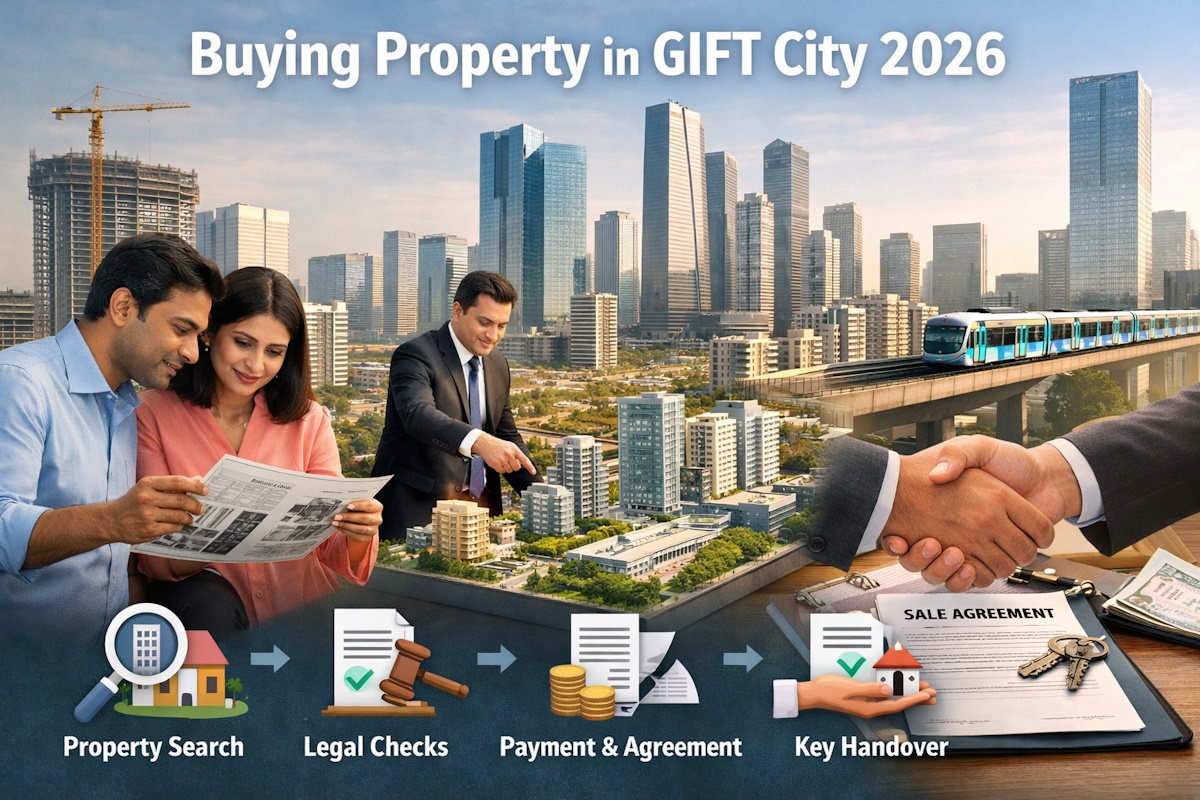
Buying property here is a structured journey that requires attention to detail at every stage. Unlike traditional markets where informal agreements are common, the GIFT City process is highly formalized to protect investor interests and maintain the city’s global standing.
Step 1: Identifying Asset Class and Zone
Before you commit, you must decide between a commercial asset in the IFSC for potential dollar denominated returns or a residential asset in the DTA for long term capital appreciation. The demand for “Walk to Work” housing has spiked in 2026, making luxury residential units near the commercial spine highly coveted. Analyzing the supply pipeline is essential to avoid overbuilt segments.
Step 2: Due Diligence and RERA Verification
While GIFT City developers are generally vetted, independent due diligence is a prerequisite. You must verify the project’s RERA registration number on the Gujarat RERA portal and check the land allotment letters from the GIFT City Company Limited (GIFTCL). Since land in GIFT City is typically provided on a long term leasehold basis, understanding the lease terms and the renewal clauses is a critical part of the process when you buy property in GIFT City.
Step 3: Execution of Allotment and Sale Agreement
Once the initial booking amount is paid, the developer issues an allotment letter. This is followed by the Agreement for Sale. In 2026, most top tier developers have moved to digital contract management, allowing investors to review and sign documents from anywhere in the world. Ensure that the payment plan is linked to construction milestones to protect your capital from project delays.
Financial Nuances: Taxes, Levies, and Funding
The financial structure of a GIFT City investment is where the real value often lies. The tax advantages offered by the central and state governments can significantly enhance your effective ROI, but only if the transaction is structured correctly from the outset.
Stamp Duty and Registration Charges
In Gujarat, stamp duty and registration charges are applicable as per state laws. However, certain exemptions or rebates may apply for specific types of commercial entities or units within the IFSC. It is important to factor in these costs, which typically range between 5 percent and 7 percent of the transaction value, into your total investment budget. Many investors overlooking these “closing costs” find their initial yield projections slightly skewed.
GST Implications for 2026
Goods and Services Tax (GST) is applicable on under construction properties. For residential units, the GST rate is generally lower for affordable segments and higher for luxury segments. Commercial properties attract a standard GST rate, which can often be claimed as an Input Tax Credit (ITC) if the property is being used for business purposes or leased out to registered entities. Understanding the ITC flow is a sophisticated way to optimize the cost to buy property in GIFT City.
Financing and Mortgages
Leading Indian banks and international branches within the IFSC offer specialized mortgage products for GIFT City properties. For NRIs, the interest rates are often competitive with global benchmarks, and the loan to value (LTV) ratios are attractive. Securing a pre-approval from a bank that understands the GIFT City leasehold structure can accelerate your purchase process significantly.
Evaluating ROI: Rental Yields vs Capital Gains
Investors buy property in GIFT City with two main objectives: consistent rental income and long term capital appreciation. By 2026, the rental market has matured, with a steady influx of professionals from the banking, insurance, and technology sectors creating a robust demand for high quality housing.
Commercial Rental Yields
Grade A office spaces in GIFT City have historically delivered rental yields that outperform traditional residential investments. With the presence of the NSE-IX and various international bourses, the demand for office space is driven by high margin businesses. These tenants typically sign long term leases with annual escalations, providing a predictable and inflation indexed income stream for landlords.
Residential Appreciation Factors
Residential prices in GIFT City have seen a steady upward trend as the social infrastructure, including the GIFT International School and various hospitals, has become fully operational. The limited availability of residential land within the city limits ensures a supply-demand imbalance that favors early investors. As the city moves toward its goal of housing over 500,000 residents, the secondary market for premium apartments is expected to become highly liquid.
Risk Mitigation: Avoiding Common Investment Pitfalls
Even in a regulated environment like GIFT City, real estate investment is not without risks. A smart investor looks beyond the marketing brochures to identify potential points of failure. The most successful investors in 2026 are those who prioritize developer credibility and project location within the city over the lowest price per square foot.
Developer Track Record and Execution
Not all developers in GIFT City are equal. Some have a history of institutional delivery, while others are newer entrants to the Gujarat market. Investigating the developer’s past performance in terms of construction quality and adherence to timelines is the most effective way to protect your investment. Gift City Realty recommends focusing on developers who have already successfully delivered and managed at least one commercial or residential tower within the precinct.
Leasehold Tenure and Renewal Risks
Because the land in GIFT City is owned by the GIFTCL and leased to developers, the residual lease period is a factor that many retail investors ignore. When you buy property in GIFT City, you must ensure that the master lease is for a sufficiently long period, typically 99 years, and that the sub lease rights are clearly defined. This ensures that the property remains a bankable asset for future buyers when you decide to exit.
The 2026 Exit Strategy: Liquidity and Resale
A sound investment plan must include an exit strategy. The resale market in GIFT City is becoming increasingly active as more units reach completion. To ensure maximum liquidity, investors should focus on properties with high “rentability,” as these are the easiest to sell to other investors looking for immediate yields. The process of transferring a property in GIFT City involves obtaining a No Objection Certificate (NOC) from the GIFT City Company and ensuring all utility dues are cleared. This regulated exit process prevents the “black money” issues often found in other parts of the country, making the resale market transparent and professional.
FAQs
1. Can an NRI buy property in GIFT City without a local bank account?
While the initial booking can sometimes be initiated from NRE or NRO accounts, it is highly recommended to have a local bank account or an account within an IFSC banking unit to facilitate seamless future payments, tax deductions, and rental receipts. Compliance with FEMA regulations is mandatory for all NRI transactions.
2. Is the land in GIFT City freehold or leasehold?
Most land in GIFT City is allotted on a 99 year leasehold basis by the GIFT City Company Limited. This is a common structure for planned institutional cities and does not typically affect the ability to get a mortgage or resell the property, provided the lease terms are standard and the developer is in good standing.
3. What is the difference between buying in the SEZ and DTA zones?
The SEZ/IFSC zone is primarily for businesses engaged in international finance and services, offering various tax holidays. The Domestic Tariff Area (DTA) is for businesses and residents serving the Indian market. Buying in the DTA is generally simpler for residential investors, while the SEZ is geared toward commercial investors targeting multinational tenants.
4. What are the maintenance costs like in a smart city environment?
Maintenance in GIFT City is managed by the city’s central command center. While the costs might be slightly higher than in unorganized developments due to the high tech infrastructure, they are more predictable and provide higher value in terms of waste management, water security, and cooling efficiency, which preserves the building’s long term value.