
For the modern Chief Financial Officer, the decision to expand into a new territory is rarely about the physical square footage alone. It is a complex exercise in capital allocation, risk mitigation, and long-term tax optimization. As India positions itself as a global financial hub, GIFT City in Gujarat has emerged as the primary destination for firms looking to bridge the gap between domestic operations and international markets. The transition from traditional business districts in Mumbai or Bengaluru to a specialized economic zone requires a deep understanding of how a GIFT City Office Space functions as a financial instrument rather than just a corporate address.
This guide approaches the GIFT City ecosystem through the lens of institutional investment and operational efficiency. We evaluate the structural advantages of the International Financial Services Centre (IFSC), the tangible impact of Special Economic Zone (SEZ) status on the bottom line, and the specific metrics that should drive your commercial real estate acquisition strategy. By the end of this analysis, you will have the framework necessary to justify a relocation or expansion to your board, backed by data on ROI, tax incentives, and the unique regulatory environment of Gujarat, India.
The Strategic Rationale for GIFT City Office Space
The primary driver for institutional interest in GIFT City is the convergence of a world-class regulatory framework with significant cost arbitrage. Unlike other Indian business hubs, GIFT City is designed to compete with Singapore, Dubai, and Hong Kong. For a CFO, this means operating in a dollarized economy within India, allowing for seamless international transactions without the friction of traditional foreign exchange hurdles. The commercial real estate GIFT City offers is not merely a place to house staff, it is a gateway to a simplified capital structure.
Regulatory Arbitrage and the IFSCA
The Unified Regulator, the International Financial Services Centre Authority (IFSCA), provides a single-window clearance system that drastically reduces the time to market. From an investment perspective, this reduces the “hidden cost” of bureaucracy that often plagues Indian real estate ventures. The ability to operate under a consolidated set of regulations for banking, insurance, and capital markets makes the GIFT City Office Space a highly liquid asset for global firms.
Tax Neutrality and Incentives
One of the most compelling reasons to invest in commercial real estate GIFT City is the ten-year tax holiday. Under Section 80LA of the Income Tax Act, units in the IFSC can avail of a 100 percent tax exemption for any ten consecutive years out of fifteen. When calculating the internal rate of return (IRR) for a project, this tax-free window significantly enhances the net present value of the investment compared to any other domestic location.
Minimum Alternate Tax (MAT) and Dividend Distribution
For companies operating within the IFSC, MAT is applicable at a reduced rate of 9 percent on book profits, compared to the standard 15 percent. Furthermore, there is an exemption from Dividend Distribution Tax (DDT) for companies distributing profits out of their IFSC units. These nuances are critical for CFOs looking to optimize the repatriation of profits to global headquarters.
Evaluating SEZ Office Benefits and Operational Expenditure
Operating within a Special Economic Zone (SEZ) brings a suite of benefits that directly impact the operational expenditure (OpEx) of a firm. While the initial capital expenditure (CapEx) for a GIFT City Office Space may be comparable to Grade-A properties in other metros, the long-term savings on utility costs, procurement, and statutory compliance are substantial. CFOs must distinguish between the Domestic Tariff Area (DTA) and the SEZ/IFSC zones to ensure they are maximizing their incentives.
GST Exemptions on Services and Procurement
The SEZ office benefits include a complete exemption from Goods and Services Tax (GST) on services received by a unit in the SEZ or IFSC. This applies to everything from professional consultancy fees to the procurement of capital goods required for the office fit-out. For a large-scale global office, these 18 percent savings on procurement can represent millions of dollars in saved upfront costs.
State-Level Incentives in Gujarat
Beyond the federal benefits, the Gujarat government provides specific incentives for units in GIFT City. These include exemptions from stamp duty and registration fees on the lease or purchase of a GIFT City Office Space. Additionally, there are subsidies on electricity duty, which, when compounded over a decade, significantly lower the operational cost per square foot compared to the high-cost power in Mumbai or Delhi.
Market Dynamics: Commercial Real Estate GIFT City Trends
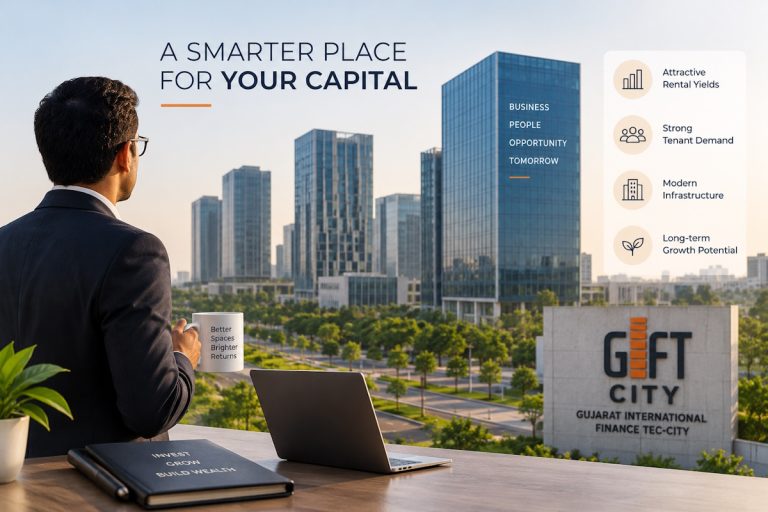
From an investment standpoint, the supply-demand imbalance in GIFT City is creating a favorable environment for early entrants. As more global banks, law firms, and fintech companies establish their presence, the demand for Grade-A GIFT City Office Space is outstripping supply. This leads to strong capital appreciation and healthy rental yields for those who choose to own their assets rather than lease.
Rental Yields and Appreciation Potential
Currently, rental yields for commercial real estate GIFT City are hovering in the range of 7 percent to 9 percent, which is higher than the national average for commercial hubs. As the residential ecosystem matures, the workforce will move closer to the office towers, further stabilizing the commercial value. For institutional investors, this represents a dual-play: immediate operational savings and long-term asset appreciation.
The Shift Toward Ownership
Many CFOs are now evaluating a “buy vs. lease” strategy for their GIFT City Office Space. Given the low interest rates for IFSC-based lending and the potential for capital gains in a rapidly developing hub, ownership allows a firm to hedge against future rent escalations. Furthermore, owning the asset provides the company with more control over the environmental, social, and governance (ESG) standards of their workspace, a key metric for global institutional buyers.
Infrastructure and De-risking the Investment
Risk mitigation is at the core of any CFO’s responsibility. GIFT City addresses the common infrastructure risks found in emerging markets through its “Plug and Play” model. The city features a district cooling system, automated waste collection, and a utility tunnel that ensures maintenance can occur without disrupting office operations. This reduces the risk of operational downtime, which is a critical factor for financial services and technology firms.
Power and Connectivity Resilience
GIFT City boasts a dual-power supply from different grids, ensuring 99.99 percent uptime. For firms reliant on high-frequency trading or global data processing, this level of infrastructure redundancy is essential. Investing in a GIFT City Office Space eliminates the need for expensive backup power systems and the associated fuel costs, further leaning out the OpEx profile.
Environmental and Sustainable Building Standards
The office towers in GIFT City are built to LEED Gold or Platinum standards. As global reporting requirements for carbon footprints become more stringent, having an office in a green-certified city helps CFOs meet their sustainability targets. This alignment with global ESG trends makes the commercial real estate GIFT City offers more attractive to international stakeholders and investors.
Talent Acquisition and the Residential Synergy
A major concern for any CFO scaling a business is the ability to attract and retain high-quality talent. The success of a GIFT City Office Space is inextricably linked to the quality of life for the employees. The recent liberalization of residential rules in GIFT City has made it possible for professionals to live, work, and play within the same ecosystem. This reduces commute times and increases employee productivity, which directly influences the company’s bottom line.
The “Walk to Work” Concept
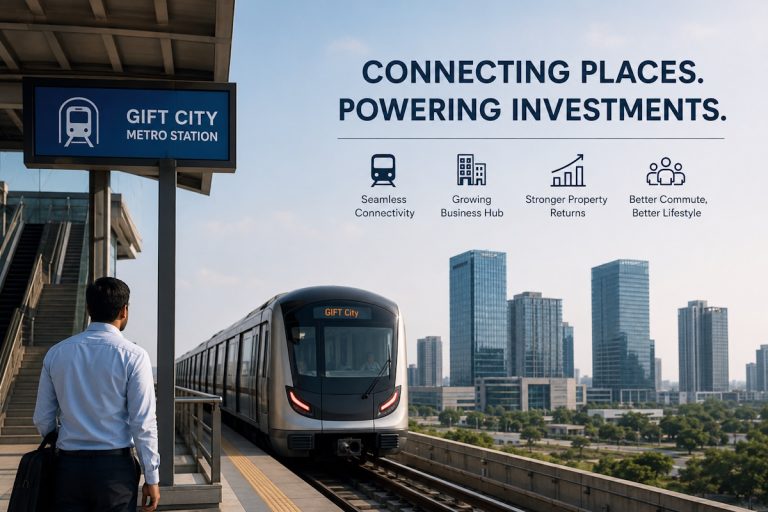
With high-end residential projects now integrated into the GIFT City master plan, firms can offer employees a lifestyle that rivals international financial centers. This synergy between commercial and residential real estate ensures that the city remains vibrant outside of office hours, making it easier to recruit talent from major Indian metros and the NRI community.
Social Infrastructure Development
The inclusion of international schools, hospitals, and social clubs within the GIFT City perimeter is a strategic move to de-risk the talent equation. For a CFO, this means lower turnover rates and reduced recruitment costs. When evaluating a GIFT City Office Space, it is vital to look at the proximity to these social amenities as they are key drivers of long-term workforce stability.
Common Pitfalls and Investment Justification
While the benefits are clear, investing in GIFT City requires a nuanced approach. One common mistake is failing to align the corporate structure with the specific requirements of the IFSC. CFOs must ensure that their business model fits within the permitted activities of the SEZ or IFSC to fully realize the tax benefits. Another oversight is ignoring the “sunset clauses” associated with certain incentives, which can impact the long-term financial modeling of the investment.
Due Diligence and Developer Reputation
Not all commercial real estate GIFT City projects are created equal. It is essential to partner with developers who have a proven track record of delivering institutional-grade assets. At Gift City Realty, we focus on vetting projects for their legal compliance, structural integrity, and future-readiness. This level of due diligence is what transforms a simple real estate purchase into a strategic corporate asset.
The Cost of Inaction
As the first-mover advantage begins to narrow, the cost of entry into GIFT City is rising. For global firms, the risk of not being in GIFT City may soon outweigh the risk of the investment itself. With the rapid migration of banking and fintech sectors, being outside the hub could mean missing out on a concentrated network of partners, clients, and regulators.
Finalizing the CFO’s GIFT City Strategy
The transition to a GIFT City Office Space is a move toward institutional maturity. By leveraging the SEZ office benefits and the IFSC’s regulatory framework, a CFO can significantly reduce the firm’s tax burden while enhancing operational resilience. The decision to invest in commercial real estate GIFT City should be viewed through the lens of a 10-to-15-year horizon, where the combination of tax savings, rental yields, and capital appreciation creates a compounding effect on corporate wealth.
As you move toward a board-level decision, focus on the quantifiable data. The arbitrage is real, the infrastructure is world-class, and the regulatory environment is designed for global success. Gift City Realty stands ready to provide the specialized advisory needed to navigate this complex but rewarding market.
Frequently Asked Questions
1. What is the minimum investment for a GIFT City Office Space?
Investment levels vary significantly depending on whether you are looking for a small boutique office or a whole floor in a Grade-A tower. Generally, entry-level commercial units start at a competitive price point relative to Mumbai, but institutional buyers typically look at larger allocations to maximize the SEZ office benefits and tax incentives.
2. Can a company operate in both the DTA and the IFSC?
Yes, a company can have a presence in both the Domestic Tariff Area (DTA) and the IFSC. However, the operations must be legally and financially segregated. The GIFT City Office Space in the IFSC must be dedicated to global services to qualify for the specific tax holidays and currency advantages provided by the regulator.
3. How does the tax holiday work for commercial property owners?
The tax holiday primarily applies to the income generated from the business unit within the IFSC. However, for those who own commercial real estate GIFT City as an investment, the tax benefits on rental income and capital gains are governed by the specific tax treaties and Indian income tax laws applicable to SEZ developers and units. It is advisable to consult a tax expert to model specific scenarios.
4. What happens if the SEZ regulations change in the future?
GIFT City is a project of national importance for India and is backed by a robust legal framework (the IFSCA Act). While regulations can evolve, the trend has been toward greater liberalization and ease of doing business. The long-term nature of the tax commitments provided under Section 80LA offers a level of statutory certainty that is rare in other jurisdictions.
5. Is there sufficient residential support for my employees in GIFT City?
Yes, the residential sector in GIFT City is expanding rapidly. With the introduction of new housing policies, there are now numerous residential projects within the city that cater to different income levels, ensuring that your workforce can live in close proximity to their GIFT City Office Space, thus enhancing productivity and retention.