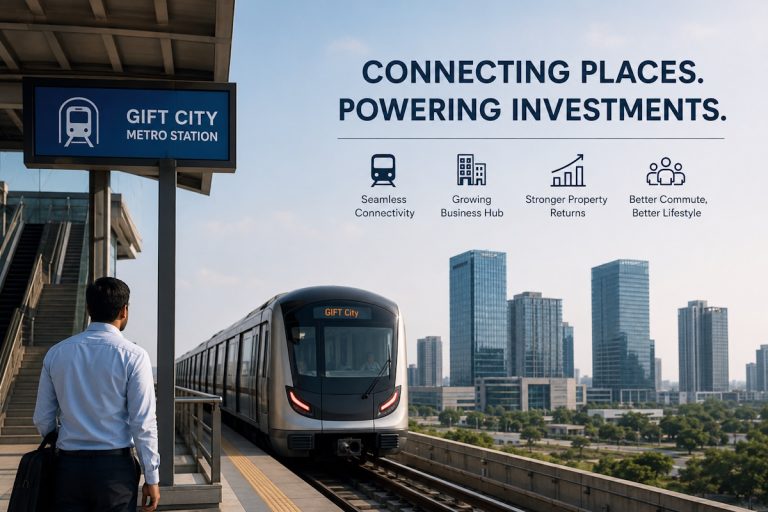

Institutional capital, family offices, and individual high-net-worth investors are paying close attention to commercial properties in GIFT City. As India’s maiden operational International Financial Services Centre (IFSC) located in Gujarat, GIFT City offers a unique dual-regulatory ecosystem comprising both a Special Economic Zone (SEZ) and a Domestic Tariff Area (DTA). For real estate allocators, evaluating this market requires looking beyond typical commercial real estate metrics like headline cap rates. It demands a clear understanding of regulatory arbitrage, structural tenant demand, and strategic asset positioning.
The transition of global banks, asset managers, fintech firms, and IT conglomerates into this corridor has shifted the market from speculative development into an institutional-grade asset class. Deciding where to invest across commercial developments requires an objective framework. You must evaluate corporate absorption rates, lease covenant quality, floor plate efficiency, and the long-term yields supported by cross-border business activities. Selecting the right GIFT City commercial property is fundamentally a study in matching property configurations with institutional tenant profiles.
The Macro Drivers Behind GIFT City Commercial Real Estate Demand
Commercial real estate performance is fundamentally an outcome of enterprise demand. In GIFT City, this demand is underpinned by statutory incentives that cannot be replicated elsewhere in India. Understanding these economic tailwinds allows investors to separate systemic growth from standard market cycles when acquiring commercial real estate assets.
Regulatory Arbitrage and IFSC Tax Incentives
The core engine driving enterprise absorption in the IFSC zone is fiscal efficiency. Entities setting up in the GIFT SEZ benefit from a 100 percent tax holiday for ten consecutive years out of a fifteen-year block, alongside competitive minimum alternate tax rates and exemptions on transaction taxes. For global treasury centers, alternative investment funds (AIFs), and international insurers, operating here provides direct access to foreign currency business transactions under a unified regulatory body, the IFSCA.
From an investment standpoint, these statutory benefits create an enduring tenant base with exceptionally high switching costs. Corporate occupiers do not easily vacate spaces when their operational licenses, regulatory approvals, and corporate tax structures are tied directly to an IFSC address. When evaluating a commercial property in GIFT City, investors should view this regulatory framework as a significant moat protecting occupancy levels and mitigating vacancy risk over extended holding periods.
Enterprise Ecosystem and Clustering Effects
Commercial hubs scale when industry clusters achieve critical density. GIFT City is experiencing compounding network effects across three primary verticals: banking, asset management, and technology services. When global custodial banks and domestic banking units establish substantial operations, they naturally draw legal counsel, audit institutions, fund administrators, and specialized consultancies into the same ecosystem.
This ecosystem expansion creates a multi-tiered leasing market. While top-tier multinationals absorb massive multi-floor footprints, supporting service firms require nimble, high-efficiency office spaces. Investors who structure their commercial acquisitions to cater to this diverse corporate hierarchy stand to capture consistent demand across economic cycles.
Commercial Office Space Classifications in GIFT City
Every commercial asset in GIFT City does not serve the same tenant base. The market is structurally divided into clear zones and formats, each presenting distinct risk-return profiles, capital outlay requirements, and leasing liquidity metrics.
SEZ (IFSC) Commercial Assets
Office spaces located within the SEZ boundary are governed by IFSC regulations. These spaces can only be occupied by entities holding valid processing zone permissions and regulatory approvals to conduct offshore or cross-border financial and technology services. Capital allocation into SEZ offices is inherently focused on long-term corporate credit and foreign enterprise tenants.
Investor Implications of SEZ Properties
Investing in SEZ assets mandates strict compliance adherence. Leases must be executed with entities approved by the development commissioner and IFSCA. The primary advantage is tenant creditworthiness; defaults are rare among regulated financial institutions. However, the tenant universe is restricted exclusively to eligible offshore and IFSC entities, making market positioning and asset quality critical for smooth re-leasing cycles.
DTA (Non-SEZ) Commercial Assets
The Domestic Tariff Area accommodates domestic Indian enterprises, tech firms catering to the domestic market, retail businesses, and corporate service headquarters that do not operate under offshore mandates. DTA assets offer broader leasing flexibility because any legally registered Indian corporate entity can occupy the space without specialized IFSC licensing.
Investor Implications of DTA Properties
DTA office space in GIFT City attracts strong absorption from technology providers, consulting practices, logistics coordinators, and regional corporate hubs. The broader pool of prospective tenants reduces prolonged structural vacancy risk. Investors prioritizing steady liquidity and versatile leasing strategies often favor DTA commercial holdings.
Bare-Shell, Warm-Shell, and Fully Furnished Assets
The state of delivery plays a pivotal role in upfront capital requirements and tenant targeting. Institutional tenants frequently prefer bare-shell or warm-shell setups to execute custom corporate branding, whereas mid-sized firms seek fully fitted, turnkey premises to expedite operations.
Strategy Considerations for Fit-Out Delivery
- Bare-Shell Assets: Lower entry price point per square foot, preferred by large institutional occupiers negotiating long leases with dedicated tenant improvement budgets.
- Warm-Shell Assets: Includes essential HVAC, base power, and screeded flooring, lowering tenant onboarding timelines while preserving interior design flexibility.
- Furnished Units: Commands premium gross rental yields per square foot and enables rapid occupancy for boutique hedge funds, family offices, and specialist advisory firms.
Strategic Investment Models: Pre-Leased vs. Open Leasing
When deploying capital into GIFT City office properties, your primary tactical decision revolves around cash flow immediacy versus entry valuations. Selecting between stabilized, income-generating units and open market inventory depends heavily on your risk appetite, debt structure, and holding duration.
Evaluating Pre-Leased Commercial Assets
Acquiring a pre leased office GIFT City asset provides immediate cash flow clarity. In this structure, the investor purchases a property with an active lease agreement, an established corporate tenant, and an ongoing security deposit held in trust. It is the preferred entry route for conservative investors seeking predictable, recurring income streams.
When assessing a pre-leased transaction, intelligent due diligence centers entirely on lease contract mechanics rather than cosmetic appeal. Investors must evaluate the weighted average lease expiry, the credit rating of the occupying entity, structural rent escalation milestones (typically 12 to 15 percent every three years), and the remaining lock-in period. Evaluating pre-leased vs open leasing in GIFT City requires balancing immediate yield stability against the capital appreciation upside that comes from repositioning unleased inventory as market rents climb.
The Open Leasing Investment Approach
Purchasing vacant or under-construction commercial inventory requires investors to take on calculated leasing execution risk in exchange for lower entry pricing per square foot. This approach appeals to high-net-worth individuals and family offices focused on aggressive capital appreciation alongside custom tenant placement.
Managing Fit-Out and Re-Leasing Timelines
Investors opting for open inventory must account for carrying costs during the lease-up phase. Factoring in tenant-sourcing periods, rent-free fit-out holidays (often spanning two to four months for corporate tenants), and property management expenses is essential when underwriting projected initial yields.
Asset Sizing: Full Floors vs. Fractional and Strata Titles
The scale of capital deployment dictates property format selection. Commercial developers in GIFT City offer configurations ranging from micro-strata units to entire institutional floor plates, each appealing to fundamentally distinct tenant profiles.
Full Floor-Plate Institutional Allocations
Acquiring complete floor plates, often ranging from 15,000 to 35,000 square feet, places an investor in the institutional asset class. Large global banks and multinational IT services firms rarely lease small, scattered parcels. They demand continuous, unified operational space to maintain efficiency and security compliance.
Full-floor ownership eliminates multi-tenant management friction, simplifies utility metering, and grants greater leverage when negotiating lease terms with blue-chip enterprises. Serious allocators often review the comprehensive GIFT City office floor investment guide to understand the structural advantages, load ratios, and tenant retention benefits associated with large-format acquisitions.
Strata-Title Commercial Units
Strata-titled offices allow private investors to participate in prime commercial assets with lower absolute capital commitments. These units typically range from 1,000 to 5,000 square feet, offering entry points for investors looking to diversify capital across multiple assets or phases.
Critical Considerations for Strata Investors
Strata assets require careful assessment of building management policies and floor-level co-tenancy. When small spaces share common corridors and infrastructure, building upkeep, lift capacity, and unified maintenance directly influence tenant retention. Partnering with professional asset managers, such as Gift City Realty, helps private investors identify well-governed towers that maintain institutional operational standards across strata-titled developments.
Underwriting Yields, Appreciation, and Risk Mitigation
Underwriting a commercial investment GIFT City asset requires a disciplined quantitative approach. Projecting returns based solely on broad macroeconomic narratives often leads to mispriced risk. Investors must rigorously model baseline yields, net operational income, and potential liquidity bottlenecks.
Rental Yield Benchmarks and Net Operating Income
Gross rental yields in prime commercial developments within GIFT City typically range between 7.5 percent and 9.0 percent for grade-A office spaces. However, the metric that truly dictates long-term portfolio performance is Net Operating Income (NOI). To arrive at NOI, investors must factor in property tax assessments, asset maintenance surcharges, insurance outlays, and asset management expenses.
Commercial lease agreements in GIFT City frequently follow standard corporate triple-net or modified gross structures. In institutional triple-net leases, the corporate tenant covers direct operating costs, maintenance charges, and local property taxes, preserving the investor’s clean rental yield and insulating returns against inflationary operational cost increases.
Key Risks and Strategic Mitigation Steps
Savvy commercial investors systematically identify downside risks before committing capital to long-dated real estate assets. Commercial real estate in emerging financial centers carries specific structural risks that can be actively managed.
Micro-Market Oversupply Cycles
As commercial towers reach completion simultaneously, short-term supply surges can create temporary pressure on rental rates. Mitigate this by investing in developments with superior core infrastructure, higher parking allocations, energy-efficient building certifications, and lower building load factors.
Tenant Concentration and Credit Risk
Relying heavily on early-stage startups or poorly capitalized service entities can expose investors to sudden vacancies. Prioritize creditworthy corporate occupiers, negotiate minimum three-year lock-in clauses, and secure robust security deposits equivalent to six to nine months of gross lease value.
Developer Execution and Maintenance Standards
The long-term value of a commercial tower is heavily tied to ongoing facility operations. Poor lift maintenance, inadequate HVAC systems, or neglected common areas directly degrade asset prestige and cause corporate tenant attrition. Focus acquisitions on projects managed by established facility management firms with verified operating track records.
Strategic Investor Checklist for GIFT City Commercial Assets
Before issuing an expression of interest or committing capital to a commercial asset in this hub, review these essential operational criteria:
- Zone Verification: Confirm whether the asset is physically situated in the SEZ/IFSC processing zone or the DTA zone to match your target tenant strategy.
- Efficiency Ratio: Analyze the development’s usable carpet area relative to the super built-up area. Lower loading percentages directly improve tenant utility and leaseability.
- Infrastructure Integration: Verify automated waste collection, district cooling connections, and utility tunnel connectivity to evaluate operating efficiency.
- Parking Ratios: Institutional tenants demand adequate dedicated parking bays per 1,000 square feet of leased area to accommodate workforce needs.
- Regulatory Compliance: Ensure all title deeds, local development authority clearances, and RERA registrations are fully vetted and verified.
Frequently Asked Questions
1. Can individual retail investors buy commercial office space in GIFT City?
Yes, individual domestic Indian investors, Non-Resident Indians (NRIs), and corporate entities can purchase freehold and long-term leasehold commercial properties across both the SEZ and DTA zones, subject to standard property registration and KYC procedures.
2. What distinguishes SEZ office spaces from DTA commercial properties?
SEZ office spaces require tenants to hold valid IFSC authorization to conduct cross-border or foreign exchange business activities. DTA spaces are open to all registered domestic enterprises and support standard commercial operations without specialized offshore licensing.
3. What are the standard lease lock-in periods for corporate tenants in GIFT City?
Institutional lease agreements in prime commercial towers typically feature three- to five-year initial lock-in clauses within a total lease tenure of nine to fifteen years, accompanied by predetermined rent escalation clauses every three years.
4. How does the District Cooling System impact commercial operating costs?
The centralized District Cooling System eliminates the need for individual building chillers, reducing upfront mechanical installation costs, lowering tenant power bills, and optimizing usable rooftop and floor plate space across commercial assets.