
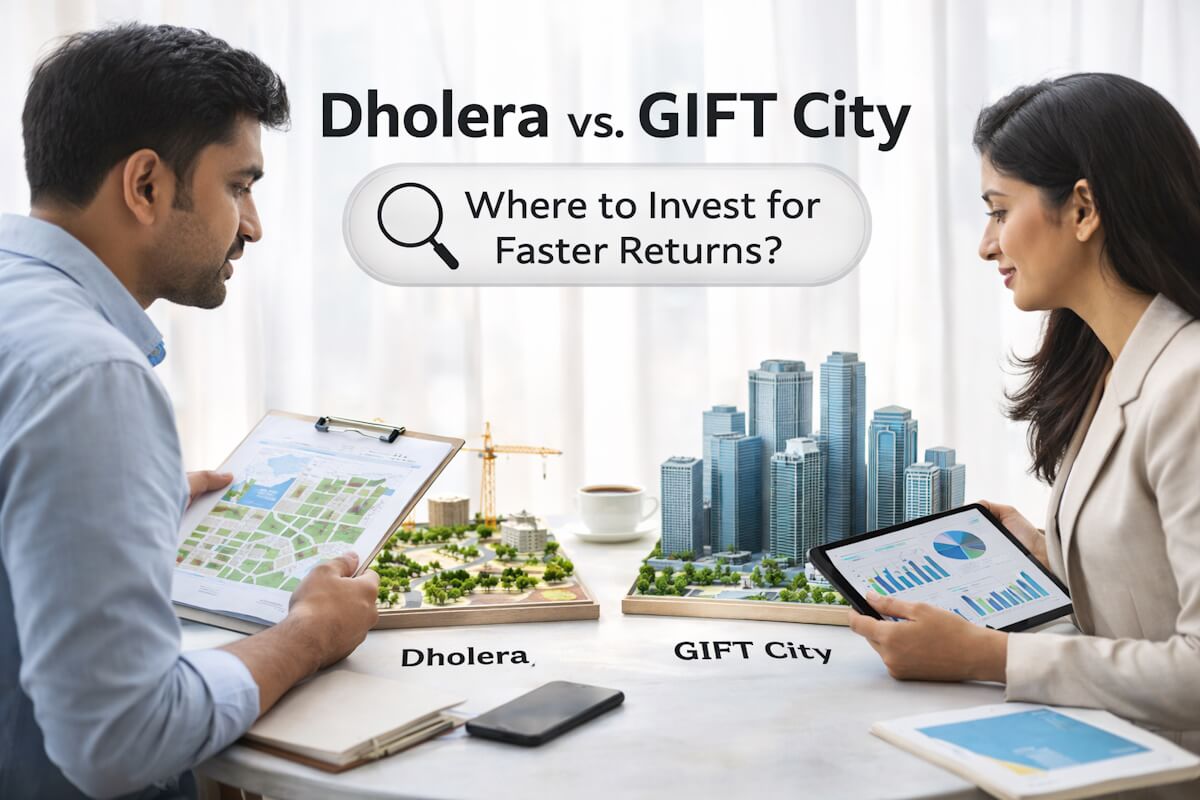
If your focus is simple — where will my money grow faster, Dholera or GIFT City — then you are already thinking like an investor.
Speed of return changes everything. It affects liquidity, stress levels, and future opportunities.
But here’s the reality.
You are not comparing two similar markets.
You are comparing an operational financial district with an early-stage industrial smart city.
That difference alone shapes how returns behave.
Let’s break this down properly, from a buyer’s perspective.
What You’re Actually Investing In
Before discussing speed of returns, you need clarity on what these two locations represent in practical terms.
GIFT City
GIFT City is India’s first operational International Financial Services Centre. It functions under the regulatory framework of the International Financial Services Centres Authority.
This is not a proposal on paper.
Banks, fund managers, fintech firms, insurance players, and global financial service companies are operating from here. Offices are occupied. Residential buildings are gradually filling up. Leasing activity is real.
It is a live ecosystem.
When you invest here, you are entering an already functioning business district that is still expanding.
Dholera
Dholera Special Investment Region is part of the Delhi Mumbai Industrial Corridor initiative. It is being developed as a large-scale industrial and smart city.
Right now, much of it is still under development.
Infrastructure work is progressing in phases. Industrial allocations are happening. Residential ecosystems are limited. Most buyers are investors holding plotted land for long-term appreciation.
So your investment is largely future-driven.
This difference matters more than most investors realize.
What Do You Mean by Faster Returns?
When someone asks which delivers faster returns, they usually mean one of three things:
- Faster capital appreciation
- Faster rental income
- Faster resale liquidity
Each of these behaves differently in Dholera and GIFT City.
Let’s evaluate them one by one.
Capital Appreciation: Which Moves Quicker?
GIFT City Appreciation Pattern
GIFT City prices have already seen early-stage growth. The low entry phase is largely behind us.
Appreciation now tends to be linked to:
- Expansion of IFSC activities
- New global firm registrations
- Increase in office absorption
- Limited residential supply
Growth here is gradual and activity-backed.
You are unlikely to see sudden doubling in two years unless there is a major regulatory shift or global capital surge.
The upside is steadier.
The downside risk is more controlled because economic activity already exists.
This appeals to investors who prefer measured growth over dramatic spikes.
Dholera Appreciation Pattern
Dholera is more announcement-driven.
Land prices tend to move based on:
- Airport construction updates
- Expressway milestones
- Industrial zone allocations
- Government infrastructure pushes
You may see sharp jumps when positive news enters the market.
Then prices can stay flat for long stretches.
It is more cyclical.
On paper, percentage appreciation may look faster during hype cycles. But turning that appreciation into real liquidity depends on finding buyers at the right time.
That timing risk is something many investors underestimate.
Rental Income: This Is Where the Gap Widens
If speed of return includes cash flow, the difference becomes clearer.
Rental in GIFT City
In GIFT City:
- Commercial units are leased to IFSC-approved entities
- Residential units are rented by professionals working in finance and related sectors
- Demand exists because people are actually working there
Rental yields vary depending on entry price and asset type. Early investors have seen strong yields. New buyers may see moderate returns, depending on purchase cost.
Still, rental income starts relatively early once the property is completed and operational.
Cash flow reduces holding pressure.
It also stabilizes your investment psychology.
Rental in Dholera
Dholera today offers limited rental income opportunities.
Plotted land generates no rent.
Industrial leasing demand is still developing.
Residential demand is minimal compared to established cities.
So if your idea of faster return includes monthly income, GIFT City is clearly ahead at this stage.
Dholera is primarily a capital appreciation play.
Liquidity and Exit Timeline
Return speed is meaningless if you cannot exit when needed.
This is where the two markets differ sharply.
Resale in GIFT City
GIFT City has:
- Active end-users
- Working professionals relocating
- Investors seeking yield exposure
- NRIs exploring IFSC-linked real estate
Transactions are happening.
Banks are more comfortable financing completed properties.
There is a secondary market.
It is not as liquid as Mumbai or Ahmedabad prime zones, but resale activity exists.
If you need to exit within 3 to 5 years, probability of resale is stronger here.
Resale in Dholera
In Dholera, most resale buyers are other investors.
End-user demand is still limited.
Your exit depends on:
- Continued infrastructure progress
- Positive sentiment cycles
- Marketing momentum
If the market slows, resale can take time.
If hype is strong, resale may happen faster.
So liquidity here is more sentiment-sensitive.
You must be comfortable with that variability.
Risk Tolerance: Be Honest With Yourself
Different investors handle uncertainty differently.
GIFT City offers:
- Regulatory clarity
- Structured development
- Active economic activity
- Defined SEZ and Non-SEZ zones
Risks still exist. Supply increase. Rental pressure. Policy shifts.
But these risks are measurable.
Dholera involves:
- Long development horizon
- Infrastructure dependency
- Land-based speculation
- Limited current economic base
Returns may be higher long term.
But patience is not optional.
If you cannot hold for 7 to 10 years without income, Dholera may feel heavy on your portfolio.
SEZ vs Non-SEZ in GIFT City
This is important if you are evaluating commercial space.
SEZ commercial units are primarily leased to IFSC-approved financial service entities.
Tax incentives apply to eligible businesses operating within IFSC guidelines.
So your tenant base is narrower but structured.
Non-SEZ properties offer broader flexibility. Residential properties fall into this category.
If your goal is faster rental stabilization, residential or Non-SEZ commercial may lease faster due to wider tenant eligibility.
Understanding this segmentation helps avoid confusion.
Dholera does not currently operate with this kind of functional tenant segmentation for residential investors.
Holding Costs and Financial Structure
Speed of return is also influenced by holding cost.
GIFT City Costs
- Stamp duty as per Gujarat norms
- GST applicable on under-construction units
- Maintenance charges for completed towers
- Property management if rented
You may earn rent, but holding cost is real.
So net yield matters, not just gross yield.
Dholera Costs
- Stamp duty on land purchase
- No GST on resale of land
- Minimal maintenance if vacant
Holding cost is lower.
But again, no rental income to offset that cost.
It becomes a pure waiting game.
Appreciation Expectations: Keep Them Realistic
Some brokers highlight 3x returns in Dholera within five years.
Some compare GIFT City to global financial hubs and imply rapid price escalation.
Pause for a moment.
Rapid appreciation usually comes with:
- Higher volatility
- Thin liquidity
- Timing risk
Steady appreciation usually comes with:
- Rental support
- Broader buyer base
- Lower emotional swings
Which environment suits you?
Are you comfortable tracking infrastructure announcements closely?
Or would you rather monitor leasing trends and occupancy rates?
Your personality matters more than you think.
Who Actually Gets Faster Returns?
Let’s simplify this.
If you want:
Rental income within 1 to 2 years
GIFT City is more likely to deliver.
Speculative percentage spike during development phases
Dholera may show sharper short-term jumps.
Resale flexibility within 3 to 5 years
GIFT City has stronger probability.
Long-term land banking with potential large upside
Dholera fits better.
Notice something.
Faster return does not mean guaranteed return.
And higher percentage growth does not mean easier liquidity.
You must decide what kind of speed you are measuring.
The Psychological Difference
This part rarely gets discussed.
In GIFT City, you see functioning buildings, office lights at night, and professionals commuting daily.
It feels active.
In Dholera, you are investing in a vision that is still taking shape.
Some investors are comfortable backing long-term master plans.
Others prefer visible activity.
Which one gives you peace of mind?
If your capital is surplus and you are patient, Dholera may feel comfortable.
If your capital is limited and you need predictability, GIFT City may feel safer.
So Which Delivers Faster Returns?
In most practical scenarios:
GIFT City delivers faster usable returns because rental income can begin earlier and resale activity is more active.
Dholera can show faster percentage appreciation during infrastructure-driven cycles. But monetizing that appreciation depends heavily on timing and market sentiment.
If speed means money in hand within a few years, GIFT City usually wins.
If speed means speculative upside during development momentum, Dholera may look attractive.
Neither is universally better.
It depends on your timeline, liquidity needs, and tolerance for uncertainty.
Why Overseas Investors Are Watching GIFT City Closely
One interesting trend over the past few years is growing interest from overseas investors evaluating structured exposure to India through GIFT City.
Professionals and NRIs from countries like Australia, Canada, Fiji, France, Germany, Malaysia, New Zealand, Singapore, South Africa, Spain, Thailand, the United Arab Emirates, the United Kingdom, and the United States are increasingly exploring IFSC-linked real estate.
Why?
Because GIFT City operates under a distinct financial regulatory framework that feels more globally aligned compared to traditional Indian real estate markets. For investors familiar with regulated financial hubs abroad, the structure is easier to understand.
For someone based in the United Kingdom or the United States, the idea of investing in a financial district with global banking presence feels more familiar than investing in early-stage land development.
For investors from Singapore or the United Arab Emirates, the financial services angle makes more sense than pure land speculation.
Even NRIs from Australia, Canada, Germany, or France who are not actively involved in Indian real estate often prefer something operational rather than speculative.
On the other hand, Dholera may appeal more to investors who are comfortable with long-term land banking and infrastructure-led appreciation. Some overseas investors from markets like Malaysia, Thailand, South Africa, or Spain who are used to development-cycle investing may find that model familiar.
The key difference is this:
GIFT City tends to attract investors looking for structured exposure, rental possibility, and regulatory clarity.
Dholera tends to attract investors comfortable with patience, long horizons, and infrastructure execution risk.
If you are evaluating from outside India, ask yourself one more question.
Do you want participation in a functioning financial district?
Or are you comfortable holding land while a city takes shape over time?
Your answer will quietly guide your decision.
Ask Yourself These Before Deciding
- Do I need rental income to support this investment?
- Can I hold land without income for many years?
- Am I comfortable with announcement-driven price movements?
- How quickly might I need to exit?
- Is this core capital or surplus capital?
Answer these honestly.
Once you do, the faster-return debate becomes clearer.
Because the real question is not which city grows more quickly.
The real question is which investment structure fits your financial reality and emotional comfort.
That clarity matters more than chasing speed.
FAQs
1. Which location is likely to deliver faster returns?
GIFT City generally delivers faster usable returns because rental income and resale activity already exist. Dholera may see sharper price jumps during infrastructure phases, but liquidity depends on market sentiment.
2. Is rental income realistic in Dholera?
At present, rental demand in Dholera is limited, especially for plotted land. GIFT City offers better rental potential due to active offices and working professionals.
3. Which is better for a 3–5 year investment horizon?
For a shorter horizon like 3–5 years, GIFT City is usually more suitable because it has stronger liquidity and operational demand. Dholera typically requires longer holding patience.
4. Can Dholera offer higher long-term appreciation?
Over a 7–10 year period, Dholera may offer higher percentage upside if infrastructure development progresses steadily. But returns are closely tied to execution timelines.
5. Which investment carries lower risk?
GIFT City carries relatively lower risk due to its operational ecosystem and regulatory clarity. Dholera involves higher uncertainty since it is still developing at scale.