
Why Family Suitability Is the Ultimate Investment Metric in GIFT City
For high-net-worth investors and institutional buyers, evaluating residential property in GIFT City extends far beyond merely checking the square footage or developer brand. The core investment question is not about the building itself, but about the long-term, sustained demand for occupancy. Will the CXOs, founders, and skilled professionals who drive the IFSC economy choose to relocate their families here?
The transition of GIFT City from a nascent commercial district into a fully integrated Smart City hinges entirely on its ability to support comprehensive family living GIFT City requires. If talent relocates only for work, but families remain in major metros like Mumbai or Bengaluru, occupancy rates will stagnate, rental yields will suffer, and the promise of long-term capital appreciation will be diluted. Therefore, assessing the suitability for family living GIFT City offers is a mandatory due diligence step for any serious real estate portfolio manager.
Evaluating Core Demand Drivers: The Residential Lifestyle IFSC
The regulatory and fiscal advantages of the International Financial Services Centre (IFSC) are well-documented, but regulations don’t pay rent; people do. The sustained financial viability of any residential asset here rests on the attractiveness of the overall residential lifestyle IFSC provides, especially when compared to established metro hubs.
The Walk-to-Work Advantage: A Paradigm Shift
One of the most powerful demand drivers for the residential lifestyle IFSC promotes is the ‘Walk-to-Work’ model. This unique urban planning element drastically cuts down on commute times and urban stress, a critical factor for senior management considering relocation. However, for a family to thrive, this convenience must be paired with comprehensive civic infrastructure.
We see a strong initial take-up in rentals driven by single professionals or those with highly mobile lifestyles. The true test of asset stability comes when the second wave of residents arrives: those with school-going children, dependent parents, and expectations of sophisticated social infrastructure.
What Investors Must Evaluate: Look beyond current amenities to approved future plans. Are hospitals, high-end retail, and recreational zones already under construction, or are they merely conceptual drawings? Delayed social infrastructure is the primary drag on sustained rental demand in new cities.
To help you navigate these critical future projections and assess which developers are meeting infrastructure milestones, we strongly advise a structured data review. Download the GIFT City investor guide to get a clearer picture of phase-wise infrastructure rollout.
Security, Planning, and Urban Density
GIFT City is built on a high-security, master-planned grid, which offers a level of urban control and efficiency unmatched in typical Indian metros. For families, this translates into safer common spaces, predictable utilities (like District Cooling Systems, reducing household costs), and superior traffic management.
This organized environment significantly elevates the quality of life, which directly impacts the premium an investor can command on rental properties. Low congestion and high urban efficiency make the idea of family living GIFT City much more appealing to senior talent who value time and reduced stress.
Addressing the Major Objection: Schools Near GIFT City
For any family with children, the availability and quality of education is the single biggest factor determining relocation. The primary objection we often encounter from potential residents is the perceived lack of immediate, high-caliber educational institutions within the city limits. Investors must understand the current educational landscape to accurately predict future occupancy rates.
The Current Education Landscape
While GIFT City is rapidly developing internal schools, the current reality involves leveraging the proximity to Ahmedabad and Gandhinagar. Several top-tier international and national curriculum schools are located within a 15–30 minute drive, making logistics manageable, though not ideal for a truly self-contained experience.
The viability of schools near GIFT City access heavily influences the demographics of renters. Early movers tend to be families with pre-schoolers or those whose children are already in college. The long-term stability of the residential market depends on capturing the middle segment: families with children aged 6 to 16.
Evaluating Future Educational Commitments
Investors must scrutinize developer and government plans for educational facilities *within* the GIFT City boundary. A commitment from a major national or international school chain is a powerful signal that future rental demand will stabilize and grow, supporting the feasibility of family living GIFT City promises.
If you are serious about capitalizing on the sustained rental income derived from stable family occupancy, understanding the pipeline of social infrastructure is paramount. We provide bespoke financial modeling based on these infrastructure timelines. We invite you to explore various GIFT City Projects and request detailed ROI projections tailored to the expected growth of resident facilities.
Comparing Lifestyle: GIFT City vs. Metropolitan Living
The decision to relocate a family to GIFT City is often a trade-off. While metros offer established infrastructure and vast social networks, GIFT City offers unique advantages that appeal to modern professionals, particularly those moving from overseas or other congested urban areas.
Cost of Living and Household Efficiency
While property prices in GIFT City are competitive, the overall cost of running a household can be more efficient. Due to centralized systems like the District Cooling System and streamlined utility management, residents often report lower long-term operational costs compared to poorly planned metro suburbs. This efficiency is an unspoken benefit of the residential lifestyle IFSC offers, making it financially appealing for the professional class.
Furthermore, the IFSC framework offers specific tax advantages for professionals working within the SEZ/IFSC units, enhancing disposable income, which in turn supports the ability of renters to pay premium rates for high-quality residential assets.
Healthcare and Wellness Infrastructure
A thriving ecosystem for family living GIFT City demands excellent healthcare. Similar to the education sector, current residents rely on the advanced multi-specialty hospitals in the neighboring twin cities. However, the presence of planned wellness centers and boutique clinics within the city is quickly growing. Investors should confirm that the nearest residential projects they are considering have direct and easy access routes to emergency services and quality medical facilities.
We specialize in detailed comparisons, providing clients with a balanced view of the trade-offs between a high-growth city like GIFT City and the established stability of metropolitan assets. For a comprehensive analysis of risk-adjusted returns across various segments, Download the GIFT City investor guide.
How Overseas Families Evaluate GIFT City Differently
A large share of family-led demand in GIFT City is not coming from domestic relocations alone. It is coming from professionals and founders returning, partially relocating, or keeping India as a base while maintaining overseas exposure. The way family living GIFT City is evaluated changes sharply depending on where the family is coming from.
Families relocating from the United Arab Emirates, Singapore, or Malaysia tend to place heavy weight on convenience and predictability. Many are used to compact cities, short commutes, managed utilities, and controlled urban environments. For them, GIFT City’s walk-to-work layout, centralized cooling, and regulated zoning feel familiar rather than experimental. The bigger hesitation is not daily life, but schooling continuity and whether the city will feel socially complete within a few years.
Buyers based in the United States, Canada, United Kingdom, Germany, France, or Spain often look at GIFT City through a longer holding lens. These families are more comfortable with phased development as long as the planning is credible. Their questions lean toward residency stability, healthcare access, and whether a move back to India improves overall family time rather than just career economics. For them, family living GIFT City works best when the relocation coincides with middle or senior career stages, not early experimentation.
NRIs from Australia and New Zealand tend to be particularly sensitive to lifestyle trade-offs. Open spaces, traffic discipline, and air quality matter more than headline tax benefits. GIFT City’s structured planning scores well here, but only if green zones, pedestrian areas, and recreational facilities are delivered on schedule. Delays in these soft but daily-use elements can materially affect long-term family retention.
Families returning from South Africa, Thailand, and Fiji often view GIFT City as a stability play. Security, governance, and infrastructure reliability take precedence over social density. For this group, the appeal of family living GIFT City lies in controlled urban design and access to India’s professional ecosystem without the chaos of large metros.
What cuts across all these geographies is a shared pattern. Overseas families are willing to tolerate early-stage gaps in exchange for long-term livability, but only if the direction is clear. They do not move families for tax math alone. They move when daily life feels predictable, safe, and expandable over time.
For investors, this matters. Rental demand driven by overseas families is stickier, more patient, and less price-sensitive than demand driven by single professionals. These tenants anchor occupancy once family living GIFT City reaches a critical mass.
The Investment Thesis: How Family Suitability Drives ROI
The central question for the investor remains: How does the quality of family living GIFT City offers translate into tangible returns?
Stability and Lower Vacancy Rates
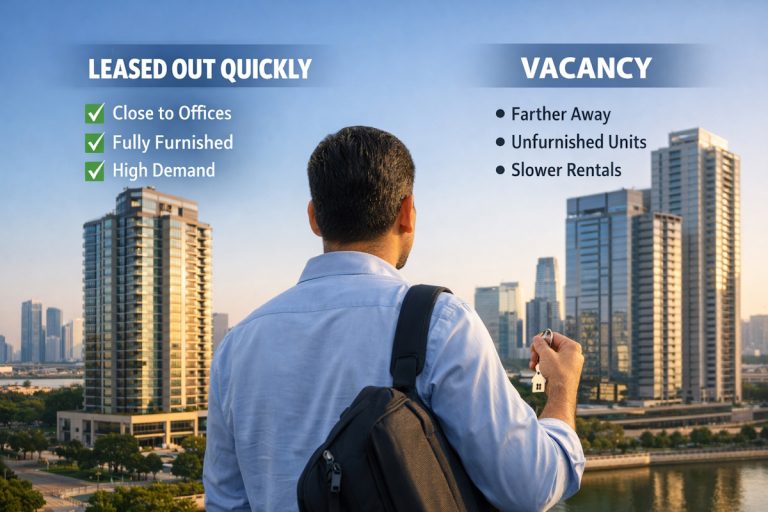
A city that successfully attracts families demonstrates greater residential stability. Single professionals, while high-paying, are often transient. Families typically sign longer leases (2-3 years) and are less likely to move, significantly lowering an investor’s vacancy risk and reducing the turnover costs associated with finding new tenants. This stability ensures predictable cash flow.
Premium Rental Potential and Appreciation
The ability of GIFT City to provide a cohesive residential lifestyle IFSC suitable for high-income families allows investors to command a premium rental rate. These are tenants who value security, planning, and proximity to work and quality schools near GIFT City. As the social infrastructure matures—i.e., when internal schools open and high-end retail fills up—the overall asset class will de-risk and appreciate faster than purely commercial or single-occupancy focused real estate.
Investment in residential projects today is essentially a strategic bet on the successful completion of this human infrastructure. The most promising assets are those closest to planned social amenities and the non-SEZ areas, where residential development and retail are concentrated.
If you’re evaluating specific projects based on their proximity to future family amenities and regulatory zoning, now is the time to act on precise data. Schedule an Investment Consultation with a Gift City Realty expert to align your portfolio goals with high-potential residential zones.
Mitigating Risks in Residential Investment Decision-Making
While the long-term outlook for family living GIFT City is positive, investors must be aware of the specific risks associated with investing in a developing city.
Risk of Infrastructure Delays
The primary risk is the timeline of auxiliary infrastructure. While the financial tower construction is swift, the development of parks, community centers, and specialized schools near GIFT City may lag. If these facilities are delayed, the expected influx of long-term family tenants will also be delayed, potentially slowing rental growth in the immediate term.
Investor Mitigation Strategy: Partner with an advisory firm, like Gift City Realty, that tracks official infrastructure completion rates, not just developer claims. We help you distinguish between high-conviction and speculative projects. Download the GIFT City investor guide for a comparison matrix of leading developers.
Regulatory Clarity on Non-SEZ Residential Zones
Residential properties in GIFT City primarily fall within the Non-SEZ area, which means they operate under standard state regulations, unlike the IFSC units. Investors must understand the nuances of owning assets in both zones and how the residential property interacts with the strict work compliance rules of the SEZ. Clarity on property tax, transfer laws, and tenancy agreements within the specific GIFT City framework is vital for smooth operations and high yield optimization.
Understanding these intricacies is non-negotiable for maximizing asset performance. Request ROI Estimates from our team to see how regulatory compliance affects net yields.
GIFT City: Deciding on Residential Portfolio Allocation
The question of whether family living GIFT City is suitable has shifted from ‘if’ to ‘when.’ The current phase of residential investment is ideal for those who have a three-to-five-year holding period and can tolerate the initial lag as social infrastructure catches up to the commercial momentum.
The suitability for family life is not a soft amenity; it is a hard business metric that guarantees stable, premium demand. Assets purchased now, before the complete roster of schools near GIFT City are operational and before the residential lifestyle IFSC is fully mature, offer the highest leverage potential.
Investors should focus on properties that are strategically positioned to benefit maximally from future connectivity and social hub development. This requires tactical foresight and deep domain expertise.
We are here to provide that targeted guidance. If you are ready to move from evaluation to execution, speak with a GIFT City Expert at Gift City Realty for a personalized project briefing.
Frequently Asked Questions (FAQ)
What is the current demand for residential units in GIFT City?
Demand is currently robust, driven largely by financial professionals and high-net-worth individuals relocating for the IFSC. The demand is expected to accelerate significantly as internal social infrastructure, especially educational facilities, reaches maturity, ensuring the long-term viability of family living GIFT City offers.
Are there international schools located within GIFT City?
While the ecosystem for schools near GIFT City relies partially on institutions in neighboring Ahmedabad and Gandhinagar, GIFT City itself has commitments from several high-profile educational groups to establish campuses within the city limits. Investors should check the expected operational timelines of these new facilities.
How does the IFSC tax structure benefit residential property investors?
While residential property falls in the non-SEZ zone, the tax benefits directed towards IFSC employees (who are your target tenants) increase their disposable income, allowing them to afford higher rental premiums. Additionally, regulatory clarity provided by the IFSC framework supports streamlined business operations in the region.
Is the residential lifestyle IFSC comparable to established metro areas?
The residential lifestyle IFSC provides superior planning, security, and the unique convenience of walk-to-work culture, which metros cannot offer. While metros currently surpass GIFT City in terms of mature social networks, GIFT City excels in planned urban efficiency, making it increasingly appealing for discerning families seeking high quality of life.
What is the typical lease duration for residential properties in GIFT City?
Due to the relocation of senior talent and the stability desired by IFSC employers, we observe a tendency towards longer lease agreements (18 to 36 months) in high-quality assets, especially for families committed to family living GIFT City provides.