Infrastructure and transit speed fundamentally dictate urban real estate appreciation. For institutional investors, family offices, and high-net-worth buyers evaluating Gujarat’s twin-city growth story, understanding physical distance versus actual commuter transit times between key economic centers is essential. The corridor connecting the state capital, Gandhinagar, to Gujarat International Finance Tec-City represents one of the fastest-growing commercial and residential real estate corridors in Western India.
When capital flows into an international financial hub, residential absorption and commercial expansion naturally spill over into adjacent urban networks. Navigating the exact Gandhinagar to gift city distance is not merely an exercise in route planning, but a foundational metric for assessing rental yields, employee commute patterns, corporate catchment zones, and real estate investment timing.
Strategic Importance of the Gandhinagar to GIFT City Corridor
Evaluating transit corridors requires looking beyond simple kilometers on a map to consider how seamlessly economic activity moves across metropolitan boundaries. The spatial dynamic between Gandhinagar and GIFT City provides a clear blueprint for urban integration.
Evaluating the Economic Axis Between Capital and Financial Hub
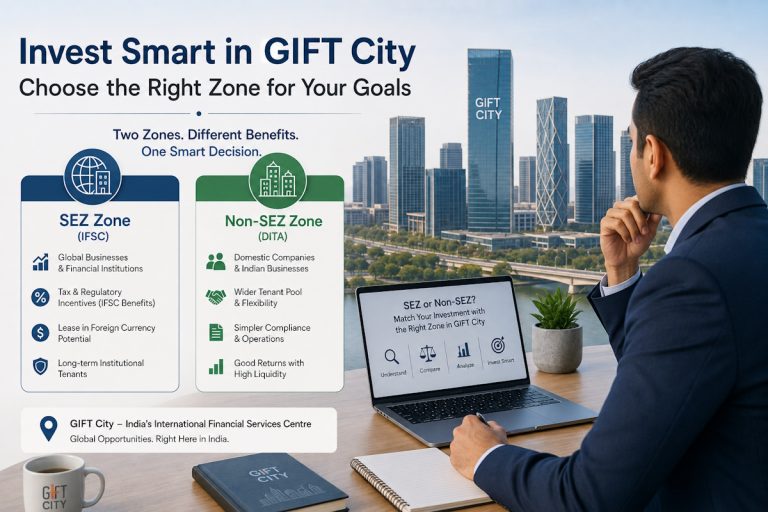
Gandhinagar serves as the administrative core of Gujarat, housing key bureaucratic bodies, institutional headquarters, and established civic infrastructure. Conversely, GIFT City is designed as an autonomous, globally competitive financial and technological SEZ and DTA zone. The short physical distance between these two centers creates an integrated economic ecosystem where policy governance and private global finance operate in close proximity.
For investors, this geographic closeness ensures sustained commercial demand. Corporate occupiers, legal practices, multi-family offices, and financial consultancies that deal directly with state regulatory entities while servicing international clients at IFSC GIFT City actively seek properties along this connective highway network.
The Multiplier Effect on Commercial Real Estate Demand
Transit velocity directly influences Grade-A office absorption rates. When executive travel time is minimized, multi-office corporate strategies become practical. Many firms choose to maintain administrative or liaising footprints within Gandhinagar proper while establishing front-office trading or offshore banking units inside GIFT City.
This dynamic increases the value of assets located near strategic arterial intersections. Monitoring GIFT City infrastructure and metro updates helps investors identify entry points along the corridor before infrastructure completion gets fully priced into underlying land rates.
Gandhinagar to GIFT City Distance and Key Transit Routes
Understanding the exact routes and driving conditions is essential for commercial tenants assessing executive accessibility and residential buyers evaluating daily commutes.
Primary Arterial Routes and Driving Distance Breakdown
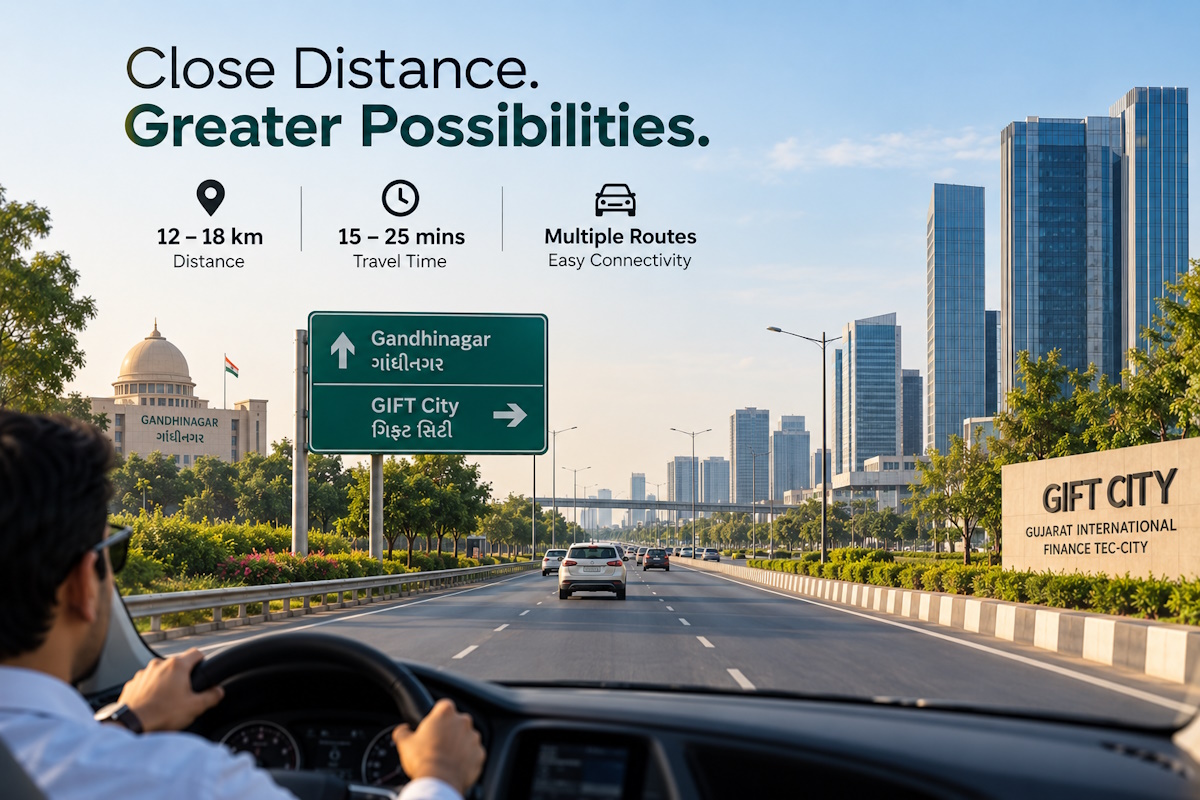
The total driving distance to GIFT City from central Gandhinagar typically spans between 12 to 18 kilometers, depending entirely on the starting sector in the capital city. The geographic separation is remarkably concise for an international financial center adjacent to a state capital.
- Route via Gandhinagar-Ahmedabad Road (via Koba Circle): Approximately 14 to 16 kilometers. This is the primary commercial route, offering wide, multi-lane divided roadways, uninterrupted traffic flow, and modern flyovers.
- Route via PDPU Road / Bhaijipura: Approximately 11 to 13 kilometers from the southern sectors of Gandhinagar. This route serves as a rapid access path for daily commuters and residents.
- Route via CH Road to GIFT City Bridge: Approximately 15 kilometers, delivering direct access to the SEZ gate and commercial towers.
Gandhinagar to GIFT City Travel Time Across Peak and Off-Peak Hours
Because of expansive civic road planning in Gujarat, the actual Gandhinagar to GIFT City travel time is significantly lower than in traditional metropolitan centers such as Mumbai or Bengaluru. On average, driving between the two centers takes between 15 and 25 minutes by private vehicle or dedicated executive shuttle.
During morning peak hours (8:30 AM to 10:30 AM) and evening return periods (5:30 PM to 7:30 PM), travel times along primary junctions like Koba Circle may experience moderate queuing, extending the commute to 22 to 28 minutes. Off-peak travel typically requires no more than 12 to 15 minutes door-to-door.
Analyzing Arterial Access via NH 48 and Koba Circle
National Highway 48 and the Koba Circle junction form the spine of regional transport in this district. High-capacity flyovers and structured lane management reduce vehicular bottlenecks, making properties situated near these interchanges prime targets for commercial real estate acquisition.
Bypass Options and Alternative Urban Corridors
For investors examining peripheral residential parcels, secondary access roads bypassing Koba Circle via Raysan and Bhaijipura provide uninterrupted transit to GIFT City’s processing and non-processing zones. These auxiliary routes offer alternative commuting options for the expanding workforce.
Multi-Modal GIFT City Connectivity and Infrastructure Upgrades
While road transit provides immediate accessibility, long-term capital preservation and high rental velocity depend on integrated multi-modal transit networks. GIFT City’s master plan emphasizes zero-congestion accessibility through combined road, rail, and metro initiatives.
Phase 2 Metro Integration and Commuter Velocity
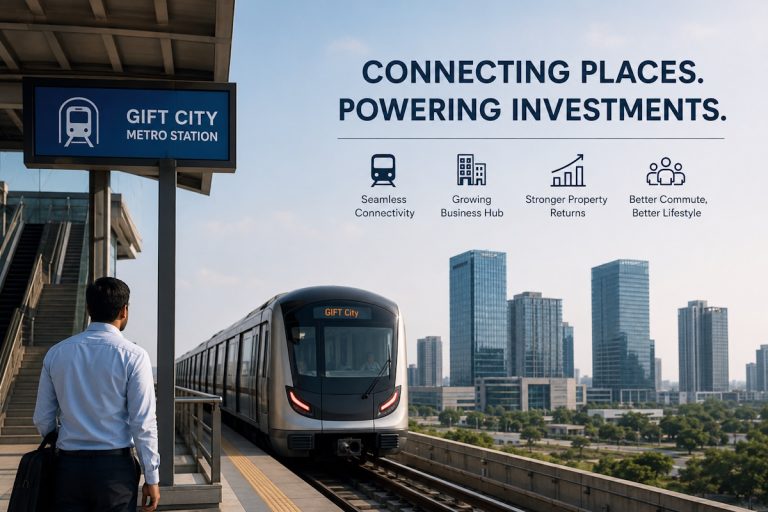
The operational expansion of the Ahmedabad-Gandhinagar Metro Phase 2 fundamentally reshapes commuter behavior. The dedicated metro corridor establishes direct rapid transit linkage between central Gandhinagar sectors, Mahatma Mandir, and GIFT City.
Mass rapid transit reduces travel times to fixed, predictable schedules, insulating workforce mobility from roadway variations. Strategic deployment of capital into assets positioned near operational metro stations allows investors to capture superior yields, as highlighted in analysis on GIFT City metro connectivity and its direct impact on asset value.
Last-Mile GIFT City Road Connectivity and Micro-Mobility
Master-planned infrastructure inside GIFT City coordinates directly with incoming state highways. Multi-level entry points, underpasses, and automated traffic management systems prevent the localized gridlock common around high-density financial districts.
High-grade GIFT City road connectivity ensures that transit buses, electric feeder services, and app-based mobility networks can navigate into both the Special Economic Zone (SEZ) and Domestic Tariff Area (DTA) without administrative delay. Knowing how to reach GIFT City via these integrated last-mile options is a major consideration for prospective corporate tenants planning workforce logistics.
Real Estate Implications Along the Gandhinagar-GIFT Axis
Every minute shaved off a daily commute expands the viable residential catchment area for executive talent. Consequently, transit proximity between Gandhinagar and GIFT City directly drives occupancy rates and capital appreciation.
Residential Absorption and Rental Yield Expansion
The expanding workforce inside GIFT City has generated substantial demand for premium housing. Because residential development inside GIFT City’s boundary is targeted to reach balance over multi-phase completions, immediate residential demand naturally flows into proximate sectors of Gandhinagar and adjoining development nodes.
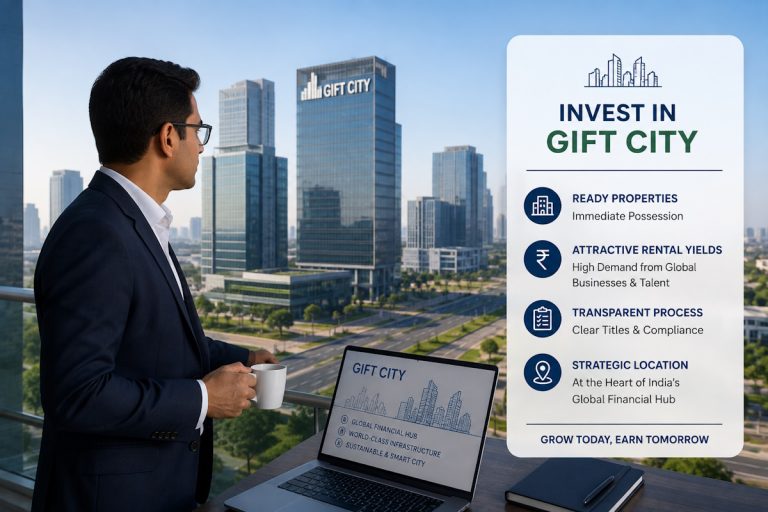
Institutional and retail investors acquiring residential assets along this corridor report gross rental yields outperforming traditional Indian tier-one residential averages. Working professionals prefer living in established Gandhinagar sectors with complete social infrastructure while commuting under twenty minutes to GIFT City. Investors often review the best residential areas near GIFT City to optimize portfolio yields between capital appreciation and rental demand.
Commercial Spillover and Corporate Office Relocation Trends
Robust GIFT City connectivity has stimulated demand for secondary corporate offices, business hotels, co-working facilities, and commercial retail strips in southern Gandhinagar. Businesses that support the financial ecosystem but do not strictly require IFSC tax registrations choose locations along the transit corridor to remain adjacent to major institutions at competitive occupancy costs.
Evaluating Micro-Markets Along the Transit Corridor
- Raysan & Randesan: High-density residential micro-markets favored by mid-to-senior executives due to immediate riverfront proximity and a 10 to 12-minute commute to the SEZ gates.
- Koba: The central interchange node, ideal for commercial mixed-use developments, corporate leasing spaces, and retail centers capturing twin-city transit traffic.
- Kudasan & Sargasan: Established residential markets featuring mature social infrastructure, leading international schools, and seamless road transit to both GIFT City and central Gandhinagar.
Risk Factors and Due Diligence for Transit-Corridor Investors
While the investment thesis for the Gandhinagar-GIFT corridor is compelling, sophisticated investors must navigate specific regulatory, execution, and zoning parameters before committing capital.
Infrastructure Timelines versus Speculative Pricing
A common investment pitfall is acquiring land or off-plan residential developments based entirely on speculative transit proposals without verified town planning approvals. Investors must verify that designated arterial roads are fully budgeted and under execution by regional authorities rather than relying on conceptual master plan sketches.
Working with specialized advisory firms such as Gift City Realty allows investors to verify the authenticity of infrastructure delivery schedules and measure true capital appreciation potential against prevailing market prices.
Zoning, DTA, and SEZ Boundary Considerations
Investors must differentiate between real estate located within the regulatory boundary of GIFT City and peripheral properties along the Gandhinagar corridor. While GIFT City proper offers specialized IFSC regulatory standing, dual tax benefits, and single-window clearances for international operations, peripheral Gandhinagar real estate operates under standard state municipal frameworks.
Allocating capital correctly requires aligning your target tenant profile with the corresponding regulatory environment. Corporate units demanding tax-neutral offshore operations must be located directly inside the IFSC boundary, whereas workforce housing and general support businesses thrive along the connective transit corridor.
Strategic Investment Verdict for the Gandhinagar-GIFT Corridor
The short Gandhinagar to gift city distance of 12 to 18 kilometers, paired with rapid 15 to 25-minute travel times, makes this transit corridor one of the most reliable real estate investment belts in India. The integration of modern arterial expressways with mass rapid transit creates structural support for sustained rental yields and long-term capital preservation.
For investors seeking a balance between mature social amenities and exposure to international financial growth, positioning capital along this corridor offers high utility. Focus on Grade-A construction, walk-to-transit accessibility, clear regulatory land titles, and master-planned developments to capture the complete upside of Gujarat’s primary economic axis.
Frequently Asked Questions
1. What is the exact driving distance between Gandhinagar and GIFT City?
The driving distance ranges between 12 and 18 kilometers depending on your departure point within Gandhinagar sectors. Travel via the Koba Circle or Bhaijipura access roads provides the most direct connection to GIFT City entry gates.
2. How long does it take to travel from Gandhinagar to GIFT City during peak hours?
Commute times typically range from 15 to 25 minutes. During peak traffic hours, travel times rarely exceed 25 to 30 minutes due to multi-lane divided roadways, modern flyovers, and master-planned traffic management.
3. How does Phase 2 Metro connectivity affect property values along this corridor?
Phase 2 Metro connectivity provides fixed, predictable travel times between Gandhinagar and GIFT City. Commercial and residential properties within walking or short feeder distance of operational metro stations traditionally command higher rental premiums and experience faster capital appreciation.
4. Is it better to invest inside GIFT City or along the Gandhinagar transit corridor?
Investment inside GIFT City is ideal for targeting international corporate leases, SEZ/IFSC tax incentives, and direct financial hub rental demand. The Gandhinagar corridor is exceptionally well-suited for broader residential developments, mid-market rental housing, and supporting commercial services.