
The evolution of GIFT City into a global financial powerhouse is no longer a speculative narrative; it is a documented economic reality. Among the various sectors driving this growth, the aviation finance and leasing vertical has emerged as a cornerstone of the International Financial Services Centre (IFSC). As India moves to repatriate the multibillion-dollar aircraft leasing industry from offshore hubs like Dublin and Singapore, the physical footprint of this sector within Gujarat is expanding. For the astute real estate investor, this shift represents more than just industrial growth; it signifies a structural change in the demand for high-end commercial and residential assets within the GIFT City ecosystem.
Understanding the link between GIFT City aircraft leasing and real estate requires a deep dive into the corporate infrastructure required to support aviation finance. Leasing companies do not operate in a vacuum. They bring with them a cluster of legal firms, specialized accounting practices, insurance brokers, and technical auditors. This cluster effect creates a concentrated demand for Grade-A office spaces and premium residential units designed for high-net-worth professionals. For those evaluating the GIFT City market, the focus should be on how this specific sector influences long-term capital appreciation and rental yield stability in a competitive investment landscape.
The Strategic Integration of Aviation Finance and Real Estate
The decision to localize aircraft leasing in India via GIFT City was a strategic move by the government to reduce foreign exchange outgo. However, the operationalization of these leasing entities requires physical substance—a mandate by the International Financial Services Centres Authority (IFSCA). This substance requirement directly translates into real estate consumption. Unlike shell companies in traditional tax havens, entities involved in GIFT City aircraft leasing must maintain functional offices and management presence within the SEZ or IFSC zones, ensuring a steady absorption of commercial inventory.
The Substance Requirement and Commercial Absorption
For an investor, the term “substance” is a key driver of value. The IFSCA regulations require leasing companies to demonstrate that their management and control are situated within the GIFT IFSC. This means that as more global players and domestic airlines set up leasing arms, the demand for sophisticated, tech-enabled office environments grows. These are not typical back-office operations; they are high-stakes financial hubs that require premium security, redundant power systems, and world-class connectivity. Consequently, commercial properties that cater to these specific requirements are seeing a tightening of supply and a subsequent rise in lease rates.
Ancillary Services and the Cluster Effect
Beyond the lessors themselves, the aviation ecosystem attracts a secondary tier of tenants. Law firms specializing in maritime and aviation law, tax consultancies, and asset management firms are all establishing a presence to serve the lessors. This creates a multi-layered demand profile for commercial real estate. When evaluating a project, investors should look at the proximity to the IFSC core, as these ancillary services prioritize locations that offer easy access to the primary financial institutions and regulatory bodies.
Driving Residential Demand Through High-Income Demographics
The personnel required to manage aircraft leasing operations are typically highly skilled professionals with significant purchasing power. This includes aviation lawyers, structured finance experts, and technical consultants. Their entry into the GIFT City market is shifting the residential demand from basic housing to luxury apartments and branded residences. This demographic seeks proximity to their workplace, but more importantly, they demand an international standard of living that includes smart home features, comprehensive lifestyle amenities, and robust property management services.
Transition from Commuter Hub to Resident Ecosystem
Historically, many professionals working in GIFT City commuted from Ahmedabad or Gandhinagar. However, as the aircraft leasing sector matures, there is a visible trend toward residency within the city limits. The convenience of a “walk-to-work” culture, combined with the tax benefits associated with living within the IFSC for certain global roles, is making residential investment in GIFT City highly attractive. For the investor, this means higher occupancy rates and a more reliable tenant profile, reducing the risks associated with frequent turnover or non-payment.
Yield Implications of the Aviation Professional Class
When analyzing potential rental yields, investors must consider the corporate lease potential. Many aviation firms provide housing allowances or enter into corporate lease agreements for their executive staff. These contracts often command a premium over individual leases and offer greater legal security for the landlord. Real estate assets that align with the aesthetic and functional preferences of this global workforce are positioned to achieve superior yields compared to more generic residential offerings in the surrounding regions.
Regulatory Advantages as a Catalyst for Capital Appreciation
The growth of GIFT City aircraft leasing is underpinned by a robust regulatory framework that provides long-term certainty to investors. The 10-year tax holiday, exemptions from GST on lease rentals, and the absence of withholding tax on interest payments to non-residents make this a globally competitive hub. While these are financial incentives for the aviation industry, they act as a massive de-risking mechanism for real estate investors. A stable, government-backed financial hub ensures that the underlying demand for real property remains resilient even during broader market fluctuations.
IFSCA Governance and Investor Confidence
The unified regulator, IFSCA, has been instrumental in creating a business-friendly environment. For real estate investors, this regulatory clarity means that the “vision” of GIFT City is being executed with precision. When the government simplifies the process for an international lessor to set up shop, they are effectively ensuring the future occupancy of the city’s buildings. This transparency and ease of doing business are critical factors that contribute to the long-term capital appreciation of assets within the city.
Long-Term Appreciation Factors
Capital appreciation in real estate is often a function of scarcity and economic utility. As the available land parcels within the IFSC are developed and occupied by high-value sectors like aircraft leasing, the remaining inventory becomes more valuable. The specialized nature of the aviation industry means that once an ecosystem is established, it is difficult to displace. This “stickiness” of the sector provides a level of protection for real estate values that is rarely found in more generalized commercial markets.
Impact of Global Benchmarking
GIFT City is frequently benchmarked against Dubai International Financial Centre (DIFC) and Abu Dhabi Global Market (ADGM). As it reaches parity with these hubs in terms of aviation finance volume, the real estate prices are expected to follow a similar upward trajectory. Investors who enter the market while the aviation sector is still in its high-growth phase are likely to capture the most significant gains as the city reaches full operational maturity.
Evaluating the Risks: Supply Dynamics and Market Timing
While the growth driven by GIFT City aircraft leasing is compelling, a sophisticated investor must also evaluate the risks. The primary concern in any rapidly developing hub is the mismatch between supply and demand. Currently, there is a race to deliver Grade-A office space to meet the requirements of newly licensed lessors. Investors need to be discerning about the quality of the projects they fund, as not all developments will meet the stringent global standards required by international aviation firms.
Avoiding the “Generic” Investment Trap
One common mistake is investing in projects that lack the necessary infrastructure for financial services. Aviation and fintech firms require specific floor plate designs, high-speed data capabilities, and specific security protocols. Projects that are built to a “generic” commercial standard may face higher vacancy rates as specialized tenants move toward purpose-built financial towers. Gift City Realty emphasizes the importance of vetting developers based on their track record of delivering international-standard assets.
Liquidity and Exit Strategies
Liquidity is a vital consideration for HNIs and institutional buyers. The specialized nature of the GIFT City market means that your eventual exit will likely be to another investor looking for stable, yield-generating assets. By focusing on properties that are occupied by or attractive to the aircraft leasing sector, you are essentially ensuring the future liquidity of your investment. A building with a roster of global leasing firms is a far more liquid asset than a partially vacant residential block on the periphery.
Infrastructure and Connectivity: The Multiplier Effect
The physical infrastructure of GIFT City, including its district cooling system, automated waste management, and utility tunnels, provides a foundation that supports high-intensity industries like aviation finance. However, the external connectivity—specifically the proximity to Sardar Vallabhbhai Patel International Airport—is the real catalyst for the aircraft leasing sector. For an industry that revolves around global movement, the ease with which executives can travel between the leasing hub and major airline headquarters is a decisive factor.
The Metro Link and Urban Integration
The expansion of the Ahmedabad Metro to GIFT City is a transformative development for residential real estate. It broadens the talent pool that can easily access the city, while also making the city more attractive for residents who want to maintain a connection to the broader Gujarat region. For real estate investors, infrastructure milestones like the metro link often serve as “price triggers” that lead to immediate jumps in valuation.
Sustainability and ESG Mandates
Global aircraft leasing companies often have strict Environmental, Social, and Governance (ESG) mandates. They prefer, and sometimes require, their office spaces to be in LEED-certified or green-rated buildings. This is an important consideration for investors. Properties that do not meet these sustainability standards may find themselves excluded from the consideration set of the very tenants that are driving the city’s growth. Investing in “green” commercial assets is not just an ethical choice; it is a strategic necessity in the GIFT City market.
Strategic Decision-Making for the GIFT City Investor
As the aircraft leasing sector continues its ascent, the window for entry at current valuations is narrowing. Investors must decide whether they are looking for immediate rental income or long-term capital growth. The commercial sector, driven by the substance requirements of lessors, offers immediate stability and corporate-backed yields. Conversely, the residential sector offers significant upside as the city transitions into a 24/7 living ecosystem populated by high-earning aviation professionals.
At Gift City Realty, the focus is on providing data-backed guidance that goes beyond the brochures. The synergy between GIFT City aircraft leasing and real estate is a unique phenomenon in the Indian market, mirroring the growth patterns seen in global financial centers. By aligning your investment strategy with these structural tailwinds, you can position your portfolio for resilience and superior performance in the years to come.
Frequently Asked Questions
1. How does aircraft leasing specifically impact residential real estate prices?
Aircraft leasing brings high-income executives and specialized consultants to the city. These professionals often receive corporate housing benefits and demand premium amenities, which drives up both rental yields and the capital value of luxury residential units.
2. Are commercial properties in the SEZ better than those in the Non-SEZ area for this sector?
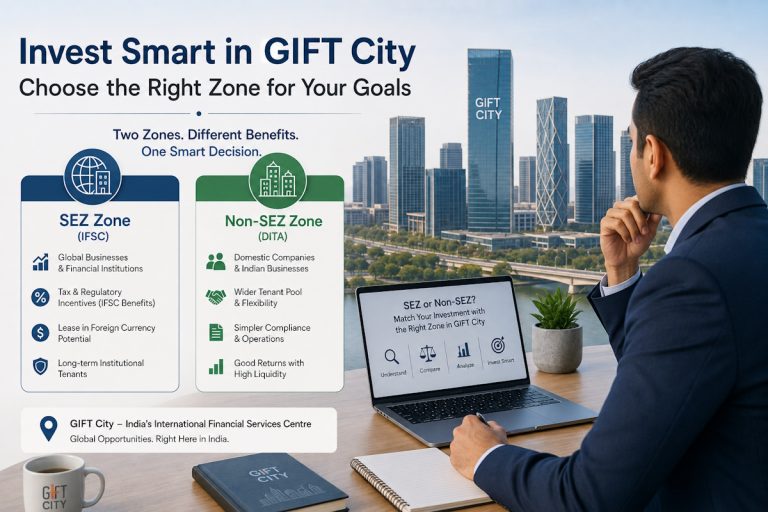
Most aircraft leasing entities operate within the IFSC/SEZ zone due to the tax incentives. Therefore, commercial properties within the IFSC are more likely to see direct demand from these firms and their immediate service providers.
3. What is the typical lease term for aviation-related tenants in GIFT City?
Lease terms for these entities are generally long-term, often ranging from 5 to 9 years, with structured escalations. This provides investors with predictable cash flows and lower vacancy risks compared to retail or smaller service sectors.
4. Does the growth of aircraft leasing affect the liquidity of my investment?
Yes, positively. Assets that are leased to or designed for global financial sectors like aviation are highly attractive to institutional investors and REITs, which increases the ease of exit and the likelihood of a premium valuation upon sale.
5. Is there a risk of oversupply in the commercial segment?
While many projects are under construction, the demand from specialized sectors like aviation finance is highly specific. There is a persistent shortage of “Grade-A+” spaces that meet the technical and ESG requirements of global firms, meaning high-quality assets remain insulated from general oversupply risks.