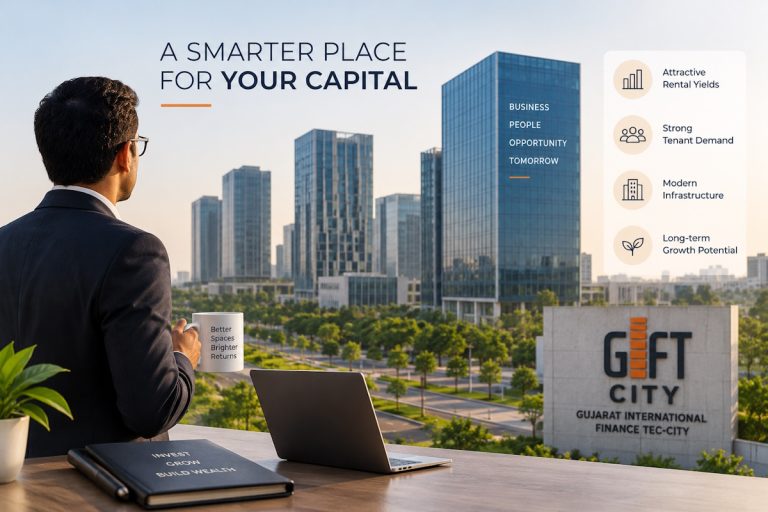

India is experiencing an unprecedented realignment of its financial and technological enterprise hubs, with Gujarat International Finance Tec-City leading this transformation. As India’s maiden operational smart city and International Financial Services Centre, the business district is moving from an ambitious vision into an active, globally integrated commercial powerhouse. For high-net-worth individuals, non-resident Indians, family offices, and institutional funds, assessing the commercial landscape here is no longer a speculative exercise, but a core strategic allocation decision.
The acceleration of enterprise leasing, regulatory de-bottlenecking, and significant infrastructure rollouts have created an attractive risk-reward profile for prime commercial assets. Understanding the shifting dynamics of tenant demand, rental appreciation curves, capital values, and regulatory zones is essential for capital preservation and yield optimization. Navigating the evolving GIFT City commercial real estate landscape requires looking past marketing hype to evaluate the structural fundamentals driving sustainable long-term returns.
Macro Drivers Shaping the GIFT City Office Market
The institutional momentum underpinning commercial real estate GIFT City relies on a convergence of structural advantages that traditional Indian central business districts cannot easily replicate. While legacy commercial markets in Mumbai, Bengaluru, and the National Capital Region face severe urban congestion and high operational costs, this greenfield financial center delivers an integrated ecosystem built specifically for international finance and technology operations.
The IFSC Framework and Fiscal Incentives Driving Occupier Demand
The single most powerful economic catalyst for office absorption is the presence of the International Financial Services Centres Authority. Operating as a unified regulator, the IFSCA provides financial institutions with a streamlined, internationally competitive regulatory environment. Global banks, alternative investment funds, reinsurance majors, and capital market intermediaries benefit from significant fiscal advantages.
These incentives include a 100 percent tax holiday for ten consecutive years out of a fifteen-year block, competitive Minimum Alternate Tax rates, and complete exemptions on goods and services tax for services rendered within the offshore jurisdiction. When multinational corporations evaluate operating inside the GIFT City commercial property market, these tax efficiencies directly improve corporate balance sheets, converting policy support into persistent commercial leasing demand.
Infrastructure Readiness and Operational Cost Arbitrage
Operational stability is a non-negotiable requirement for multinational tenants. The master-planned infrastructure incorporates utility tunnels, automated vacuum waste collection, district cooling systems, and dual-redundant power supplies. This smart utility backbone delivers uninterrupted operational reliability while cutting recurring maintenance costs for occupiers by up to twenty-five percent compared to standard Tier-1 office spaces.
Beyond operating efficiencies, the cost arbitrage in commercial occupancy costs compared to traditional prime locations like Bandra-Kurla Complex in Mumbai or Connaught Place in New Delhi is striking. Enterprises secure state-of-the-art office infrastructure at competitive rental rates, allowing them to scale their workforce while improving capital efficiency.
Office Demand Segments and Tenant Profiles
Tenant absorption profiles have broadened significantly over recent quarters, moving beyond domestic banking back-offices into high-value global operations. Analyzing which industries are signing long-term leases allows commercial property investors to forecast vacancy risks, lease renewal probabilities, and future rental escalations.
Banking, Capital Markets, and Global In-House Centers
The banking sector remains the foundational pillar of office absorption. Major domestic private and public sector banks, alongside international banking institutions, have established fully operational IFSC banking units. These operations handle cross-border trade finance, external commercial borrowings, and international treasury transactions. Similarly, the setup of international bullion exchanges and stock exchanges has brought in institutional brokerages, clearing corporations, and custodial services that demand Grade-A floor plates.
Simultaneously, multinational corporations are establishing Global Capability Centers and Global In-House Centers in GIFT City. These enterprises leverage the skilled talent pool from Ahmedabad and Gandhinagar to manage quantitative analytics, risk modeling, software architecture, and international compliance, driving sustained multi-floor office requirements.
Tech, Fintech, and Ancillary Professional Services
The Special Economic Zone and Domestic Tariff Area both host an expanding footprint of enterprise technology providers and emerging fintech innovators. Regulatory sandboxes provided by the IFSCA attract payment service providers, cross-border payment processors, and insurtech firms seeking room for regulatory innovation.
This concentrated influx of core financial and technical entities triggers immediate secondary demand for professional service firms. Leading accounting networks, international law practices, actuarial consultancies, and management advisors require premium office space in adjacent towers, ensuring steady block-wise demand in GIFT City across varied office floor configurations.
Space Absorption Patterns and Lease Commitments
Historical leasing data reveals a structural shift in tenant commitment terms. Early occupiers often opted for flexible workspaces or short-term managed office arrangements. Today, enterprise tenants regularly execute five to nine-year institutional leases with standard three-year lock-in periods and structured escalation clauses of twelve to fifteen percent every three years. This shift confirms long-term corporate commitment, protecting asset owners against near-term lease churn.
Commercial Pricing, Rental Yields, and Capital Economics
Evaluating commercial real estate requires an objective assessment of capital outlays, net operating income, and yield spreads. The financial profile of GIFT City commercial property trends shows a market moving out of its early speculative stage and into an era of steady institutional yield generation.
Current Lease Rate Benchmarks across SEZ and Non-SEZ Zones
Lease rentals in GIFT City show clear differentiation between Special Economic Zone spaces and Domestic Tariff Area properties. SEZ offices, catering exclusively to offshore finance, IT services, and export-oriented entities, command premium rental rates due to direct regulatory and tax incentives tied to the location.
DTA commercial spaces, while pricing at a moderate entry point, see steady demand from domestic financial entities, regional corporate headquarters, and service businesses that serve the broader domestic market. Monitoring GIFT City commercial property prices allows individual investors to identify entry valuations that support optimal capitalization rates across both zones.
Yield Compression and Long-Term Capital Appreciation Outlook
Commercial gross rental yields in GIFT City currently range between seven and nine percent annually, visibly outpacing traditional residential yields and outperforming prime commercial office yields in oversaturated metro locations. As more institutional developers enter the market and sovereign funds evaluate asset acquisitions, capital values are expected to rise, leading to natural yield compression over the next five to seven years.
For early and growth-stage investors, this dynamic offers a dual benefit: strong immediate cash flow coupled with meaningful capital appreciation as the overall ecosystem matures and institutional capital seeks stabilized, income-generating Grade-A office blocks.
Risk-Adjusted Returns Compared to Traditional Tier-1 Metros
- Mumbai (BKC and Lower Parel): Established liquidity, but compressed gross rental yields around six to seven percent with high capital acquisition costs and restricted expansion capacity.
- Bengaluru (Outer Ring Road): Strong tech absorption, but persistent municipal infrastructure challenges, traffic bottlenecks, and rising strata vacancy risks.
- GIFT City (IFSC and DTA): Favorable tax-advantaged operational framework, gross yields hovering between seven and nine percent, modern integrated infrastructure, and strong government policy backing.
Evaluating Commercial Assets: Due Diligence and Strategic Entry Points
Allocating capital into the GIFT City office market requires thorough due diligence. Not every commercial development offers the same level of tenant appeal, construction execution, or legal compliance. Sophisticated investors must evaluate several risk variables before executing purchase agreements.
Developer Execution Track Record and Asset Quality
The gap in tenant demand between institutional-grade developments and lower-tier commercial buildings is substantial. Premium international tenants consistently select developers that demonstrate clean track records of on-time delivery, clear institutional property governance, and advanced environmental certifications like LEED or IGBC ratings. Partnering with advisory firms like Gift City Realty helps individual investors verify developer credibility and secure allocations in developments with high structural quality and tenant appeal.
Pre-Leased vs Bare-Shell Commercial Property
Investors must decide between acquiring pre-leased commercial units and investing in bare-shell spaces within under-construction or newly delivered towers:
- Pre-Leased Commercial Assets: Offer immediate cash flow from day one, verified tenant covenants, and zero lease-up gestation risk. However, they trade at a pricing premium and yield lower capital appreciation during the initial holding period.
- Bare-Shell or Under-Construction Offices: Provide advantageous payment plans, lower entry valuations, and higher total capital upside upon completion. They carry construction risk and require active leasing efforts once delivered.
Regulatory Compliance and Title Verification
Commercial acquisitions within the SEZ processing zone require strict adherence to IFSCA and SEZ authority regulations. Buyers must ensure that the developer possesses unencumbered title deeds, all requisite development approvals, environmental clearances, and formal RERA registration. Furthermore, understanding the legal mechanics of long-term sub-leases within the development authority framework is critical for avoiding future title or transfer complications.
Strategic Commercial Investment Blueprint for HNIs and Institutional Buyers
Building a resilient, high-performing commercial property portfolio in GIFT City requires a clear entry strategy, disciplined capital allocation, and an active risk mitigation framework tailored to evolving market cycles.
Portfolio Allocation Strategies for Maximum Yield
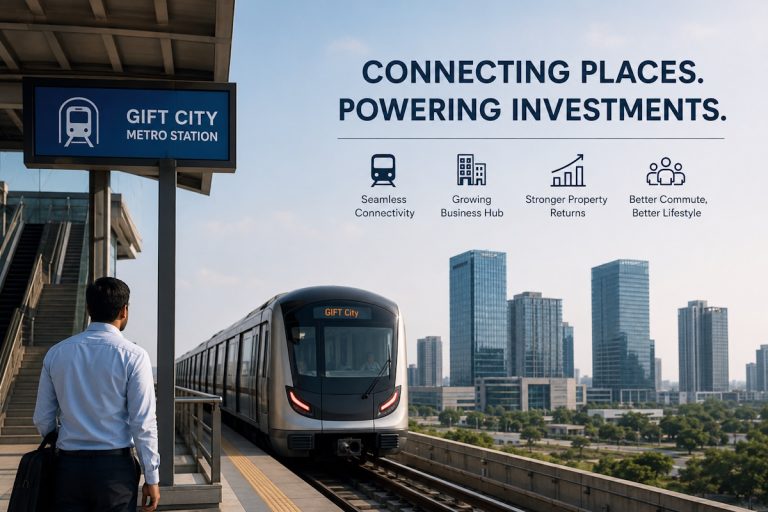
A balanced commercial allocation often blends steady income assets with growth-oriented inventory. Allocating sixty percent of commercial capital into pre-leased or soon-to-be-completed Grade-A office spaces provides an immediate cash flow baseline. The remaining forty percent can be allocated across strategically located under-construction developments that will benefit from upcoming infrastructure links, such as metro connectivity to Ahmedabad and international airport expansions.
This barbell investment approach combines downside capital protection with long-term upside participation in the city’s growth trajectory.
Mitigating Vacancy and Tenancy Risks
To guard against extended vacancy cycles, investors should target office configurations that appeal to the broadest tenant pool. Highly flexible, mid-sized floor plates ranging from one thousand to five thousand square feet typically experience faster re-leasing cycles than ultra-large contiguous floor plates, which depend entirely on large enterprise relocations.
Additionally, prioritizing towers that incorporate multi-tier parking, professional facility management, high elevator-to-floor ratios, and modern green building standards ensures your asset remains attractive even as newer commercial inventory enters the market.
Frequently Asked Questions
1. Can individual domestic and NRI investors buy commercial property in GIFT City?
Yes, both resident Indian investors and Non-Resident Indians can acquire commercial real estate across both the Special Economic Zone and Domestic Tariff Area, subject to standard FEMA guidelines and relevant regulatory registrations.
2. What is the typical difference between SEZ and DTA office investments?
SEZ commercial units are restricted to tenants registered with the IFSC or SEZ authorities, offering international tax concessions and targeting global financial or tech services. DTA units can be leased to any domestic business or corporate entity without offshore operational mandates.
3. What are the prevailing rental yields for commercial offices in GIFT City?
Gross commercial rental yields currently range between seven and nine percent annually for Grade-A spaces, depending on asset quality, tenant covenant strength, floor level, and specific zone location.
4. How does capital gains tax apply to commercial property transactions in GIFT City?
Capital gains taxation for real estate sales in GIFT City generally adheres to statutory Indian income tax laws based on the asset holding duration, though specific tax benefits or holiday periods may apply to qualifying corporate entities operating within the IFSC framework.