GIFT City is not just another new business district on the edge of Ahmedabad and Gandhinagar. It is being built as a planned finance and technology city on about 886 acres, with a long-term built-up target of roughly 62 million sq ft. What matters for you as a buyer is the mix inside that plan. About 67% of the planned built space is commercial, 22% residential, and 11% social infrastructure. That split tells you something right away. Real estate demand here is expected to be driven first by jobs and office activity, then by housing, and then by schools, healthcare, retail, and daily-life services catching up around that base.
A lot of people look at GIFT City and ask a simple question: will the development plan create real end-user demand, or just speculative demand? The answer sits somewhere in the middle, leaning more toward end-user demand than many new-city projects in India. The reason is that GIFT City is not being planned as a pure housing township. It is being pushed as India’s IFSC and multi-services SEZ, with office, finance, banking, insurance, fund management, fintech, and related services as the main economic engine. When a city is planned in that order, property demand usually becomes more layered over time. Office space gets absorbed first. Rental housing demand follows. Then better family housing, retail, healthcare, and school-linked demand begins to matter.
Why the development plan matters more here than in a normal micro-market
In a regular suburb, real estate demand often depends on nearby road access, one or two employment hubs, and what private developers decide to launch. GIFT City works differently because the city structure itself is part of the investment story. It has a notified development authority setup, a separate SEZ area, a non-SEZ area, and a strong policy push from both Gujarat and the central government. That means zoning, building permissions, utility systems, and business clustering are not random side issues. They shape demand directly.
For buyers, this changes the way you should judge property. In many markets, you start with the flat and then check the location. In GIFT City, you should start with the zone, then the planned use of that zone, then the developer, and only after that the unit itself. A good apartment in the wrong part of GIFT City can still underperform if the liveability layer around it takes longer to fill out.
The office-first plan will be the biggest demand driver
The clearest signal from the development plan is that GIFT City is still office-led. The official city website says more than 29 million sq ft has already been allotted, with more than 1,000 entities operational and over 20,000 jobs generated. The site also states banking asset size above USD 100 billion as of September 2025. That matters because residential demand in GIFT City will rise only if office absorption stays active and firms keep adding people on the ground.
This is also where many buyers get carried away. They see the scale of the IFSC story and assume every residential unit will see strong appreciation. Real life is slower than that. The development plan points to a city where commercial demand can deepen much faster than family housing demand in the early and middle stages. Why? Because many employees may first commute from Ahmedabad or Gandhinagar, or rent smaller units before deciding to buy. Some firms will also have hybrid staffing patterns. So yes, office growth supports residential demand, but not every new job turns into a home purchase inside GIFT City.
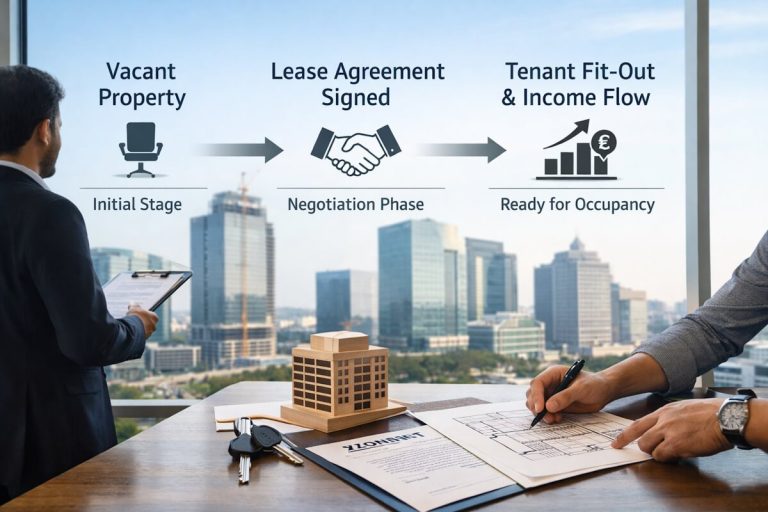
That said, the office-led model usually helps rentals before resale values. If more firms, banks, brokers, insurers, and service providers keep taking space, the first visible impact is usually on leasing demand for nearby homes, serviced residences, and smaller efficient units. Capital growth comes later, after social life becomes stickier and buyers feel the area can function as a real place to live, not just work.
SEZ, IFSC, and Non-SEZ will shape demand in different ways
This is where many buyers feel lost. GIFT City is one place physically, but demand behaves differently across parts of it.
The SEZ and IFSC side is mainly tied to export-oriented financial and related services. That zone benefits from the policy setup that attracted banks, exchanges, insurers, fund managers, aircraft leasing, ship leasing, ancillary services, and more. The non-SEZ or domestic area is where a lot of the broader city life has to grow – residential buildings, domestic offices, retail, support services, schools, and the daily ecosystem that makes people stay after work.
From a buyer’s view, this means commercial demand tied to the IFSC story may stay stronger and clearer than residential demand for some time. Residential demand depends on how quickly the non-SEZ side becomes livable at scale. So when the development plan moves social infrastructure forward, it does more than make the city look complete. It directly reduces hesitation from tenants, end-users, and long-hold investors.
This is why the share of social infrastructure in the master plan matters more than people think. Eleven percent sounds small until you realize that schools, hospitals, food zones, clubs, retail, and open areas often decide whether a working professional rents for six months or stays for five years.
Connectivity upgrades will widen the renter pool
One reason the development plan can lift demand without forcing immediate end-use relocation is transport. Ahmedabad Metro Phase II already connects to GIFT City, and the GNLU to GIFT City section was inaugurated on September 16, 2024. In February 2026, the Union Cabinet also approved a 3.33 km extension from GIFT City to Shahpur with three elevated stations. Better transit changes property demand in two ways. It helps daily commuters reach GIFT City more easily, and it makes living there less isolated for residents who still depend on the wider Ahmedabad-Gandhinagar belt.
For investors, this is not a small point. Improved connectivity can delay the moment when employees must buy within GIFT City, but it also broadens the tenant base. Someone working in GIFT City may rent there for convenience once the ecosystem improves, even if they keep family ties or social life elsewhere in the metro region. That supports rental depth. It does not guarantee fast resale liquidity, but it helps occupancy.
The development plan supports rental demand more clearly than resale demand
If you are buying for rental income, the development plan gives you a more practical thesis than if you are buying only for quick price appreciation. The city’s own material highlights its walk-to-work setup, integrated planning, and growing employment base. Its occupancy portal also shows that building-level occupancy and vacancy are being tracked openly, which is a useful sign for a maturing office-residential market.
Rental demand is likely to build in layers:
single professionals and project staff first, then senior employees wanting shorter commutes, then families once schools, healthcare, and lifestyle convenience feel dependable enough. This is a very different demand curve from a pure investor township where rental demand depends mostly on hope. In GIFT City, there is at least a visible economic spine behind it.
Still, you should not read that as “all residential supply will do well.” Some homes may stay underused if launches get ahead of genuine user demand. A development plan can create direction. It cannot force every project to perform the same way. Project quality, usable layouts, maintenance standards, access to transit, and how fast the surrounding block fills up will still decide which buildings rent better.
Social infrastructure is the real swing factor
Here is the part many buyers miss. The success of the GIFT City development plan, from a housing point of view, will not be judged only by towers and office allotments. It will be judged by whether daily life becomes easier. The official material points to schools, parks, clubs, healthcare, hotels, food zones, and other facilities as part of the integrated model. That is what converts a work district into a housing market.
Think about your own decision. Would you buy a flat in a place where your tenant still needs to leave the district for half of their routine needs? Maybe, if yield is strong enough. Would you live there with family right away? That answer is usually slower. This gap between “good for renting” and “ready for living” is where GIFT City demand may shift most over the next phase of development.
So the plan will shape demand, yes, but through sequencing. Commercial demand first. Rental housing next. Stable family end-use after that. The timing may vary by block and project. That is the honest read.
What this means for NRIs
For NRIs in the United States, United Kingdom, United Arab Emirates, Singapore, Canada, Australia, Germany, France, New Zealand, Malaysia, South Africa, Spain, Thailand, and even smaller Indian-origin communities in places like Fiji, GIFT City can look familiar in one way and unfamiliar in another. Familiar, because the value story is tied to a planned business district with policy support. Unfamiliar, because Indian residential demand still depends heavily on on-ground execution, social ecosystem, and resale depth, not just the headline vision.
So if you are an NRI, the development plan should make you more interested in rental-led or long-hold strategy, not blind capital appreciation assumptions. You should be asking: who is likely to rent this unit, how quickly can the building stabilize, and how dependent is my exit on another investor rather than an end-user? Those questions matter more here than glossy brochures.
Who benefits most from this demand shift
The buyers most likely to benefit from the development plan are those with patience and clarity. That includes long-hold investors targeting professional tenants, end-users working in or around IFSC-linked firms, and buyers who understand that liveability will improve in stages.
The buyers least suited are those expecting instant metro-style resale liquidity, very fast flipping, or broad mass-market residential demand right away. GIFT City is too policy-linked, too zone-sensitive, and still too structured for that kind of easy story. Some people like that. Some do not.
Final take
The GIFT City development plan will shape real estate demand by making employment the anchor, infrastructure the confidence builder, and social facilities the final trigger for deeper housing demand. That is a stronger setup than a typical speculative township. But it is still a staged market. Demand will not rise evenly across every asset type or every tower. Commercial and rental demand have the clearest backing right now. End-use residential demand should grow as the non-SEZ side and social layer fill out more fully.
If you are evaluating GIFT City property, this is the key question: are you buying into a development plan that matches your holding period and your purpose? If your answer is yes, the city can make sense. If you need quick resale, instant family-ready living, or easy comparison with mature metro neighborhoods, you may want to be more selective.
FAQs
1. Will the GIFT City development plan raise residential prices quickly?
Not always. The plan supports long-term demand, but price growth depends on how fast jobs, rentals, social infrastructure, and liveability move together. Commercial traction is clearer than blanket residential price jumps.
2. Is rental demand in GIFT City more reliable than resale demand?
At this stage, yes in many cases. Office growth, operational entities, and transit links support tenant demand more directly than immediate resale liquidity.
3. Why does the SEZ vs Non-SEZ split matter for buyers?
Because demand drivers differ. IFSC and SEZ-led activity support business and office demand, while non-SEZ growth is more tied to daily-life housing, domestic offices, retail, and family living.
4. Will metro connectivity make people buy homes inside GIFT City?
It can help, but first it usually helps commuting and rentals. Buying picks up more strongly when social infrastructure and day-to-day convenience also improve.
5. Who should be careful before investing in GIFT City residential property?
Short-term flippers, buyers needing immediate resale liquidity, and families expecting a fully mature city ecosystem from day one should be careful and project-selective.