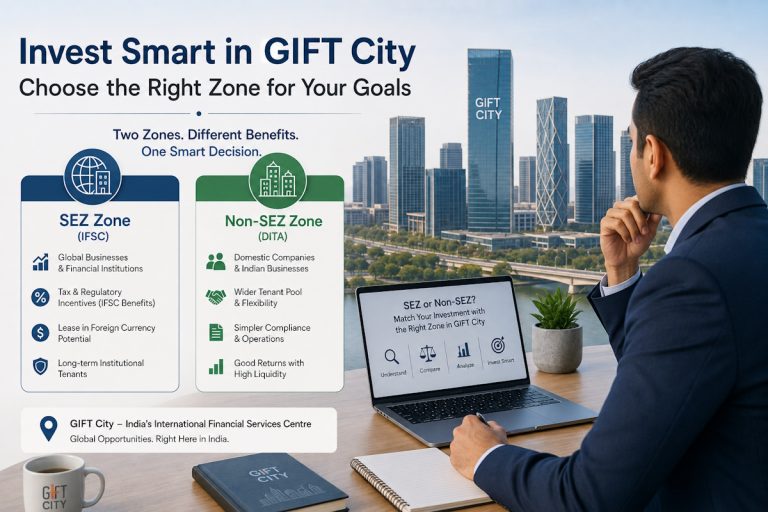

Leasing office space in Gujarat International Finance Tec-City, widely known as GIFT City, is no longer just a real estate transaction. It is a highly strategic, compliance-driven decision that directly impacts your corporate tax liability, operational freedom, and foreign exchange capabilities. As India first operational smart city and international financial hub, GIFT City is bifurcated into two distinct zones: the Domestic Tariff Area, or Domestic Zone, and the Special Economic Zone, which houses the International Financial Services Centre. For institutional buyers, corporate occupiers, and multinational founders, selecting the wrong jurisdiction can result in expensive compliance corrections, operational friction, or missed fiscal incentives.
To make an informed decision, you must look past the premium glass facades and modern infrastructure. You must analyze how your business generates revenue, where your clients are located, and how you intend to route capital. This comprehensive guide outlines the critical operational, tax, and regulatory differences of the gift city domestic zone vs sez framework, equipping you with a practical checklist to run before signing any long-term commercial lease or making a major property investment.
Decoding the Geography: GIFT City Domestic Zone vs SEZ
Understanding the physical and legal geography of GIFT City is the first step toward a successful real estate commitment. While both zones share the same world-class physical infrastructure, district cooling systems, and automated waste management, they operate under completely different legal and regulatory umbrellas. Investors looking at GIFT City commercial real estate must recognize this boundary as a hard regulatory border.
What is the GIFT City Domestic Zone?
The GIFT City Domestic Zone, often referred to as the Domestic Tariff Area, is legally considered a part of the standard domestic Indian market. Businesses operating here are governed by the standard laws of India, including the Ministry of Corporate Affairs, standard Central Goods and Services Tax rules, and ordinary Reserve Bank of India guidelines. It serves as an ideal base for companies that primarily target the vast Indian domestic market but still want to operate from a modern, world-class business district.
What is the Special Economic Zone and IFSC?
The Special Economic Zone in GIFT City is legally treated as a foreign territory for tax and customs purposes. Within this SEZ lies the International Financial Services Centre, which is regulated by a unified body, the International Financial Services Centres Authority. Businesses inside the SEZ operate under a highly liberalized regulatory framework designed to attract global capital, facilitate offshore transactions, and permit seamless multi-currency operations without standard capital control restrictions.
If your enterprise plans to operate in global markets or handle foreign currency transactions, seeking expert commercial advisory is crucial to understanding the physical boundaries and security gates that segregate these two zones within the city limits.
The Core Operational Differences: Who Can Set Up Where?
Your choice between the gift city domestic zone vs sez is dictated primarily by your business activity and target clientele. You cannot simply lease an office in the SEZ because of the tax breaks if your revenue model does not align with SEZ regulations. The development commissioner of the SEZ must approve every unit application, and they require strict adherence to foreign exchange earning rules.
Target Audience and Business Activities for Domestic Zone
The Domestic Zone is designed for companies whose primary customer base is within India. This includes domestic IT service providers, domestic consulting firms, regional corporate headquarters, and domestic financial institutions. Operating here does not require you to prove net foreign exchange earnings, making the onboarding process straightforward and fast. You can hire talent, invoice clients in Indian Rupees, and run your business like any other Indian corporate entity.
Target Audience and Business Activities for SEZ/IFSC
The SEZ and IFSC are reserved for export-oriented units, global in-house centers, offshore banking units, international fund managers, and global fintech startups. To maintain a physical presence here, your business must demonstrate a commitment to export services or conduct international financial services. The regulator expects your business to be a net earner of foreign exchange over a specified block of years.
Cross-Border Service Regulatory Framework
Inside the IFSC, transactions are primarily carried out in foreign currencies such as USD, EUR, or GBP. The regulatory framework allows for frictionless cross-border movements of capital, making it highly attractive for multinational corporations. However, if you lease office spaces in GIFT City within the SEZ, you must maintain separate books of accounts and strictly adhere to the SEZ Act of 2005.
Tax Implications: The Ultimate Compliance Cost Comparison
The financial justification for leasing office space in GIFT City often hinges on the substantial tax benefits available. However, these benefits are unevenly distributed between the Domestic Zone and the SEZ, creating distinct cost structures for corporate occupiers.
Corporate Tax Holidays and MAT Exemptions
Businesses operating within the IFSC SEZ enjoy an extraordinary 100 percent corporate tax holiday for any 10 consecutive years out of a 15-year block. Furthermore, Minimum Alternate Tax or Alternate Minimum Tax is reduced to 9 percent for companies in the IFSC, and it is completely waived for companies opting for the new tax regime. In contrast, businesses in the Domestic Zone pay the standard Indian corporate tax rates, which range from 15 percent to 22 percent plus applicable surcharges depending on the nature and setup date of the company.
Goods and Services Tax and Customs Duty Nuances
Leasing an office in the SEZ provides significant relief from transaction-level taxes. Services provided to SEZ units are considered zero-rated supplies, meaning you do not pay GST on your office rent, utility bills, or procurement of local services. Additionally, there is a complete exemption from customs duties on capital goods imported for your business operations. In the Domestic Zone, you will pay the standard 18 percent GST on commercial leases and office maintenance, though this can generally be claimed as input tax credit if you have domestic output liability.
Repatriation of Profits and Capital Accounts
For multinational corporations, the ease of moving profits back to the parent company is a major decision driver. Inside the IFSC SEZ, liberalized capital account transactions make profit repatriation seamless and free from traditional Indian exchange control bottlenecks. In the Domestic Zone, repatriation remains subject to the standard RBI Foreign Exchange Management Act guidelines, which involve more documentation and compliance steps.
The 5-Minute Compliance Checklist Before Leasing Office Space
Before your legal team signs off on a commercial lease agreement, run through this practical 5-minute checklist to ensure your business operations align perfectly with your chosen real estate zone.
Step 1: Assess Your Primary Revenue Source
Analyze where your billing will occur. If more than 70 percent of your clients are located within India and pay in Indian Rupees, the Domestic Zone is your logical home. If you are billing clients globally in foreign currency, the SEZ/IFSC will unlock massive tax savings and simplify your international transaction processing.
Step 2: Evaluate the Currency of Transactions
Do you need to hold, manage, and transact in foreign currencies without constant conversion back to Indian Rupees? If yes, the IFSC SEZ allows you to maintain foreign currency accounts easily. In the Domestic Zone, you must comply with standard Indian banking regulations, where foreign currency received must be converted to INR within prescribed timelines.
Step 3: Verify Minimum Space and Employment Requirements
SEZ authorities require units to demonstrate actual economic substance. This means you must show a direct correlation between the physical size of your leased office, your projected headcount, and your export turnover. Simply renting a small virtual desk to claim massive tax exemptions is highly discouraged and heavily scrutinized. The Domestic Zone has no such regulatory minimums, offering greater flexibility for lean setups or remote-first operations.
Step 4: Map Your Supply Chain and Vendor Interactions
If you set up in the SEZ, any domestic Indian vendor providing services to your office must go through specific customs and SEZ portal procedures to qualify for GST-free invoicing. For smaller vendors, this administrative burden can sometimes lead to friction. If your business relies heavily on local physical suppliers, ensure your procurement team is prepared to handle SEZ-specific documentation.
Step 5: Confirm Developer Approvals and Lease Terms
Ensure that the commercial tower you are looking at has the appropriate approvals for the specific zone you require. Some developers offer co-working spaces or private offices that are dual-licensed or partitioned into SEZ and non-SEZ areas. You must verify that the specific floor and unit number are officially notified by the government as SEZ or Domestic territory before executing the lease.
Choosing the Right Asset Type: Rental Yields and Real Estate Liquidity
From an investment standpoint, the dynamics of the gift city domestic zone vs sez choice also affect rental yields, occupancy rates, and long-term capital appreciation. Institutional investors must look at these zones through the lens of tenant profiles and asset liquidity.
Domestic Zone Office Spaces: Yields and Capital Growth
The Domestic Zone in GIFT City is experiencing rapid absorption due to the influx of Indian tech companies, domestic banks, and professional service firms. Because the entry barrier is lower, the tenant pool is much larger. This translates to highly stable occupancy rates and steady capital appreciation. Rental yields in the Domestic Zone are competitive, driven by the strong demand from Indian corporates seeking a prestigious address in Gujarat without the compliance overhead of an SEZ unit.
SEZ/IFSC Office Spaces: Tenant Profile and Occupancy Stability
Commercial properties within the SEZ cater to high-credit-profile tenants such as international banks, global tech firms, and large financial entities. These tenants typically sign long-term leases ranging from 5 to 9 years, offering excellent cash flow predictability for property owners. Because these corporations invest heavily in high-end office fit-outs and secure IT infrastructure, they are highly unlikely to vacate early. This makes SEZ commercial assets highly attractive to institutional buyers and HNIs seeking long-term, inflation-hedged yields.
Navigating the Leasing Process Safely
The decision to lease commercial real estate in GIFT City should never be rushed. While the tax incentives are incredibly lucrative, they come with a strict compliance regime that must be managed properly from day one. Choosing between the Domestic Zone and the SEZ is a foundational decision that will shape your business operations, tax liabilities, and growth trajectory for years to come.
By leveraging the expertise of a specialized local advisory, you can easily navigate the licensing requirements, developer negotiations, and zone clearances. Gift City Realty stands ready to guide you through every step of this journey, ensuring your real estate choice aligns perfectly with your corporate compliance needs and long-term financial goals.
Frequently Asked Questions
1. Can a company in the GIFT City Domestic Zone serve international clients?
Yes, companies in the Domestic Zone can serve international clients and receive foreign currency. However, they do not enjoy the 100 percent corporate tax holiday or the simplified foreign exchange rules available to units in the IFSC SEZ. They must also comply with standard Indian foreign exchange repatriation laws.
2. Can a business move from the Domestic Zone to the SEZ later?
A business can physically relocate its office from the Domestic Zone to the SEZ, but this is treated as setting up a new unit. You must apply for a fresh SEZ license, prove your export capabilities to the development commissioner, and sign a new lease in an SEZ-notified building. It is highly recommended to choose the correct zone initially to avoid expensive relocation and compliance costs.
3. Do employees working in the GIFT City SEZ face different personal tax structures?
No, individual employees working inside the GIFT City SEZ or IFSC are subject to the standard personal income tax rates of India. The primary tax benefits, holidays, and exemptions are structured at the corporate entity level, not the individual level.
4. Is it possible for a developer to convert an SEZ office space into a Domestic space?
A developer can only convert or de-notify an SEZ space to a Domestic space after obtaining formal approval from the Ministry of Commerce and Industry. This is a complex regulatory process. As a tenant, you should only lease space that is already officially notified for your desired usage to avoid operational delays.