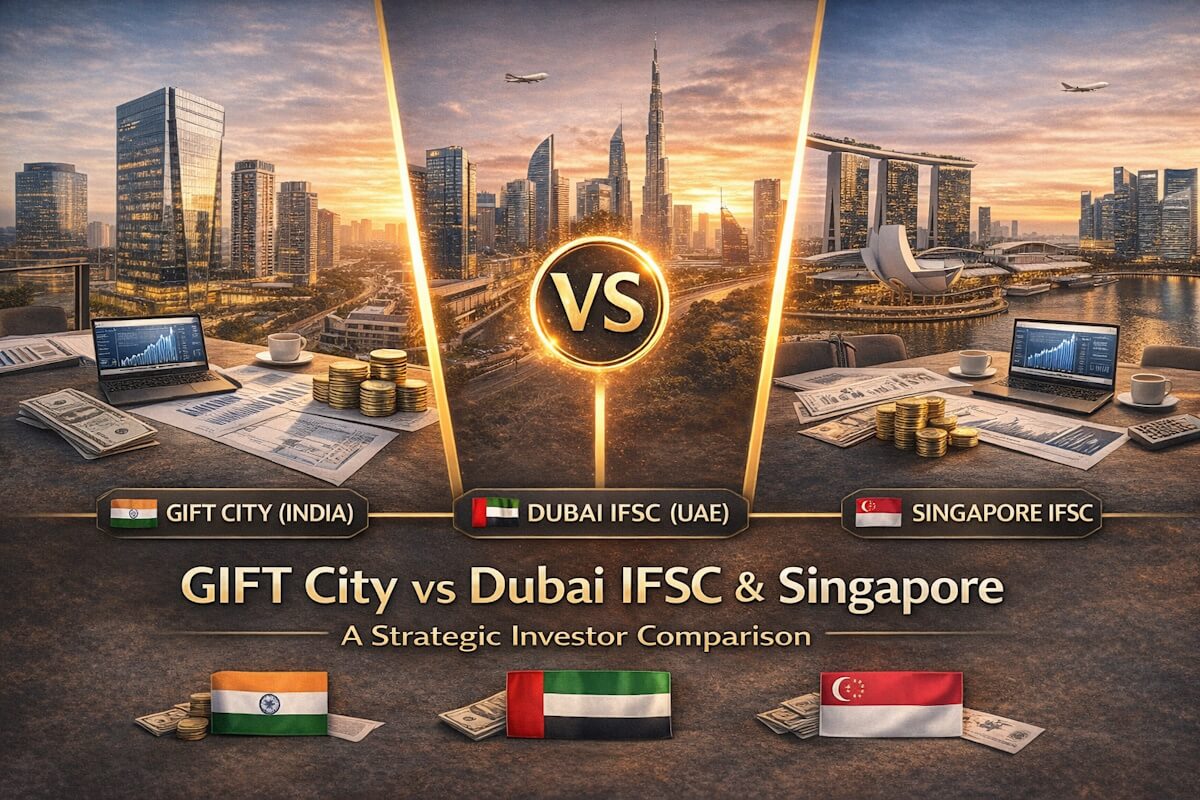
GIFT City vs Dubai IFSC & Singapore: A Strategic Investor Comparison
For high-net-worth investors (HNIs), NRIs, and institutional buyers focused on high-growth financial hubs, the landscape has traditionally been dominated by established International Financial Service Centres (IFSCs) like Dubai (DIFC) and Singapore. These centers offer regulatory clarity, tax efficiency, and deep market liquidity. However, the emergence of GIFT City, India’s first operational IFSC, necessitates a fundamental re-evaluation of capital allocation strategies.
The strategic choice is no longer simply “where is the best financial hub,” but “where is the highest potential for growth, complemented by strong regulatory backing and geopolitical tailwinds?” Comparing GIFT City vs Dubai IFSC and Singapore is crucial because each offers a distinct risk/reward profile. Dubai and Singapore provide stability and maturity, while GIFT City offers ground-floor access to India’s massive economic expansion, underpinned by unprecedented fiscal incentives designed specifically to attract global capital.
The Core Investment Proposition: Regulatory and Tax Arbitrage
The primary reason capital flows into IFSCs is tax efficiency and regulatory ease. An investor must analyze whether the tax savings outweigh the potential market risks associated with a newer or less established jurisdiction. The most compelling differentiator for GIFT City is its proximity to and integration with the fast-growing Indian economy, coupled with a regime that explicitly addresses historical pain points like capital gains taxation and compliance burdens for foreign investors.
Tax Efficiency: India vs. UAE vs. Singapore
When comparing GIFT City vs Dubai IFSC and Singapore, tax structures reveal divergent priorities. Dubai (DIFC) long benefited from a 0% corporate tax environment, though this is shifting with the introduction of a new corporate tax regime in the UAE. Singapore maintains a competitive corporate tax rate (currently 17%) with numerous exemptions.
GIFT City’s advantage lies in its targeted exemptions. Businesses operating within the GIFT City SEZ/IFSC are granted a 100% tax exemption on profits for 10 consecutive years (out of 15 years). More critically for real estate investors, there are significant exemptions on dividend distribution tax, long-term capital gains tax, and interest payments on external commercial borrowings (ECBs). This comprehensive shield makes the effective tax rate highly appealing, especially for NRIs seeking to re-route their global income through a compliant Indian jurisdiction.
- Corporate Tax: GIFT City offers a 10-year holiday, positioning it aggressively against the changing tax landscape in other global IFSC comparison hubs.
- Capital Gains: Investors in GIFT City real estate linked to IFSC operations may benefit from reduced or eliminated long-term capital gains tax, depending on specific investment structures and asset holding periods, a major advantage over traditional Indian jurisdictions.
Regulatory Certainty and Ease of Doing Business
Dubai and Singapore are celebrated for their common law legal frameworks, which offer strong investor protection and dispute resolution mechanisms. However, GIFT City is governed by the International Financial Services Centres Authority (IFSCA), a unified regulator that streamlines approvals and compliance. This single-window system dramatically reduces bureaucratic friction, a common deterrent in the broader Indian market.
For investors considering commercial real estate acquisition, knowing that the regulatory environment is designed to attract, rather than deter, financial institutions is key. The ease of setting up financial entities and the speed of licensing are often faster under the IFSCA than navigating the multiple governmental layers in other regions. This specific regulatory edge is what makes Get expert insights on GIFT City real estate advisory essential before deployment of large capital.
Ready to map your tax strategy against GIFT City’s benefits? Schedule an Investment Consultation today.
Real Estate Investment Analysis: Yield, Appreciation, and Risk
Real estate investment in financial centers is driven by two factors: the sustained demand from financial institutions (commercial yields) and the influx of talent (residential appreciation). The real estate profile of GIFT City vs Singapore IFSC and Dubai IFSC is inherently different due to market maturity.
Dubai’s DIFC is a mature market, offering stable, yet often compressed, yields. Singapore’s properties are globally expensive and highly regulated. GIFT City, being in an accelerated development phase, presents higher growth potential but also requires careful due diligence regarding the speed of occupational uptake.
Commercial Space Demand and Rental Yields
Commercial viability hinges on the velocity of business migration. The Indian government is actively incentivizing large domestic and international banks, insurance companies, and fintech firms to establish a presence. This creates captive demand for high-grade commercial space. When conducting a GIFT City vs Dubai IFSC assessment on commercial property, investors should focus on pre-committed leases and the profile of tenants.
Current rental yields in prime GIFT City commercial towers are competitive, often exceeding those in major Indian metros, primarily due to the specialized nature of the infrastructure and the premium attached to the SEZ status. The key risk to mitigate is oversupply; therefore, property selection (developer reputation and asset class within the SEZ/Non-SEZ area) is critical for long-term sustainable returns. Understanding the specific regulatory compliance necessary for tenancy in these commercial spaces requires expert advisory. Get expert insights on GIFT City real estate from specialized consultants.
Residential Opportunity and Capital Appreciation
Residential appreciation in IFSCs is a function of high-income professional migration. Unlike Dubai, which primarily relies on expatriate workers, GIFT City aims to attract both global talent and NRIs seeking to return to India. The residential component is crucial, situated within the unified planning zone that links the work environment to lifestyle amenities.
Residential prices in GIFT City are currently well below comparable prime residential areas in Singapore or even Mumbai, suggesting significant headroom for capital appreciation as employment figures scale. Investment in residential property here is often seen as a bet on the long-term success of the “Return to India” narrative and the domestic consolidation of financial services. Given the dynamic nature of the market, investors must look beyond immediate yields and prioritize projects with clear construction and possession timelines. We advise clients to Get expert insights on GIFT City real estate regarding developer viability and delivery track record.
Explore the current inventory of high-yield commercial and residential properties in GIFT City. Request Property Details now.
Liquidity, Exit Strategy, and Market Depth
An investment’s quality is often determined by the ease and profitability of the exit. This is where the maturity difference between the hubs becomes most apparent. Dubai and Singapore offer high liquidity due to established international buyer bases and long track records of transactions.
GIFT City is building this liquidity. However, the domestic demand base, driven by Indian institutions and wealthy NRIs, provides a powerful underlying floor. As more IFSC entities become operational, the asset base becomes increasingly valuable. The crucial element of risk mitigation is diversification; institutional buyers often find it strategic to acquire commercial assets linked to anchor tenants who are less susceptible to short-term market volatility.
Market Depth and Economic Gravity
When assessing a global IFSC comparison, the market depth of the underlying economy is paramount. Dubai and Singapore function as global transit and services hubs, relying heavily on international trade flows. GIFT City’s strength lies in its tether to the massive, rapidly digitizing Indian domestic economy. This offers a degree of insulation from global recessions that non-domestic-market-focused centers might lack. The long-term valuation of GIFT City property is inherently linked to India’s trajectory toward becoming a $5 trillion economy. This economic gravity provides a powerful investment justification.
Currency and Capital Control Risks
Investment in Singapore or Dubai typically involves stable currencies (SGD, AED often linked to USD). Investing in GIFT City, while denominated in foreign currency (USD) for IFSC transactions, still exposes investors to the volatility of the Indian Rupee for local transactions and eventual capital repatriation unless specific structures are employed. However, the IFSC framework permits the settlement of transactions in foreign currency and offers simplified repatriation rules, mitigating some historical concerns investors had with mainland India investments. Careful structuring is vital here, and clients should Get expert insights on GIFT City real estate regulatory compliance before finalizing fund structures.
Evaluating Total Cost of Ownership (TCO)
Beyond the sticker price, investors must consider the total operating costs. Singapore is known for high operating expenditures (OPEX) due to labor and infrastructure costs. Dubai offers more moderate OPEX. GIFT City currently benefits from significantly lower operational costs compared to both, largely due to competitive local wages and government subsidies on utility consumption within the SEZ.
This TCO analysis feeds directly into commercial property viability. Lower OPEX for tenants translates to lower default risk and higher long-term demand for the physical infrastructure, supporting sustained rental yields. This competitive advantage is a key factor shifting the balance in favor of GIFT City in the ongoing GIFT City vs Dubai IFSC discussion for multinational corporations.
Entry Barriers and Transaction Costs
Transaction costs, including stamp duty and registration fees, can significantly erode initial ROI. While India traditionally had higher costs, transactions within the GIFT City SEZ benefit from various waivers and streamlined processes, making the barrier to entry lower than in comparable prime zones in Singapore or major metros in India. Utilizing the expertise of firms like Gift City Realty ensures that all compliance requirements are met efficiently, minimizing unforeseen transaction costs and delays.
The Institutional Confidence Factor
Institutional investment signals long-term viability. The fact that major global and domestic financial entities—including large insurance, banking, and aircraft leasing firms—have committed capital and operations to GIFT City speaks volumes. This high level of institutional confidence strengthens the foundation for real estate valuation and supports the long-term appreciation narrative. This is perhaps the strongest qualitative factor distinguishing GIFT City today. Investors should always verify the roster of tenants and operational entities before making a decision. Get expert insights on GIFT City real estate tenant profiles.
Ready to capitalize on India’s financial growth engine? Explore GIFT City Projects tailored for institutional investors.
The Strategic Positioning in the Global Financial Ecosystem
For investors, choosing an IFSC is a matter of predicting future global economic alignment. Dubai will remain the gateway to the Middle East and Africa. Singapore is the established anchor for Southeast Asia. GIFT City is strategically positioned as the gateway to India and a major hub for South Asia and the sub-continent’s immense capital requirements.
The decision to invest in GIFT City real estate is fundamentally a decision to leverage India’s systemic growth while benefiting from an internationally competitive regulatory framework. While Dubai offers maturity and Singapore offers stability, GIFT City offers the highest potential for cyclical growth in property valuation and strong tax-advantaged rental yields, making it increasingly essential for any diversified global portfolio. When examining the GIFT City vs Dubai IFSC proposition, the choice often boils down to balancing present stability with future explosive growth potential.
We work closely with clients to perform detailed cash flow modeling, comparing expected returns from each region based on regulatory stability and macro-economic projections. This strategic, consultative approach ensures that your capital is deployed where the regulatory incentives and market growth intersect most profitably. Get expert insights on GIFT City real estate tailored to your specific investment profile.
Don’t navigate complex global regulatory waters alone. Speak with a GIFT City Expert today to secure your investment advantage.
Frequently Asked Questions (FAQ) for Global Investors
How does the IFSC framework in GIFT City specifically benefit NRI real estate investors?
NRI investors benefit from streamlined capital repatriation rules and preferential tax treatments, including potential exemptions on certain capital gains, interest, and dividends related to investments structured through IFSC entities. The regulatory framework is designed to overcome friction points historically associated with investing in mainland India.
Is the regulatory environment in GIFT City as stable as Dubai’s DIFC or Singapore?
The regulatory environment, governed by the unified IFSCA, is robust and globally aligned. While Dubai and Singapore have longer track records, the IFSCA model provides high certainty through consistent policymaking aimed exclusively at financial services, minimizing legislative risks often seen in broader national markets. This commitment to stability is central to its competitive advantage in any international financial centers comparison.
What is the primary risk associated with investing in GIFT City real estate compared to a mature market?
The primary risk is market maturity and time-to-liquidity. As a developing financial center, GIFT City’s real estate assets, while appreciating rapidly, may take longer to transact compared to highly liquid, globally established hubs like Singapore or Dubai. Strategic property selection and developer due diligence are essential risk mitigation tools. We encourage investors to Get expert insights on GIFT City real estate project risk assessments.
Are real estate transactions in GIFT City conducted in Indian Rupees or foreign currency?
While the underlying real estate asset is in India, transactions involving IFSC entities (like leasing commercial space) can often be denominated and settled in foreign currency, typically USD, providing a hedging mechanism and aligning with global financial practice. Residential transactions usually occur in INR but still benefit from the overall IFSC tax advantages and simplified repatriation for NRIs.
How does the overall cost of living and operations influence investment demand in GIFT City vs Singapore IFSC?
GIFT City offers a significantly lower cost of living and operational expenses compared to the high costs associated with Singapore, making it highly attractive for companies looking to relocate or consolidate back-office and middle-office functions. This lower TCO fuels sustained demand for high-quality commercial real estate in GIFT City.