The Strategic Evolution of GIFT City into a Global Education Hub
For several years, the narrative surrounding GIFT City was dominated by its rise as a premier International Financial Services Centre (IFSC). Investors focused almost exclusively on the massive influx of banking, fintech, and insurance giants. However, a significant pivot is occurring as the government opens the doors to international academia. This transition from a purely financial hub to a diversified knowledge ecosystem is creating a new and highly specialized vertical within the real estate market: education-centric residential and commercial spaces.
As an investor, understanding this shift is crucial. We are no longer looking at GIFT City as just a place for corporate offices. With the establishment of the Education Zone, the demand for high-quality housing has expanded beyond the local workforce to include international faculty and a global student body. Investing in foreign university campus GIFT City real estate represents a first-mover advantage in a sector that traditionally offers higher rental stability and consistent capital appreciation compared to generic residential assets.
Beyond Finance: Why Education Drives Real Estate Value
Education hubs historically act as anchors for regional development. Unlike corporate offices where headcount can fluctuate based on market cycles, educational institutions provide a permanent and predictable influx of residents. When a foreign university establishes a campus, they bring with them a long-term commitment that stabilizes the local property market. This stability is exactly what sophisticated investors seek when looking for defensive assets within a growth-oriented portfolio.
The Significance of the IFSC Education Framework
The regulatory environment in GIFT City is unique. The ability for foreign universities to set up standalone campuses without the typical bureaucratic hurdles found elsewhere in India has accelerated the entry of top-tier global names. For an investor, this means the quality of the “tenant” (the university ecosystem) is guaranteed to be of an international standard, which directly correlates to the quality and price point of the real estate required to support it.
The Catalyst: Deakin and Wollongong University GIFT City
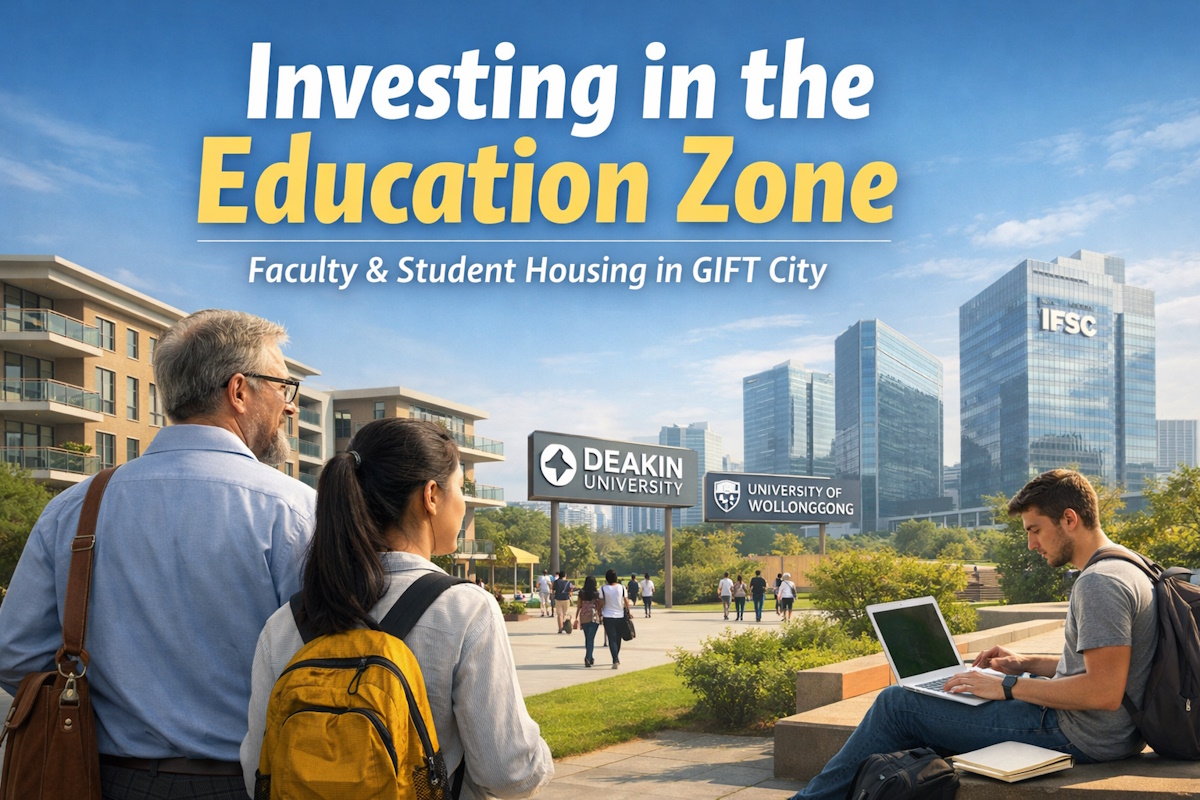
The entry of Deakin University and the presence of Wollongong University GIFT City have served as the ultimate proof of concept. These are not merely satellite offices but functional campuses requiring a comprehensive support system. Their presence has immediately triggered a need for localized housing solutions that didn’t exist three years ago, specifically targeting a demographic that values proximity, high-speed connectivity, and modern amenities.
Decoding Faculty Housing Demand: A Premium Investment Opportunity
One of the most overlooked segments in the current GIFT City boom is faculty housing. When international universities relocate their academic staff to Gujarat, they are not just looking for apartments; they are looking for “executive-grade” living experiences. This demographic consists of high-net-worth individuals and expatriates who have specific expectations regarding security, privacy, and lifestyle integration.
The faculty housing demand in GIFT City is currently underserved. Most residential projects have been designed with the general professional in mind, but the specific requirements of global academics—such as study areas, high-end finishing, and community-centric designs—offer a premium niche for investors. Targeting this segment often allows for higher rental premiums because institutions or senior faculty members are willing to pay for convenience and quality that mirrors international standards.
Understanding the Expat Educator Demographic
Expatriate faculty members typically move on long-term contracts. This reduces the risk of vacancy and minimizes the high costs associated with tenant turnover. From an investment perspective, this translates into a higher net operating income (NOI). These tenants prioritize walking distance to the foreign university campus GIFT City real estate, making properties within a 1-2 kilometer radius of the Education Zone highly prized assets.
Amenity-Led Appreciation for Academic Residents
Investors should look for projects that offer more than just four walls. For the faculty segment, quiet environments, proximity to green spaces, and high-quality property management are non-negotiable. Real estate that caters to these needs will see faster appreciation as the “hub” effect takes hold and more universities join the ecosystem, increasing the pool of high-quality potential tenants.
Schedule an Investment Consultation
The Economics of Education Hub Property Investment
When we analyze education hub property investment, we must look at the unique yield dynamics that differ from standard residential real estate. Student and faculty housing often operate on a “per-bed” or “per-unit” basis that can outpace the rental yields of traditional family apartments. In the context of GIFT City, where land is premium and the workforce is growing, the densification of the Education Zone creates a pressure cooker for rental prices.
Investment in this sector is not just about monthly rent; it is about the long-term utility of the asset. As the student population grows, the demand for studios and 1-BHK units will skyrocket. These smaller units typically offer the best ROI for investors because they are easier to rent, have lower entry price points, and serve the core demographic of the Education Zone.
Rental Yield Projections in the Education Zone
Early data suggests that residential units near the education corridor in GIFT City could command a premium of 15-20% over units in the outer peripheries. The synergy between the corporate IFSC and the academic zone creates a “live-work-learn” environment that is highly resilient to market volatility. Investors can expect a dual benefit of high occupancy rates and steady year-on-year rental escalations.
Comparing Student Housing vs. General Residential Yields
While general residential property in Gujarat might offer yields in the 3-4% range, specialized foreign university campus GIFT City real estate products—particularly those tailored for students or junior faculty—are projected to hit 5-6% as the campuses reach full capacity. This gap represents the “education premium” that savvy investors are currently chasing.
Identifying High-Value Assets Near Foreign University Campuses
Not all property in GIFT City will benefit equally from the education boom. Strategic selection is required to ensure that your investment aligns with where the demand will be most acute. The layout of GIFT City is highly planned, meaning that certain parcels are designated for specific uses. Investors must look at the Master Plan to identify which residential blocks have the best accessibility to the primary academic sites.
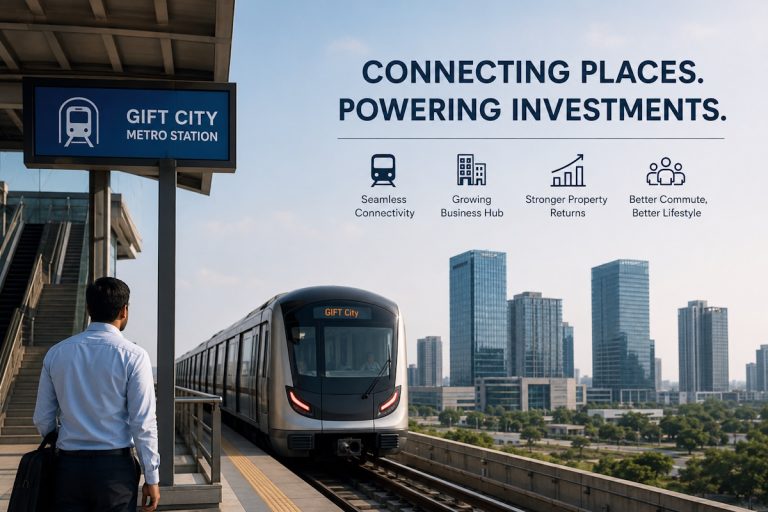
Proximity is the single most important factor. In an education hub, “near” means within walking or cycling distance. The pedestrian-friendly infrastructure of GIFT City makes this even more critical. Properties that sit on the transit corridors connecting the residential zones to the foreign university campus GIFT City real estate will naturally see the highest liquidity and demand.
Evaluating Developer Track Records in Special Economic Zones
Investing in a project within an IFSC or SEZ requires a developer who understands the nuances of the regulatory framework. For education hub property investment, you want to partner with developers who have a history of delivering high-specification units on time. Delays in construction can be particularly costly in this sector, as academic cycles are fixed; missing a semester start date can result in a vacant unit for six months or more.
The Importance of Integrated Property Management
For absentee investors, NRIs, or HNIs, the management of the property is as important as the purchase. Managing a student or faculty rental requires a different approach than a standard lease. Look for projects that offer integrated facility management or “lease-back” models specifically designed for the education sector. This ensures that the asset is maintained to the standards required by international tenants.
Risk Mitigation and Strategic Timing for Investors
While the prospects for foreign university campus GIFT City real estate are strong, every investment comes with risks. The primary risk in an emerging hub is the timing of infrastructure completion versus campus operationalization. If residential supply leads the student influx too aggressively, there may be a temporary period of lower occupancy. Conversely, waiting too long means missing the lowest entry prices and the highest potential for capital gains.
To mitigate these risks, investors should focus on “multi-purpose” assets—units that are attractive to both the education sector and the corporate workforce. A well-designed 1-BHK or studio near the Wollongong University GIFT City site is equally attractive to a young fintech professional as it is to a PhD student. This dual-demand profile provides a safety net for your investment.
Tax Benefits and Regulatory Advantages for Investors
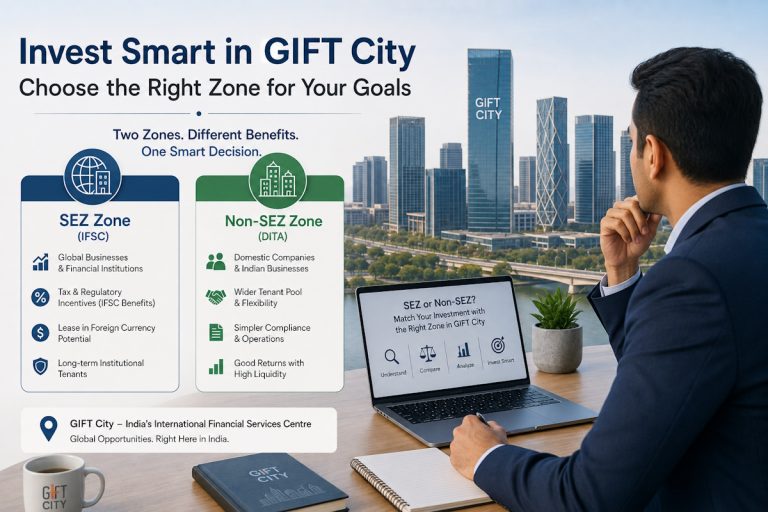
Investing in GIFT City real estate comes with unique fiscal advantages, particularly for NRIs and foreign entities. The absence of certain local taxes and the streamlined repatriation of funds (where applicable within IFSC rules) make it a highly efficient environment for capital. Understanding how these tax benefits impact your net ROI is essential for a complete investment evaluation.
Long-Term Liquidity and Exit Strategies
The beauty of an education-anchored asset is its liquidity. Institutional investors frequently look to acquire entire blocks of student or faculty housing once they are stabilized and yielding. This provides a clear exit path for individual investors who may want to sell their units to a larger fund or REIT in the future, often at a significant premium due to the proven track record of the property.
Making the Decision: Is the Education Zone Right for Your Portfolio?
The decision to invest in foreign university campus GIFT City real estate should be driven by a desire for a specialized, high-yield asset within a globally recognized financial center. While the commercial towers often grab the headlines, the residential support for the education sector is where the “sticky” value lies. This is a play on the long-term human capital of India and the internationalization of its workforce.
As Deakin and Wollongong begin their operations, the window for “early-stage” pricing is rapidly closing. Investors who move now are not just buying real estate; they are buying into the infrastructure of global knowledge exchange. Ensure your investment strategy accounts for the specific needs of the faculty housing demand and the lifestyle requirements of a modern student population to maximize your returns in this thriving ecosystem.
FAQs
1. How does the rental yield of student housing in GIFT City compare to traditional residential units?
Student housing and faculty units in the Education Zone are projected to offer yields between 5-7%, which is significantly higher than the 2-4% typically seen in standard residential markets across Gujarat. This is due to the high density of demand and the premium placed on proximity to the campuses.
2. Are there specific regulations for NRIs investing in GIFT City real estate?
Yes, GIFT City offers a streamlined process for NRIs, often with benefits related to the repatriation of rental income and capital gains. However, it is essential to consult with a specialist like Gift City Realty to ensure compliance with the latest IFSC and FEMA guidelines.
3. What makes faculty housing a “premium” investment compared to student housing?
Faculty housing targets a higher-income demographic of international academics who require larger units, better amenities, and longer lease terms. This usually results in lower tenant turnover and higher absolute rental figures, making it a more “passive” and stable investment for many HNIs.
4. Which foreign universities are currently operating or setting up in GIFT City?
Deakin University and the University of Wollongong are the pioneers in the Education Zone. Several other top-tier international institutions are currently in various stages of approval, which will further drive the education hub property investment market.
5. Should I focus on commercial or residential real estate near the Education Zone?
While both have merits, residential real estate—specifically studios and 1-2 BHK units—currently faces a more acute supply-demand gap. As the student and faculty population grows, the immediate need is for high-quality living spaces, making residential the preferred choice for those seeking immediate rental income.