Navigating the Next Phase: Understanding the GIFT City Future Development Timeline
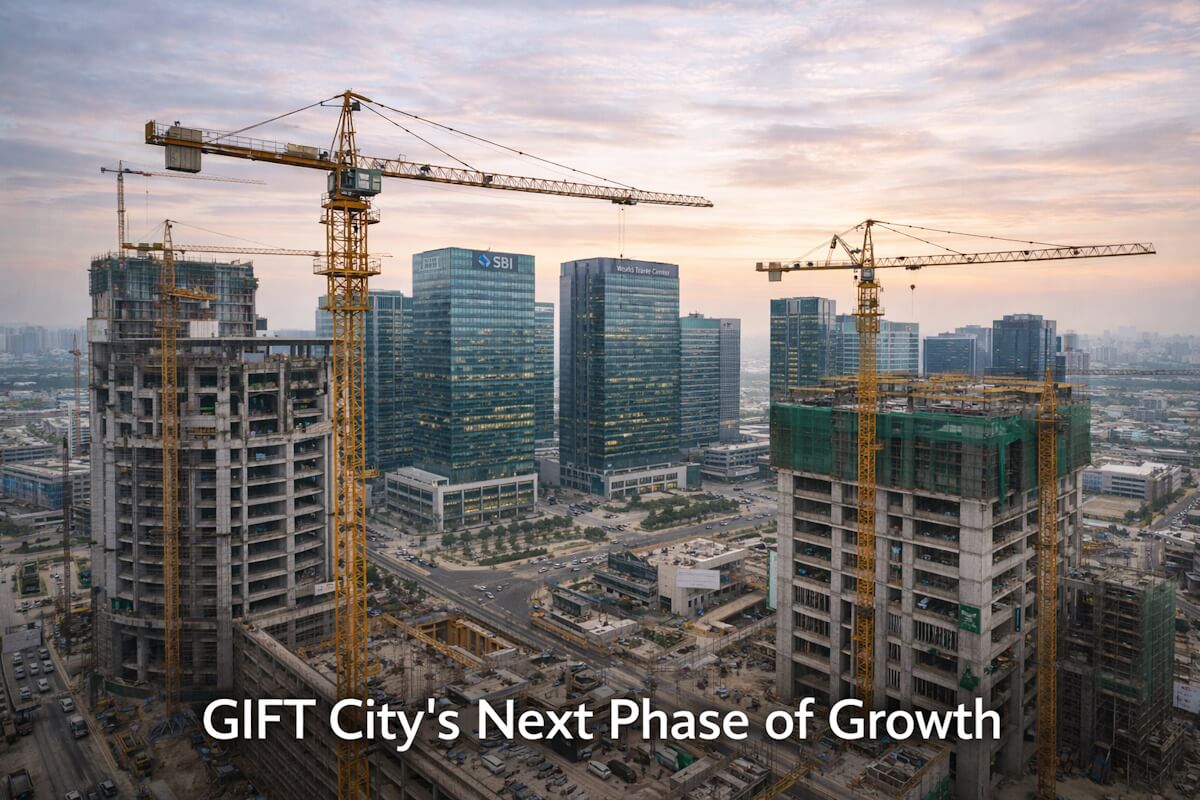
For serious real estate investors, timing is paramount. The difference between an opportunistic purchase and a marginal investment often hinges on anticipating structural changes—both regulatory and physical—that unlock long-term value. GIFT City, India’s flagship International Financial Services Centre (IFSC), is currently moving past its foundational phase and entering a rapid expansion cycle.
This transition mandates a careful review of impending changes. Over the next five years, the viability and appreciation curve of any commercial or residential property in GIFT City will be determined less by present amenities and more by confirmed GIFT City infrastructure projects and anticipated GIFT City policy updates. Our focus here is to provide a predictive framework: what critical factors will define the GIFT City future development, and how should investors position their capital now to capitalize on these shifts?
Infrastructure Expansion: The Physical Drivers of Real Estate Demand
Infrastructure is the bedrock of real estate valuation. In a planned urban environment like GIFT City, infrastructural completeness directly correlates with occupancy rates, rental yield stability, and the confidence of major institutional tenants. The next five years involve aggressive scaling beyond the core financial district.
Connectivity and Access Upgrades: Lowering the Friction Cost
The success of an SEZ/IFSC complex relies heavily on the efficient movement of capital and people. For GIFT City, this means enhancing transit links to Ahmedabad, Gandhinagar, and international logistics hubs.
Metro Rail Integration and Impact on Residential Viability
The planned Metro link is arguably the single most important infrastructural catalyst for the residential market. Currently, travel relies heavily on road networks. Once integrated, the Metro drastically cuts commute times, transforming GIFT City residential areas from specialized employee housing into viable, accessible homes for high-income professionals based in the wider Ahmedabad-Gandhinagar corridor. Investors must look closely at projects positioned strategically close to planned Metro stations, as these will command premium rental yields due to reduced vacancy risk.
External Road Network Enhancements
Upgrades to national highways connecting GIFT City to major ports (Mundra, Kandla) and airports are crucial for non-financial SEZ businesses, such as IT/ITES companies setting up back-office operations. These improvements validate the “Gujarat Gateway” thesis and underpin the long-term feasibility of commercial investments in the non-IFSC SEZ area.
Urban Density and Social Infrastructure Projects
Investors often overlook social infrastructure, yet it is a primary driver of long-term tenant stability. A thriving city requires more than just office towers.
- Retail and F&B Footprint: The expansion of integrated retail spaces within Phase II and Phase III is critical for creating a ‘live-work-play’ environment. This density boosts daytime traffic, supporting commercial ground-floor retail and driving up the value of surrounding residential units.
- Education and Healthcare: Confirmed plans for international schools and tertiary healthcare facilities will solidify GIFT City as a permanent residency choice, especially for global talent and expatriates drawn by IFSC job opportunities. This ensures enduring demand for premium residential properties.
Evaluating physical GIFT City infrastructure projects requires checking developer agreements and government commitments. Don’t invest purely on architectural renderings; invest based on the confirmed pipeline of enabling infrastructure that directly supports tenant demand.
Download the GIFT City investor guide to access our proprietary analysis of current infrastructure delivery timelines and their impact on specific project completion dates.
Policy Deepening: Anticipating Regulatory Tailwinds
In GIFT City, policy is often more powerful than concrete. The ongoing refinement of the IFSC regulatory framework is essential for attracting global finance and sustaining high occupancy rates in Grade A commercial spaces. The GIFT City future development relies heavily on continued policy stability and expansion.
Tax Regime Stability and Global Compliance
A primary draw for capital is the favorable tax structure. While current benefits are robust, investors must monitor regulatory signals regarding stability and potential harmonization with global standards.
Corporate Tax Certainty for IFSC Entities
The continued certainty regarding corporate tax holidays (currently 100% tax exemption for 10 years on IFSC income) is non-negotiable for anchor tenants. Any GIFT City policy updates that solidify this framework for the medium term will instantly de-risk commercial investment and secure long-term leases from major institutions. This certainty translates directly into higher commercial property valuations.
GIFT City Future Development in International Finance
Look for policies supporting cross-border derivatives, fund management, and global treasury operations. As India pushes for greater capital account convertibility, IFSC policies relating to derivative trading, custodian services, and banking operations will expand. Every regulatory expansion that draws a new class of financial institution is a new driver for leasing commercial space.
Request Property Details: Explore commercial towers in Phase II designed specifically to comply with the expanding regulatory landscape for global banks and financial institutions.
Residential Policy Focus and HNI Appeal
While the focus is often commercial, policy changes also affect the residential market, particularly for NRIs and HNIs.
Residential Ownership and Repatriation Clarity
Clarity on property ownership, especially for NRIs investing through the LRS route or other foreign entities, remains vital. Favorable GIFT City policy updates simplifying property management, rental repatriation, and eventual divestment processes ensure that the residential market remains attractive to global, high-net-worth investors looking for passive income and capital appreciation in Gujarat.
Demand Projections: The Core of the Future of GIFT City
The planned infrastructure and policy framework are designed to support a projected surge in tenant demand. Understanding which sectors are set to grow fastest is key to selecting the right property type (commercial vs. residential, SEZ vs. Non-SEZ).
The Fintech and Technology Ecosystem
The future of GIFT City is inextricably linked to the growth of financial technology. We anticipate major investment from global fintech companies drawn by sandbox environments, favorable taxation, and access to a talented workforce.
The shift from traditional banking to digital finance means that demand for specialized IT, data center, and back-office operations will escalate. This requires investment in properties that offer high connectivity, redundant power, and scalable office setups, often located in the Non-SEZ or DTA (Domestic Tariff Area) sections of the city to serve both international and domestic markets.
Insurance, Reinsurance, and Alternate Investment Funds (AIFs)
GIFT City is rapidly becoming a significant hub for insurance and reinsurance activities, capitalizing on regulatory liberalization. Similarly, the fund management sector, particularly AIFs and global fund houses setting up brass plate offices, is expanding exponentially.
This institutional influx dictates demand for premium Grade A office space and increases the pool of high-salaried professionals requiring luxury residential units. The growth in this sector is a robust indicator of the long-term stability of commercial leasing rates.
The pace of institutional commitment confirms the market’s positive outlook on the GIFT City future development. Savvy investors analyze tenant profiles, not just square footage, to project the sustainability of rental income.
Schedule an Investment Consultation: Speak with a Gift City Realty expert to analyze how projected sectoral demand affects the ROI projections of specific upcoming projects.
Evaluating Risk: What Could Slow GIFT City’s Trajectory?
A balanced investment thesis must account for potential risks. While the trajectory for GIFT City is strong, investors must mitigate exposure to common development hurdles.
Managing Supply-Demand Dynamics
The biggest immediate concern is managing the influx of supply. As multiple developers launch large commercial and residential towers simultaneously in the coming 3-5 years, there is a short-term risk of oversupply relative to current demand. This is a crucial factor to monitor in the GIFT City future development.
- Investor Strategy: Focus on differentiated projects. Commercial properties with unique compliance or technical specifications (e.g., Tier IV data center readiness) will command premium tenants. Residential properties offering superior amenities and proximity to the planned Metro will stand out from generic housing stock.
It is important to remember that demand in GIFT City typically arrives in large institutional waves, which can absorb significant supply quickly. The key is monitoring pre-commitment rates from major anchor tenants, which Gift City Realty tracks rigorously.
Timelines and Project Dependencies
Infrastructure development—particularly the major GIFT City infrastructure projects like Metro or large external road linkages—can face delays. A residential property investment made today relies on those planned systems being operational in 36 months to achieve target rental yields.
- Investor Strategy: Choose developers with proven track records of adhering to timelines within the GIFT City SEZ/IFSC environment, minimizing the risk associated with construction delays and delayed infrastructure commissioning.
By diligently tracking confirmed policy rollouts and evaluating the maturity of GIFT City policy updates, investors can significantly reduce the regulatory uncertainty typically associated with emerging financial hubs. Download the GIFT City investor guide for a deep dive into developer credibility and risk mitigation strategies.
Capitalizing on Anticipated Growth: A Decision Framework
The next five years represent the optimal window for maximizing capital appreciation in GIFT City. The period is defined by transition: the city moves from being a government-supported initiative to a self-sustaining international financial gateway.
Investors must align their investment horizon with the infrastructural and regulatory pipeline. Short-term investors may focus on ready-to-move commercial properties benefiting immediately from current IFSC policy perks, while long-term investors should position capital in prime residential areas that will benefit most directly from the completion of the Metro link and expanded social infrastructure.
The overarching advisory remains clear: the success of your investment hinges on understanding the momentum of the GIFT City future development. Regulatory certainty, combined with rapid physical expansion, validates the argument that GIFT City is not just a high-growth asset class in Gujarat, but a strategically important investment in India’s emerging global financial landscape. Act now to secure prime inventory before the projected exponential increase in institutional and resident demand significantly raises entry barriers.
Explore GIFT City Projects: Request a customized portfolio review based on your specific risk profile and alignment with upcoming infrastructure timelines.
Frequently Asked Questions (FAQs)
What are the most impactful GIFT City infrastructure projects for residential ROI?
The Metro rail connectivity is the single most impactful project for residential ROI. It significantly enhances accessibility, making residential units desirable for professionals across Gandhinagar and Ahmedabad, dramatically reducing vacancy rates and driving rental premiums.
How will GIFT City policy updates affect commercial property values?
Policy updates that deepen the scope of the IFSC (e.g., new guidelines for fund management, derivatives, or global banking) increase the pool of potential large tenants. This institutional demand strengthens commercial leasing fundamentals, leading directly to higher commercial property values and stable yields.
Is the future of GIFT City focused solely on finance?
While finance is the core, the GIFT City future development also includes significant growth in allied sectors like FinTech, IT/ITES, data centers, and back-office operations, particularly within the SEZ and DTA areas. This diversification provides a robust tenant base for both specialized commercial spaces and general office requirements.
What should investors prioritize when evaluating projects based on the GIFT City future development timeline?
Prioritize projects that are either already complete (capturing current benefits) or those scheduled for completion concurrently with major enabling infrastructure (like the Metro or key Phase II development zones). Due diligence on the developer’s completion history is essential.