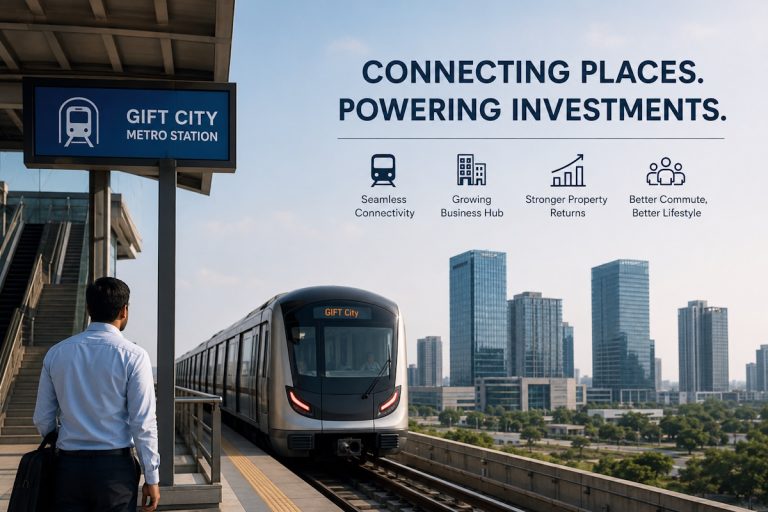

When the Global Financial Centres Index elevated Gujarat International Finance Tec-City to the 37th position globally, it signaled far more than a vanity metric for policymakers. For private wealth managers, family offices, and institutional property buyers, the updated GIFT City global ranking confirmed an economic inflection point. Gujarat, India, has moved from an ambitious domestic experiment into the global institutional conversation, competing directly with established financial districts across Asia and Europe. International banks, foreign universities, sovereign funds, and multinational corporations are no longer evaluating the district purely on paper. They are taking physical occupancy.
For investors allocating capital ahead of 2026, this rise introduces an entirely new baseline for commercial and residential asset valuations. As physical absorption accelerates to keep pace with cross-border licensing, real estate fundamentals are decoupling from traditional regional market cycles. Investors must now assess how liquidity, tenant quality, and regulatory mandates interact to drive total returns. Evaluating this macro shift requires looking beyond surface-level enthusiasm to understand what the 37th position genuinely unlocks across property portfolios.
Institutional Validation: Decoding the GIFT City Global Ranking
A high international standing directly shifts how global risk committees view deployment into secondary emerging markets. The GIFT City 37th global ranking reflects sustained institutional adoption, improved regulatory maturity through the International Financial Services Centres Authority, and increasing transaction density. In practical terms, it brings global visibility that reduces the sovereign and execution risk premium long associated with new commercial hubs in India.
The GFCI Benchmark and Global Capital Inflows
The Global Financial Centres Index measures competitiveness using instrumental factors such as business environment, human capital, infrastructure, and financial sector development. When evaluating the GIFT City financial hub ranking, foreign institutional investors recognize that Gujarat now operates with internationally harmonized financial laws, alternative dispute resolution mechanisms, and cross-border capital mobility. This ranking places the district ahead of many legacy financial capitals, compelling multinational tenants to establish regional headquarters here rather than leasing secondary outposts in congested tier-one metros.
As these multinational firms establish operations, commercial absorption shifts from speculative buying to high-credit institutional leasing. Real estate performance becomes anchored to long-term corporate commitments rather than short-term retail trading. For serious asset allocators, understanding cash flow planning for GIFT City investors is essential when underwriting assets that cater to these enterprise-grade balance sheets.
Transitioning from Policy Vision to Operational Velocity
For nearly a decade, the narrative surrounding the district leaned heavily on master-planned infrastructure, automated waste collection, and underground utility tunnels. Today, the driver of value has transitioned into commercial operational velocity. The presence of global entities, including foreign bank branches, international bullion exchanges, and aircraft leasing desks, generates persistent commercial floor plate demand. The tangible acceleration of GIFT City growth is now visible in day-to-day office headcounts and corporate registrations.
This operational transition changes how developers structure commercial inventory. Space is no longer sold purely to end-users looking for local office footprints. It is structured for global tenants requiring strict security, green building certifications, and institutional compliance standards. Aligning portfolio acquisitions with these criteria directly impacts asset liquidity when planning exit horizons.
Why Global Ranking Matters to Real Estate Underwriting
Real estate underwriting relies on tenant retention, lease covenants, and exit capitalization rates. When a financial district achieves a top-forty global ranking, exit cap rates compress because institutional asset managers actively seek stabilized core assets in that geography. Properties developed to international institutional standards experience faster lease-up periods and command premium rents, mitigating downside risk during broader macroeconomic slowdowns.
Commercial Real Estate Impact: Absorption, Tenants, and Yields
The acceleration indicated by the GIFT City ranking 2026 landscape directly shifts the supply-demand equation for commercial office space. Grade-A office footprints are seeing heightened pre-leasing activity from financial intermediaries, IT services firms, and legal advisories supporting IFSC entities. For property investors, this creates an environment where rent collections are supported by multinational balance sheets rather than fragmented local businesses.
The Corporate Influx Driving Grade-A Demand
As new licenses are granted across fintech, banking, and insurance, corporate entities face regulatory requirements that mandate physical substance within the zone. They cannot simply register a virtual address; they must establish operational desks, employ personnel, and maintain verified infrastructure. This requirement sustains baseline absorption rates for commercial developers across both SEZ and non-SEZ zones.
This continuous absorption directly influences gross rental yields across modern developments. Investors evaluating commercial space must analyze how corporate demand affects the overall GIFT City rental yield potential when comparing pre-leased offices against vacant, bare-shell properties. Properties with superior floor-plate efficiencies and institutional building management attract high-profile tenants faster, reducing carrying costs for owners.
SEZ versus Non-SEZ (DTA) Office Yields
An essential strategic distinction in GIFT City commercial real estate lies between the Special Economic Zone (SEZ/IFSC) processing area and the Domestic Tariff Area (DTA). Assets located in the SEZ cater strictly to businesses serving offshore markets and operating under the IFSC regulatory framework. These spaces often command international lease structures denominated in stable foreign currencies, offering clear currency diversification advantages for domestic and NRI buyers.
Conversely, DTA commercial properties cater to domestic financial institutions, professional services, consulting groups, and technology companies servicing the mainland Indian economy. DTA spaces typically experience broader domestic demand, providing resilience against global financial slowdowns. Sophisticated allocators often balance their exposure across both micro-markets to hedge operational regulatory exposures while optimizing rental yield and capital appreciation.
Rental Growth Trajectories Approaching 2026
Looking toward 2026, base commercial lease rates are projected to experience upward pressure as current Grade-A supply reaches full occupancy. Because master-planned commercial towers require multi-year construction and compliance timelines, new supply cannot appear overnight. This supply friction directly benefits current asset owners, driving steady rental escalations of 5% to 7% annually across prime commercial inventory.
Residential Real Estate Expansion: Population Density and Living Demand
Historically, GIFT City was perceived primarily as a commercial employment hub where professionals commuted from nearby Gandhinagar or Ahmedabad. The relaxation of residential ownership guidelines and the development of integrated social infrastructure have fundamentally altered this paradigm. Residential real estate inside the district has transformed from a speculative asset class into a critical operational necessity, creating exceptional GIFT City investment opportunities for forward-thinking residential investors.
The Widening Supply-Demand Gap for High-End Housing
While commercial space has expanded rapidly, the residential pipeline remains constrained. As thousands of corporate executives, fund managers, and technology professionals relocate to the district, the lack of immediate on-site housing has driven residential rental occupancy rates toward record highs. Walk-to-work culture, clean mobility networks, and master-planned urban zoning appeal directly to high-earning corporate employees.
This dynamic creates an acute structural imbalance. Modern residential developments inside the district are absorbed rapidly upon launch. Investors acquiring two-, three-, and four-bedroom residential configurations are experiencing exceptional tenant interest, with rental yields outperforming traditional Indian tier-one residential averages. However, understanding tenant retention requires careful vacancy risk in GIFT City analysis, particularly regarding lease turnover schedules and project delivery dates.
Executive Leasing Trends and Expat Tenant Dynamics
The arrival of foreign university campuses, such as Deakin University and the University of Wollongong, alongside international financial institutions, has introduced a steady stream of foreign academics, expatriate executives, and senior leaders. These professionals require residences that offer international specifications, centralized maintenance, round-the-clock power conditioning, and modern recreational amenities.
Developers who cater specifically to this demographic are securing corporate-backed residential leases. In these scenarios, multinational employers sign long-term master leases directly with property owners to house rotating executive staff. This lowers credit default risk and eliminates typical retail tenant friction, creating institutional-style residential investments with reliable payouts.
Capital Appreciation Forecasts for Residential Enclaves
Residential capital values inside GIFT City have appreciated consistently as social infrastructure, including retail high streets, international schools, healthcare centers, and leisure clubs, becomes operational. As the district moves closer to 2026, the completion of metro rail connections linking the zone directly to Ahmedabad International Airport will further compress travel times, reinforcing residential pricing premiums compared to peripheral suburbs.
Risk Mitigation and Strategic Underwriting for 2026
Investing successfully into a high-growth jurisdiction requires balancing capital potential against clear execution risks. While the macro narrative around the GIFT City global ranking is compelling, private investors often make missteps by treating all projects equally. Underwriting must remain disciplined, focusing on asset quality, developer balance sheets, and regulatory alignment.
Managing Vacancy Cycles and Pre-Leasing Realities
Commercial assets under construction carry execution risks related to completion timelines, regulatory sign-offs, and tenant absorption cycles. Inexperienced investors often assume instant tenant placement upon project completion. In reality, large corporate occupiers require several months for interior fit-outs, dual-power testing, and IFSC compliance approvals before commencing full operations.
To avoid liquidity crunches during these initial phases, investors must maintain conservative leverage models. Incorporating structured cash flow planning for GIFT City investors into early underwriting prevents debt servicing stress during fit-out moratoriums. Prudent buyers ensure adequate cash reserves to cover operational maintenance charges while initial occupancy stabilizes across new commercial towers.
Navigating Regulatory and Tax Structures
The tax landscape within GIFT City offers notable benefits, including competitive minimum alternate tax provisions, stamp duty exemptions in select segments, and concessional corporate tax slabs for licensed IFSC units. However, investors must distinguish between incentives designed for business entities operating inside the SEZ and property tax implications applied to asset holders.
Residential investors, for instance, are subject to standard capital gains taxation, GST on under-construction units, and local municipal property assessments. Understanding these nuances ensures that projected net yields match actual realized returns. Advisory teams like Gift City Realty frequently assist investors in structuring asset ownership properly to remain fully compliant with state and central regulatory frameworks.
Developer Due Diligence and Delivery Timelines
Not every developer operating in the district possesses the balance sheet resilience required to build complex, high-rise institutional structures. Investors must evaluate a developer’s track record, capitalization, and delivery discipline before entering off-plan transactions. Partnering with reputable, well-capitalized developers significantly reduces delivery delays and guarantees adherence to the rigorous urban guidelines enforced by the GIFT City Company Limited.
Strategic Portfolio Allocation: Positioning for GIFT City Real Estate in 2026
Capital deployment ahead of 2026 requires an intentional strategy aligned with your capital liquidity, risk tolerance, and investment horizon. Whether your focus is long-term wealth preservation or aggressive capital compounding, the evolving district offers distinctly different risk-reward profiles across asset tiers.
Commercial Pre-Leased vs. Under-Construction Assets
For investors prioritizing capital preservation and steady quarterly distributions, pre-leased Grade-A commercial office space represents the most straightforward vehicle. These assets offer immediate yield visibility, contracted lock-in periods, and institutional-grade tenant covenants. They insulate owners from construction cost escalations and market vacancy risks during the initial project gestation period.
Under-construction commercial opportunities, on the other hand, provide higher internal rates of return for investors willing to absorb construction cycle timelines. Entering projects early allows buyers to capture the valuation delta between off-plan pricing and completion-stage market values. These assets require continuous monitoring of tenant absorption patterns to actively address vacancy risk in GIFT City as projects near completion.
Long-Term Capital Appreciation versus Immediate Cash Flow
Residential assets in the district currently deliver an appealing blend of high rental absorption and strong capital value appreciation. With the continuous expansion of corporate jobs, residential units achieve strong occupancy, generating robust yields when benchmarked against traditional Indian residential markets. Investors can review comprehensive market data on GIFT City rental yield potential to evaluate how residential performance stacks up against corporate commercial leases.
For high-net-worth individuals and NRI allocators planning for the coming economic cycle, a balanced hybrid allocation often works best. Combining a core position in a pre-leased commercial floor plate with an off-plan residential unit inside a walk-to-work zone provides immediate cash flow stability alongside leveraged exposure to long-term capital appreciation. This positioning captures the full upside of GIFT City real estate investment 2026 dynamics.
Frequently Asked Questions
1. What does the GIFT City 37th global ranking mean for private property investors?
The 37th global ranking provides international validation through the Global Financial Centres Index, attracting foreign institutional capital, banks, and multinational tenants to Gujarat, India. For private investors, this increases commercial absorption, lowers tenant default risks, and compresses exit cap rates, translating into more liquid and higher-yielding real estate assets.
2. How does the GIFT City ranking 2026 outlook impact rental yields?
As corporate demand outpaces the immediate delivery of Grade-A office buildings and luxury residential apartments, occupancy levels remain elevated. This dynamic allows asset owners to secure superior lease terms, steady escalation clauses, and higher net yields compared to standard tier-one Indian real estate markets.
3. Can Non-Resident Indians (NRIs) invest in GIFT City real estate?
Yes, Non-Resident Indians can legally acquire both commercial and residential properties in GIFT City under standard Reserve Bank of India (RBI) and Foreign Exchange Management Act (FEMA) guidelines. NRI investors benefit from seamless cross-border fund repatriation processes and long-term capital appreciation driven by the district’s global expansion.
4. What is the primary difference between investing in SEZ and DTA areas?
Properties in the Special Economic Zone (SEZ/IFSC) cater strictly to businesses operating in offshore services and international finance under IFSCA regulations, often offering contracts tied to global business operations. Properties in the Domestic Tariff Area (DTA) cater to mainland Indian companies, offering a broader domestic tenant pool and stability against foreign market fluctuations.
5. How should investors mitigate vacancy risks when entering the GIFT City market?
Investors can mitigate vacancy risks by purchasing Grade-A developments managed by institutional operators, selecting properties close to major transit nodes, verifying developer execution histories, and securing pre-leased assets with established multi-year corporate lock-in clauses.