
India’s first operational smart city and International Financial Services Centre (IFSC) has matured from an ambitious blueprint into an active financial hub. For institutional capital, cross-border buyers, and domestic balance sheets, Gujarat International Finance Tec-City presents a distinct asset allocation opportunity. However, deploying capital here is not a standard real estate transaction. Success depends on understanding how regulatory structures, zoning frameworks, and demand drivers align with your specific financial goals.
Every buyer profile enters the market with different expectations regarding liquidity, rental yields, tax efficiency, and holding horizons. Whether you are an offshore investor seeking currency hedging or a corporation seeking operational efficiencies, navigating this ecosystem requires an analytical, tailored approach. This GIFT City investment guide examines the market across four core investor profiles to help you determine where, when, and how to allocate capital efficiently.
Segmenting the GIFT City Real Estate Landscape
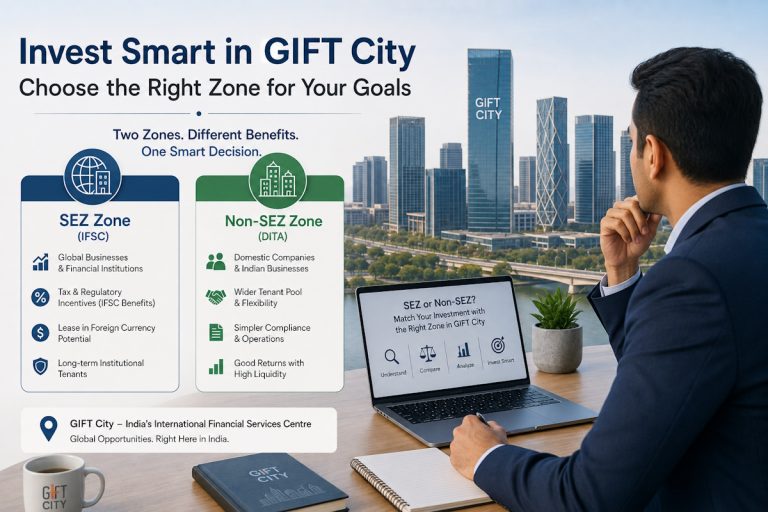
Before committing capital, investors must recognize that GIFT City is structurally bifurcated into Special Economic Zone (SEZ) and Domestic Tariff Area (DTA) demarcations. Each zone serves entirely different commercial and residential functions, carries distinct regulatory compliance mandates, and appeals to different end-user bases. Understanding who should invest in GIFT City real estate begins with mapping your investment thesis to the correct geographic and regulatory sector within the development.
The Structural Division Between SEZ and DTA Zones
The SEZ zone functions as an offshore jurisdiction within India, catering primarily to international financial services, global in-house centers, fintech enterprises, and multinational institutions operating under IFSC regulations. In contrast, the DTA caters to domestic enterprises, Indian service entities, and unrestricted residential occupancy. Commercial real estate in the SEZ requires leasing to qualifying IFSC entities, whereas DTA commercial inventory offers a broader domestic tenant pool with standard Indian tax treatments.
Yield Profiles and Capital Appreciation Horizons
Yield dynamics vary significantly across commercial and residential developments. Commercial Grade-A office spaces currently exhibit higher initial capitalization rates, supported by institutional multi-year leases with structured escalations. Residential assets deliver lower gross rental yields but show rapid capital appreciation potential driven by the expanding workforce residing in the city. Investors must balance immediate cash-flow requirements against multi-year capital compounding when selecting asset classes.
GIFT City Investment for NRI Capital: Cross-Border Wealth Strategy
Non-Resident Indians represent one of the most active capital pools in this market. When evaluating a GIFT City investment for NRI portfolios, the primary advantages stem from regulatory transparency, streamlined repatriation processes, and favorable foreign exchange dynamics. With the Reserve Bank of India and International Financial Services Centres Authority (IFSCA) establishing investor-friendly pathways, global Indians are allocating capital to capture India’s macroeconomic growth while maintaining high compliance standards.
Repatriation and Regulatory Mechanisms for Offshore Buyers
NRIs investing in Indian real estate often face hurdles around currency repatriation and administrative approvals. Within GIFT City, properties purchased through foreign currency accounts or Non-Resident External (NRE) accounts benefit from clear, statutory exit routes for both capital gains and rental distributions. The streamlined single-window clearance mechanisms established by the development authority minimize bureaucratic friction that typically characterizes domestic land titles and municipal sanctions.
Strategic Portfolio Construction: Residential vs. Commercial
Offshore investors must choose between two distinct strategies: hands-off commercial ownership with pre-leased corporate tenants, or premium residential apartments targeting the executive workforce. Exploring a detailed GIFT City investment guide for NRIs reveals that commercial holdings offer superior currency-hedged yields, while residential assets provide dual utility as long-term wealth preservation instruments and future residential bases.
Compliance, Taxation, and Cross-Border Management
Taxation remains a critical consideration for cross-border capital. Rental income generated in India is subject to standard domestic withholding rates, yet Double Taxation Avoidance Agreements (DTAA) allow foreign residents to offset these liabilities in their home jurisdictions. Professional property management infrastructure inside GIFT City ensures asset maintenance and lease administration can be handled remotely without requiring local operational involvement.
GIFT City Investment for HNI Capital: Wealth Preservation and Scale
High-net-worth individuals and family offices prioritize capital preservation, low tenant counterparty risk, and portfolio diversification. Executing a GIFT City investment for HNI accounts involves securing sizable floor plates in commercial towers or acquiring multiple residential assets early in development cycles. For large portfolios, this market provides a rare combination of statutory sovereign backing, planned urban density, and institutional-grade infrastructure.
Targeting Institutional Commercial Real Estate
Private wealth allocators focus heavily on Grade-A commercial office space leased to Tier-1 financial institutions, international banks, law firms, and consulting enterprises. These tenancy agreements often span 5 to 9 years with standard escalation clauses every three years, insulating the investor against domestic inflation and providing predictable distributions with minimal management overhead.
Navigating Valuation Multiples and Capital Entry Points
HNIs must avoid speculative buying at inflated entry multiples. Sound due diligence requires analyzing developer balance sheets, past delivery track records within Gujarat, and genuine pre-commitment levels of office towers. Evaluating price per square foot metrics against capital expenditure schedules helps ensure capital is deployed at fair valuations before infrastructure phases complete.
Long-Term Capital Preservation in the IFSC Ecosystem
Unlike fragmented metropolitan centers where uncontrolled suburban expansion dilutes land values, GIFT City operates on a master-planned floor space index (FSI) allocation model. This supply-constrained framework ensures that prime commercial and residential parcels maintain long-term pricing power, shielding high-value portfolios against supply gluts over 10- to 20-year horizons.
Corporate Occupiers and Business Owners: Operational Efficiency and Asset Control
Enterprises evaluating commercial space inside GIFT City operate under a dual lens: optimizing operational real estate expenditure while leveraging the extensive tax holidays and regulatory benefits provided under the IFSC framework. For founders, CXOs, and business owners, selecting the right corporate real estate model directly impacts enterprise balance sheets.
Buy vs. Lease Economics for Growing Enterprises
Business owners must evaluate whether purchasing commercial office inventory offers better long-term capital efficiency than traditional commercial leasing. In an appreciating market backed by institutional infrastructure, owning self-occupied commercial property creates a balance sheet asset that appreciates while eliminating lease escalation risks. Conversely, leasing conserves operational liquidity for core business expansion.
Leveraging Regulatory, Tax, and Infrastructure Arbitrage
Units operating within the IFSC SEZ enjoy competitive corporate tax holidays, minimal alternate tax exemptions, and duty-free import advantages for operational infrastructure. These regulatory incentives make establishing owned or leased offices within GIFT City significantly more accretive to net margins compared to traditional central business districts in Mumbai, Bengaluru, or Delhi NCR.
End Users and Executive Professionals: Urban Livability and Growth
As financial institutions, international universities, and tech enterprises scale their physical footprint in GIFT City, the requirement for high-quality residential housing has shifted from speculative investor interest to genuine end-user absorption. Professionals working within the smart city represent a captive demographic demanding modern, sustainable, and well-connected housing options.
Master-Planned Urban Infrastructure and Walk-to-Work Dynamics
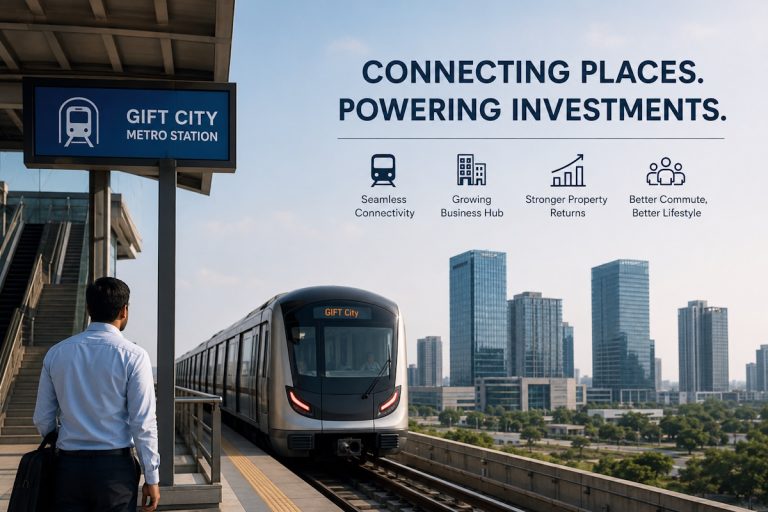
The city’s design integrates automated waste collection systems, district cooling, underground utility tunnels, and dedicated public transit connections between Gandhinagar and Ahmedabad. For executive end users, the walk-to-work culture drastically reduces transit overhead, offering a quality of life rarely found in major Indian metropolitan centers.
Capital Appreciation Trajectories for Grade-A Residential Units
Residential supply within the core city boundaries remains strictly controlled in proportion to commercial office allocations. As commercial floor plates fill with corporate employees, the structural demand for high-end residential apartments continues to outpace available completions. End users purchasing today secure long-term equity growth alongside direct residential utility.
Comprehensive Strategic Matrix by Investor Profile
Selecting an asset class requires matching your capital profile against specific risk-reward characteristics. The following decision matrix synthesizes key parameters for investors evaluating opportunities through this GIFT City property guide.
- NRI Investors: Primary Focus is Pre-leased Commercial or Executive Residential. Key Metric is Net Yield plus Forex Hedge. Risk Profile is Low-to-Moderate with 5 to 10 year horizons.
- HNI / Family Offices: Primary Focus is Multi-Unit Commercial Floorplates. Key Metric is Capital Preservation and Institutional Lease Covenants. Risk Profile is Low with 7 to 15 year horizons.
- Business Owners: Primary Focus is Self-Occupied SEZ/DTA Commercial Space. Key Metric is Operational Cost Arbitrage and IFSC Tax Relief. Risk Profile is Business-Aligned with Long-term holding.
- End Users / Executives: Primary Focus is Master-Planned Residential Apartments. Key Metric is Quality of Life, Transit Time, and Capital Appreciation. Risk Profile is Low with Medium-to-Long horizons.
Strategic Decision-Making: Due Diligence, Liquidity, and Risk Management
Regardless of your investor category, executing a successful acquisition requires structured due diligence. Navigating how to invest in GIFT City effectively means looking beyond high-level growth narratives to analyze project-level legalities, developer execution credibility, and real secondary market liquidity.
Critical Due Diligence Checkpoints Across Asset Types
Every commercial and residential asset must undergo verification against development authority approvals, clear title deeds, and RERA registrations. Investors should examine the development agreement between the builder and GIFT City authorities to confirm that FSI allocations, utility connections, and structural timelines comply with master development norms.
Secondary Market Liquidity and Exit Windows
Real estate is an illiquid asset class, and exit strategies must be planned at entry. Grade-A commercial spaces backed by strong multinational leases enjoy healthy liquidity through secondary institutional sales and private wealth syndicates. Residential assets depend on end-user demand and overall corporate occupancy rates to maintain active resale liquidity.
Investors should consult a comprehensive GIFT City real estate investment guide before signing allocation agreements to ensure their purchase structure supports future transferability without excessive exit fees or regulatory bottlenecks.
Structuring Your GIFT City Property Acquisition
Making a successful GIFT City real estate investment requires disciplined execution. Institutional buyers and private wealth allocators do not treat all developments equally. They systematically assess developer balance sheets, evaluate the underlying infrastructure phasing, and select asset classes tailored precisely to their cash flow, operational, or tax profile.
Gift City Realty assists investors across NRI, HNI, corporate, and end-user profiles by providing data-backed advisory services, independent project evaluations, and access to verified commercial and residential inventory. Structuring your investment with precision today ensures your portfolio captures the upside of India’s premier financial hub while safeguarding capital against regulatory and execution risks.
Frequently Asked Questions
1. Can foreign nationals and NRIs freely buy real estate in GIFT City?
Non-Resident Indians (NRIs) and Overseas Citizens of India (OCIs) can freely purchase residential and commercial real estate in GIFT City under standard Reserve Bank of India (RBI) guidelines. Transactions are executed through designated NRE or NRO banking channels with streamlined repatriation mechanisms for both capital and rental returns.
2. What is the difference between investing in the SEZ versus the DTA area?
The Special Economic Zone (SEZ) operates under offshore financial regulations and requires commercial tenants to be qualifying IFSC entities enjoying specialized tax incentives. The Domestic Tariff Area (DTA) allows standard domestic Indian enterprises to lease commercial office spaces and permits open residential living for any domestic or international buyer.
3. What typical rental yields can commercial real estate investors expect?
Pre-leased commercial Grade-A office spaces within GIFT City generally deliver gross rental yields ranging between 7% and 9%, supported by institutional multi-year lease covenants. Residential rental yields typically hover between 3.5% and 5%, with higher upside potential from long-term capital value appreciation as corporate density increases.
4. Are there stamp duty and registration fee concessions in GIFT City?
The Government of Gujarat periodically offers tailored incentives, stamp duty exemptions, or registration concessions for specific asset transfers and qualified business setups operating within the IFSC SEZ zone. Investors should verify project-specific applicability during formal legal due diligence.
5. How does GIFT City ensure long-term liquidity for property resales?
Liquidity is maintained through controlled supply management, master-planned FSI allocations, and rising institutional absorption. As domestic and global enterprises establish their headquarters within the IFSC, demand for Grade-A office floor plates and supporting executive residential inventory creates an active secondary market for both private and institutional investors.