
As we approach 2026, the landscape of the Gujarat International Finance Tec-City has shifted from a visionary blueprint to a high-velocity financial engine. For the first-time investor, the allure of India’s first International Financial Services Centre (IFSC) is undeniable, yet the complexity of its regulatory environment often leads to expensive oversights. Navigating this market requires a departure from traditional Indian real estate logic, as GIFT City operates under a unique framework that blends domestic laws with international financial standards.
The stakes for entry in 2026 are higher than ever, with property values reflecting the city’s maturing infrastructure and the influx of global financial institutions. Success in this environment is not merely about identifying a prime location, but about understanding the intersection of SEZ regulations, commercial absorption rates, and specialized utility structures. To secure a high-yielding portfolio, one must identify the common GIFT City real estate investment mistakes that separate institutional-grade successes from speculative failures.
Misunderstanding the Distinction Between SEZ and Non-SEZ Designations
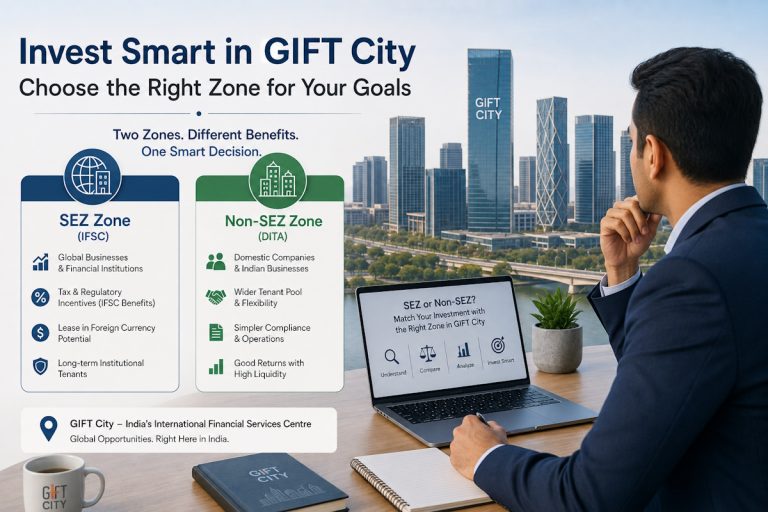
One of the most fundamental GIFT City real estate investment mistakes is failing to distinguish between the Special Economic Zone (SEZ) and the Non-SEZ (Domestic Tariff Area or DLA) portions of the city. Each zone carries significantly different implications for residency, business operations, and long-term capital appreciation. In 2026, as the city reaches a critical mass of occupancy, the liquidity of a property will depend heavily on whether it aligns with the end-user’s regulatory status.
The Limitation of SEZ Residential Units
Residential properties located within the SEZ processing area were traditionally designed to house individuals working specifically within SEZ units. While regulations have evolved to allow for greater flexibility, investors often overlook the specific compliance requirements for tenants. If you purchase an SEZ-linked residential unit with the intent of renting it to someone working in the domestic area of Ahmedabad or Gandhinagar, you may encounter administrative hurdles or tax complications that diminish your net yield.
Impact on Exit Strategy and Resale Liquidity
When it comes time to exit the investment, your pool of potential buyers for an SEZ property may be more restricted than in the Non-SEZ area. Institutional buyers often look for assets that offer the widest possible tenant base. By limiting your property to the SEZ framework, you are essentially betting on the continued growth of that specific sub-sector, which can be a risk if domestic demand in the Non-SEZ area begins to outpace it.
Overlooking the Correlation Between Commercial Absorption and Residential Demand
A frequent error among residential investors is ignoring the commercial health of the city. In GIFT City, residential demand is a direct derivative of commercial occupancy. Unlike traditional metropolitan areas where residential growth can be driven by suburban sprawl or local lifestyle preferences, GIFT City is a purpose-built ecosystem. If the commercial towers are not filling with high-value employees, the residential towers will struggle with high vacancy rates.
The 2026 Commercial Pipeline Analysis
By 2026, several major Grade-A office spaces are slated for full operational capacity. Investors must look beyond the brochures and evaluate the actual leasing activity within the IFSC. High-profile entries by global banks, fintech firms, and aircraft leasing companies are the true indicators of future residential demand. A mistake here involves buying into a residential project based on proximity to an empty office tower rather than an occupied one.
Why the “Work-Live-Play” Ratio Matters
The city’s master plan relies on a specific ratio of commercial to residential square footage. If the market becomes oversaturated with residential units before the commercial workforce arrives in full force, rental yields will inevitably compress. An astute investor monitors the pace of commercial fit-outs and company registrations as a lead indicator for when to enter the residential market.
Failing to Account for Specialized Utility and Maintenance Costs
GIFT City is famous for its world-class infrastructure, including the District Cooling System (DCS) and Automated Waste Collection System (AWCS). However, many first-time investors treat these as mere “amenities” rather than structural costs. This is one of the most practical GIFT City real estate investment mistakes. The maintenance and utility billing structure here is unlike any other city in India, and it can significantly impact your monthly cash flow.
The District Cooling System (DCS) Financial Model
In GIFT City, individual air conditioning units are largely replaced by a centralized cooling system. While this is highly efficient and reduces building-level maintenance, it involves a different billing structure. There are often fixed charges and variable consumption charges that must be accounted for in the lease agreement. If an investor fails to structure their tenant agreement to pass these costs through effectively, they may find their “lucrative” rental income being eaten away by high utility overheads.
Automated Waste and Centralized Management Fees
The cost of maintaining a “Smart City” is naturally higher than that of a standard municipality. The centralized management fees cover the vacuum-sealed waste systems, high-speed fiber connectivity, and 24/7 surveillance. Investors must factor these higher-than-average CAM (Common Area Maintenance) charges into their initial ROI calculations. In 2026, as these systems scale, understanding the long-term cost trajectory of these utilities is vital for maintaining profitability.
Neglecting the Regulatory and Tax Implications for NRIs and HNIs
For Non-Resident Indians (NRIs) and High-Net-Worth Individuals (HNIs), GIFT City offers a range of tax benefits, particularly within the IFSC. However, a common mistake is assuming these benefits apply automatically to real estate transactions. Real estate investment within the city is still subject to specific Indian tax laws, including TDS (Tax Deducted at Source) on property purchases and capital gains tax, unless structured through specific IFSC-exempt vehicles where applicable.
Tax Holiday Misconceptions
While businesses operating in the IFSC enjoy a 10-year tax holiday, this does not mean a private individual buying an apartment is exempt from property taxes or capital gains. However, there are significant advantages regarding the repatriation of funds and the use of Liberalized Remittance Scheme (LRS) routes for investment. Investors who do not consult with a tax advisor familiar with GIFT City’s unique status often miss out on optimizing their investment structure, leading to unnecessary tax leakage.
Compliance with the GIFT City Authority Regulations
The GIFT City Authority has its own set of guidelines that can occasionally supersede or complement state-level RERA rules. Ensuring that the developer is in full compliance with both Gujarat RERA and the GIFT City urban development norms is non-negotiable. A mistake in vetting this compliance can lead to delays in possession or difficulties in securing financing from major banks, which have strict “GIFT-specific” lending criteria.
Underestimating the Impact of Developer Track Records in a Managed City
GIFT City is not a place for “fly-by-night” developers. The technical requirements for building within the city—such as connecting to the utility tunnels and adhering to strict green building codes—are immense. A major mistake first-time investors make is choosing a project based on a low price point rather than the developer’s experience with large-scale, tech-integrated projects. In 2026, the performance gap between well-managed buildings and poorly executed ones will become starkly apparent.
Infrastructure Integration Risks
If a developer fails to correctly integrate a building with the city’s centralized systems, the occupants will face persistent issues with cooling, waste disposal, and connectivity. This directly impacts the property’s reputation and, consequently, its rental value. When evaluating a project, investors should look at the developer’s history of delivering Grade-A office spaces or luxury residential complexes that involve complex MEP (Mechanical, Electrical, and Plumbing) systems.
Long-term Facility Management Capabilities
In a managed city like GIFT City, the role of the facility management team is critical. Unlike a standalone apartment block in a traditional city, a building in GIFT City is part of a larger, interconnected grid. Investors should ask who will be managing the property post-handover. Is it a professional international agency or an in-house team with no experience in smart city operations? The quality of management will determine the asset’s rate of depreciation and its long-term appeal to institutional tenants.
Strategic Steps for Your 2026 GIFT City Portfolio
The window for “early-mover” advantages is closing as GIFT City matures into a global financial hub. To succeed in 2026, investors must move past the hype and focus on the technical and regulatory realities of the city. By avoiding these five costly mistakes—from zone confusion to utility cost oversights—you position yourself to benefit from what is arguably India’s most structured real estate opportunity. Gift City Realty remains committed to providing the technical depth and local intelligence required to navigate this unique market with confidence.
The most successful investors in 2026 will be those who view their property not just as brick and mortar, but as a specialized asset within a global financial ecosystem. Before committing capital, ensure every aspect of the investment—from the tax structure to the cooling system—has been vetted against the city’s long-term master plan. With the right advisory, the risks of the first-time investor can be transformed into the calculated moves of a seasoned institutional player.
Frequently Asked Questions
1. Is it better to invest in commercial or residential property in GIFT City for 2026?
Both have merits, but commercial property often offers more stable long-term leases with institutional tenants. Residential property is currently seeing high demand due to the increasing workforce, potentially offering higher short-term capital appreciation as the city becomes more “liveable.”
2. Can NRIs fully repatriate the rental income earned in GIFT City?
Yes, NRIs can generally repatriate rental income and sale proceeds, subject to the Foreign Exchange Management Act (FEMA) guidelines and payment of applicable taxes in India. Utilizing the IFSC framework can sometimes streamline these processes.
3. Are there any specific stamp duty benefits for GIFT City in 2026?
The Gujarat government has historically offered various incentives and exemptions for units within GIFT City. However, these are often subject to specific timelines and zone requirements (SEZ vs. Non-SEZ). It is essential to check the latest state notifications at the time of your transaction.
4. How does the automated waste system affect my property’s maintenance bill?
The AWCS reduces the need for manual labor and waste trucks within the city, leading to a cleaner environment. While it involves a centralized fee, it often proves more cost-effective over the long term compared to the cumulative costs of traditional waste management and pest control in standard cities.
5. What is the expected rental yield for residential property in GIFT City?
Currently, yields are competitive with other Indian Tier-1 cities, often ranging between 3% and 5%. However, properties that are well-integrated into the city’s smart infrastructure and located near major commercial hubs like the IFSC towers tend to command a premium.