
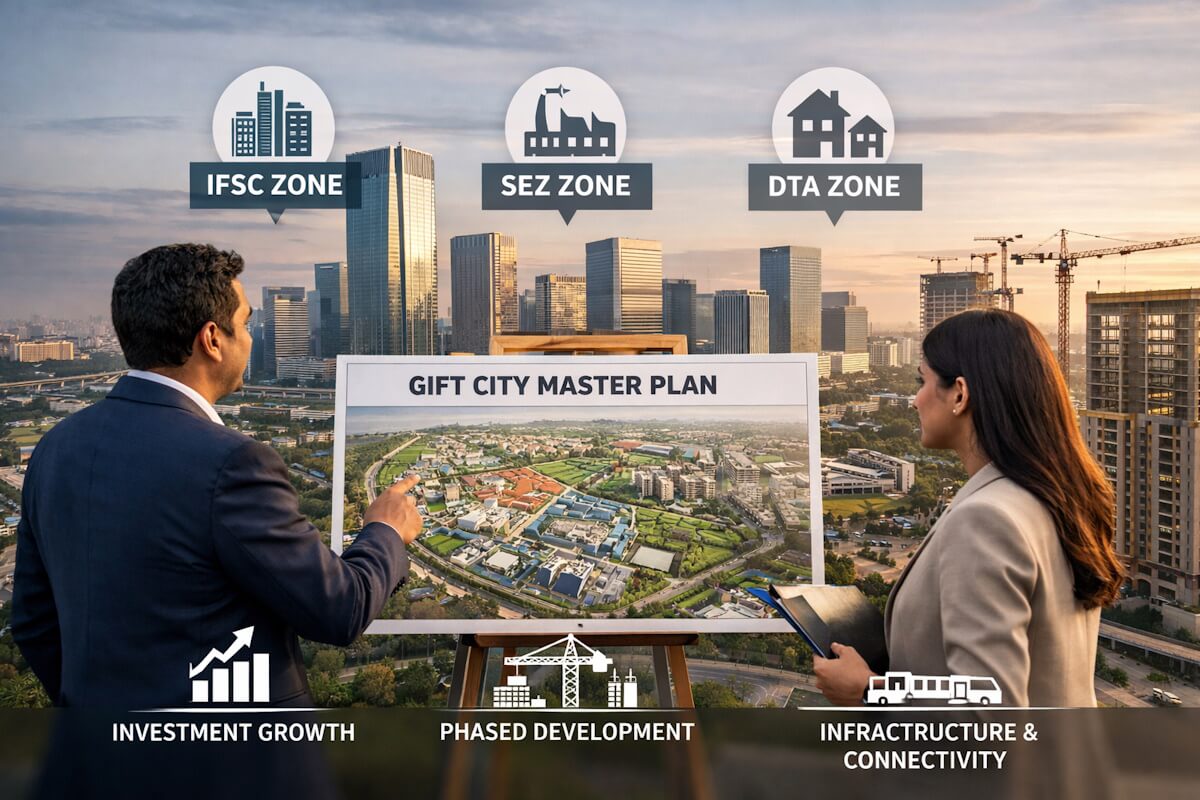
The GIFT City Master Plan Explained: Deciphering the Blueprint for Investment Stability
For serious real estate investors, the Master Plan is not just an architectural blueprint; it is the ultimate regulatory commitment that defines scarcity, manages supply, and dictates the fundamental value proposition of any project. In a rapidly evolving development like GIFT City, understanding the core structure and intent behind the GIFT City master plan is paramount to making a sound, long-term investment decision.
Unlike organic urban sprawl, GIFT City’s development is meticulous, pre-zoned, and phased. This level of control is unique in India and directly reduces investor risk associated with unbridled supply or unforeseen competitive pressure. Our analysis moves beyond tower heights and aesthetics, focusing instead on how strategic zoning, regulated density, and the predictable phasing of the GIFT City master plan lock in potential appreciation and rental stability. This is the advisory lens through which NRIs, HNIs, and institutional buyers must evaluate commercial and residential opportunities here.
The Strategic Foundation of the GIFT City Master Plan
The entire investment thesis for GIFT City hinges on regulatory stability, and that stability starts with the commitment to the Master Plan. It outlines the precise distribution of financial, residential, and social infrastructure over the 886-acre area, ensuring a balanced, high-demand ecosystem.
Segregating Demand: IFSC, SEZ, and DTA Zoning
The single most critical element of the GIFT City zoning scheme is the clear physical and regulatory separation of three distinct economic areas: the International Financial Services Centre (IFSC), the Special Economic Zone (SEZ), and the Domestic Tariff Area (DTA). These zones do not merely designate different building types; they designate different tax environments and regulatory advantages that attract specific, high-quality tenants.
Why Zone Segregation Matters for Investor Returns
The zoning directly impacts the profile of your potential tenant and, consequently, your rental yield stability. Properties within the SEZ are exclusively available to companies registered under the IFSC framework, who enjoy substantial tax holidays and regulatory exemptions. This creates an extremely high barrier to entry and a highly captive demand pool for commercial space. As an investor, you are not competing with the broader Ahmedabad or Gandhinagar market; you are competing only within the finite, regulated supply of the SEZ/IFSC zone.
The DTA, while physically located within GIFT City, caters to supporting services and the domestic market, offering more conventional tenancy profiles. Understanding which zone your investment falls into is step one in assessing risk and forecasting ROI. If you are targeting global financial institutions, your focus must be tightly defined by the SEZ boundaries. For deeper insights into navigating these regulatory differences, get investor guide focusing specifically on IFSC compliance.
Density and Supply Control: The Vertical Strategy
A key aspect of the GIFT City development plan is the aggressive but controlled use of vertical density. Unlike typical city planning that allows sprawling development, GIFT City maximizes Floor Space Index (FSI) vertically. This doesn’t mean overcrowding; it means intentional density focused entirely on efficiency and maximizing the value of the scarce land within the regulated zone.
FSI/FAR Implications on Long-Term Value
The Master Plan controls the total built-up area allowed for the entire zone. This limitation is a deliberate strategy to prevent oversupply. By committing to fixed FSI limits and pre-approved projects, the planning authority ensures that supply is tightly managed in response to proven demand, thus safeguarding asset prices and premium rental rates in the long run. If the plan were to change suddenly, allowing unrestricted development, the scarcity premium would dissolve. The adherence to the original GIFT City master plan gives investors confidence in long-term capital protection.
We advise investors to analyze project density not just in isolation, but in context of the overall supply pipeline defined by the Master Plan’s current phase. Overlooking this controlled supply environment is a common mistake that leads to miscalculating appreciation potential.
Actionable Insight: Analyzing the complex interplay between SEZ/DTA zoning, FSI limits, and current commercial absorption rates requires specialized market knowledge. Before committing capital, request a detailed project-specific ROI forecast tailored to the regulatory environment of your chosen zone. Explore GIFT City Projects that align with your risk profile.
Analyzing the Core Investment Zones and Asset Classes
The master plan segments the city into core functional areas—the central business district, residential pockets, social infrastructure, and green spaces—all interconnected by a robust internal transportation system. Each zone offers a distinct investment profile.
The IFSC Commercial Hub: The Anchor Demand
This is the engine of GIFT City. The commercial hub, predominantly within the SEZ, houses banking, insurance, capital markets, and ancillary financial services. Investment here is driven by institutional demand, long lease terms, and the prestige associated with an IFSC address. The GIFT City development plan prioritized this area in Phase I, ensuring foundational stability.
DTA and Residential Dynamics: Supporting the Workforce
The DTA segment, particularly the residential areas, supports the thousands of professionals employed in the commercial towers. Residential investment here is predicated on captive demand—a high-income, white-collar workforce seeking proximity and lifestyle. While residential investments offer different capital appreciation cycles than commercial assets, the long-term value is secured by the Master Plan’s guarantee that commercial expansion (Phase II and beyond) will continue driving new permanent residents to the DTA residential towers.
The crucial differentiator in GIFT City’s residential market is that the Master Plan limits residential supply far below the potential workforce headcount, ensuring a constant demand-supply mismatch in favor of landlords. This systematic supply control is a primary driver of sustained high rental yields.
Infrastructure and Connectivity: Ensuring Investment Liquidity
The plan allocates significant space and resources to infrastructure, including utility tunnels, automated waste disposal, district cooling systems, and smart grid technology. This focus on premium, future-proof infrastructure ensures that operations for multinational tenants are seamless, which directly supports higher lease rates and tenant stickiness. An investment in GIFT City is also an investment in India’s most technologically advanced urban infrastructure commitment.
Phased Development: Controlling Risk and Supply
The execution of the GIFT City development plan is phased, which is a critical risk mitigation strategy for investors. It ensures that supply never outpaces proven absorption.
Phase I: The Proof of Concept and Current Stability
Phase I, now largely completed, established the initial commercial core, critical mass of IFSC tenants, and initial residential projects. Investing in Phase I assets currently means investing in proven cash flows and established tenancy profiles. The risks associated with “if it will work” have largely been retired.
However, the highest potential upside often lies in strategically positioning for the next stage of growth, which requires anticipating the infrastructure alignment set out in the master plan. If you are comparing stabilized Phase I assets with strategically located Phase II opportunities, you need to deeply understand the regulatory timelines. Let our expert advisors schedule an investment consultation to evaluate these options.
Transitioning to Phase II and Beyond
The GIFT City future expansion is mapped out within the existing master plan framework, focusing on expanding the commercial footprint (more towers, more institutional space) and scaling up social and residential infrastructure (hospitals, schools, entertainment). This measured approach prevents the market shock that often accompanies sudden, large-scale supply injections in typical Indian cities.
Infrastructure Scalability and Investment Security
The master plan includes provisions for the future integration of transport links, including metro connectivity, further securing the long-term viability and accessibility of the city. For investors, this planned scalability ensures that as the city grows, the property’s physical location remains highly desirable and accessible, protecting capital appreciation.
As the city progresses through its phases, the land parcels designated for future development within the GIFT City master plan become inherently more valuable because the required supporting infrastructure is already planned and funded. This phased approach provides a transparent roadmap for long-term investment horizon planning.
Investment Due Diligence: Before making any commitment, request a comparative analysis of opportunities in the transitioning zones. Understanding which parcels are marked for Phase II vs. Phase III build-out, based on the approved GIFT City development plan, is essential to timing your entry for maximum leverage. Speak with a GIFT City Expert today.
Evaluating Future Appreciation Through the Master Plan Lens
The Master Plan is more than a control document; it is a forecast model for future value. It outlines commitments that directly reduce common risks associated with Indian real estate development.
The Commitment to Social Infrastructure Integration
A smart city cannot function solely as an office park. The GIFT City development plan emphasizes the integration of premium social infrastructure—schools, entertainment, retail—within specific, manageable boundaries. For residential investors, this integration is critical. It guarantees a high quality of life for senior executives and their families, ensuring that the residential units remain highly desirable, commanding premium rents and strong appreciation compared to comparable properties in neighboring cities.
Risk Mitigation: Regulatory Stability vs. Market Volatility
The Master Plan is governed by a Special Purpose Vehicle (SPV), the Gujarat International Finance Tec-City Company Limited (GIFTCL). This centralized control prevents the political and municipal volatility that often plagues large-scale projects. This regulatory insulation, guaranteed by the Master Plan’s structure and adherence, is perhaps the most undervalued asset protection mechanism for NRIs and institutional buyers concerned about jurisdictional risk in India. We at Gift City Realty ensure all our clients fully understand these regulatory safeguards when they request ROI estimates.
Capitalizing on Controlled Growth
The GIFT City master plan provides a clear investment mandate: stability through controlled supply. The methodical implementation of GIFT City future expansion ensures scarcity persists, and regulatory advantages remain exclusive to the designated zones. Your investment decision must therefore center on identifying the specific point of leverage within this planned scarcity—whether it’s premium commercial space in a fully absorbed SEZ tower or early entry into a high-demand DTA residential project that feeds off the continued commercial growth.
To capitalize on this environment, astute investors must look beyond current prices and focus on the regulatory moat created by the Master Plan. This strategic insight ensures your capital is positioned for predictable, high-quality returns driven by systemic growth, not speculative exuberance. Partnering with an advisory firm like Gift City Realty, which specializes exclusively in interpreting and navigating the regulatory landscape of the GIFT City master plan, is essential for securing vetted, high-potential assets.
Ready to move from analysis to action? Schedule an Investment Consultation to align your portfolio objectives with the next phase of GIFT City’s meticulously planned growth.
Frequently Asked Questions (FAQs)
Is the GIFT City master plan rigid, or can it be altered frequently?
The GIFT City master plan is designed to be highly stable. While minor adjustments for operational efficiency can occur, major changes to the core zoning (IFSC/SEZ boundaries) or FSI limits are rare, as the stability of these regulations is fundamental to attracting international institutional investment. This rigidity is a core value proposition for investors.
How does the zoning affect residential property values within GIFT City?
Residential properties fall under the DTA zoning, but their value is directly correlated with the success and absorption rate of the adjacent SEZ/IFSC commercial zones. The plan limits residential construction to ensure captive, premium demand from the high-income workforce, driving higher rents and appreciation for these DTA assets.
What defines the boundary between Phase I and Phase II expansion in the development plan?
Phase I focused on establishing the core commercial infrastructure and initial connectivity. Phase II, detailed in the GIFT City development plan, concentrates on horizontal expansion of the commercial grid, scaling up residential supply, and enhancing social infrastructure (e.g., educational and healthcare facilities) to support the increased workforce density.
Do I need to worry about competition from real estate developments outside GIFT City?
The regulatory and tax benefits associated with SEZ/IFSC tenants create a moat. Companies operating under the IFSC regime must be located within the designated SEZ. This regulatory necessity shields GIFT City real estate from direct competition with generic developments outside the special zone, ensuring sustained, premium demand for commercial properties within the Master Plan area. For residential units, the convenience and luxury of living within the smart city further insulate demand.