
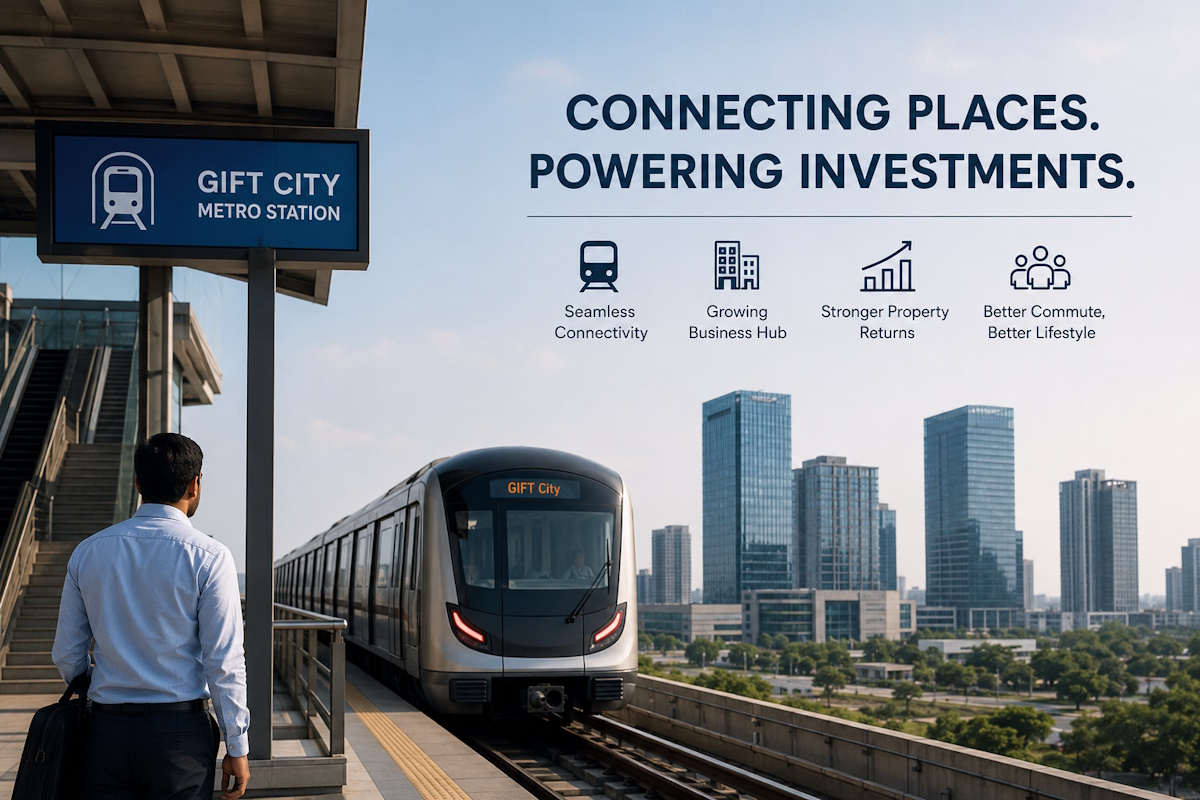
Infrastructure execution is the single most reliable predictor of commercial real estate performance in developing master-planned jurisdictions. In GIFT City, Gujarat, India, the commissioning and scaling of rapid transit networks represent a fundamental structural shift in how capital, talent, and enterprise interact with physical real estate. For high-net-worth individuals, institutional funds, and family offices assessing the international financial services center, rapid transit connectivity is not merely a convenience. It is a direct multiplier of tenant retention, net operating income, and long-term asset liquidity.
The operational expansion of the gift city metro station establishes a permanent mass transit conduit linking Ahmedabad and Gandhinagar directly to the financial district. Understanding how transit nodes alter footfall density, workforce absorption, and micro-market pricing is essential for investors structuring high-yield portfolios. This guide provides a detailed assessment of transit infrastructure, the surrounding project landscape, and the measurable impact on commercial and residential property valuations across both Special Economic Zone (SEZ) and Domestic Tariff Area (DTA) zones.
The Strategic Role of the GIFT City Metro Station in Urban Expansion
Rapid transit infrastructure alters commercial geography by compressing travel times and expanding the effective hiring radius of corporate tenants. In institutional-grade developments, proximity to mass transit dictates leasing velocity and reduces vacancy cycles.
Ahmedabad-Gandhinagar Metro Phase 2 Integration
The integration of the gift city metro route under Phase 2 of the Ahmedabad-Gandhinagar Metro project creates a seamless, grade-separated rail corridor between the twin cities and GIFT City. This line branches from the Motera-Mahatma Mandir main artery at GNLU (Gujarat National Law University) and crosses the Sabarmati River via a dedicated bridge to access the urban core of GIFT City.
By connecting directly to major transport nodes, including the Sardar Vallabhbhai Patel International Airport and the Ahmedabad Central Railway Station, this route eliminates primary logistical frictions. For corporate tenants evaluating IFSC relocations, reliable intercity rail transit solves daily executive commuting bottlenecks, directly strengthening enterprise-level tenant commitment to the district.
Commuter Demographics and Workforce Mobility
Corporate occupiers in financial services, legal advisory, asset management, and fintech rely on highly specialized human capital. The introduction of robust GIFT City transport connectivity widens the talent recruitment catchment area, allowing professionals to commute effortlessly from established residential clusters in western and northern Ahmedabad.
This demographic influx transforms the day-to-day dynamic of the business district. When white-collar talent can access workplaces within 30 to 45 minutes without highway congestion, office asset utilization rates rise. As workforce density scales from tens of thousands to over one hundred thousand active professionals, properties situated within pedestrian range of the transit station capture disproportionately higher foot traffic and retail spending.
Property Valuation and Transit-Oriented Development (TOD) in GIFT City
Transit-Oriented Development (TOD) models worldwide demonstrate that real estate within a 500-meter radius of active transit hubs captures sustained premiums over suburban or unlinked alternatives. GIFT City’s master plan leverages this exact principle to maximize floor area ratio efficiency and investor return.
Commercial Office Space Dynamics Along the Metro Line
Commercial assets positioned adjacent to the metro station experience structural advantages in leasing negotiations. Institutional tenants actively prioritize properties that minimize last-mile transit requirements for their employees. This operational preference enables landlords to command higher base rents while maintaining lower tenant turnover rates.
Evaluating historical data from similar Indian financial micro-markets reveals that prime office assets near transit hubs command between 12% and 22% rental premiums over isolated equivalents. In GIFT City, this dynamic accelerates absorption for newly completed Grade-A commercial towers, protecting investor capital against localized supply influxes. Investors tracking macro indicators can study how GIFT City metro connectivity and property appreciation establish strong baselines for medium-term capital gains.
Residential Demand Surge Near Transit Hubs
The residential sector inside and immediately surrounding GIFT City is experiencing parallel pricing adjustments. A high proportion of early-career professionals, consultants, and middle management prioritize leasing property near GIFT City metro corridors to avoid private vehicular ownership and associated transit expenses.
Investors holding residential studio apartments, 2-BHK, and 3-BHK configurations near transit hubs benefit from shortened vacancy gaps between lease agreements. Rental yields in transit-proximate residential developments maintain lower volatility during economic adjustments, as the baseline tenant demand remains supported by ongoing corporate arrivals.
Comparative Investment Matrix: Walking-Distance vs Peripheral Assets
Asset selection within a smart city requires a clear evaluation of spatial convenience versus capital expenditure. Investors must balance the acquisition cost per square foot against projected rental yield and exit liquidity.
Yield Differential Between Core and Outer Zone Assets
Properties located within a five-minute walking radius of the metro station command an initial price premium at entry, but they justify this capital outlay through superior gross yields and steady annual rental escalations. Conversely, peripheral assets situated several kilometers from the transit hub often compete on discounting, which can depress net yields over multi-year holding periods.
Understanding the metro extension impact on rental yields helps private investors determine whether paying a premium for core location assets produces higher risk-adjusted returns compared to secondary perimeter developments. In most operational scenarios, prime core positioning ensures higher occupancy stability throughout market cycles.
Core Zone (0-800m from Station)
- Cap Rate Stability: High resilience backed by institutional and multinational tenancies.
- Occupancy Rates: Consistently outperforms peripheral assets by 10% to 15%.
- Tenant Profile: Global investment banks, international tech firms, and tier-one consultancies.
Peripheral Zone (Beyond 800m)
- Cap Rate Stability: Moderate resilience, subject to competitive pricing pressure.
- Occupancy Rates: Dependent on internal feeder buses and corporate shuttle networks.
- Tenant Profile: Domestic support operations, mid-market back-office units, and local service providers.
Liquidity and Resale Velocity Across Micro-Markets
Capital liquidity is a central consideration for portfolio managers planning a five-to-seven-year exit strategy. Real estate situated near a metro near GIFT City maintains broader secondary market demand than isolated plots, because institutional buyers prefer portfolio acquisitions characterized by low tenant turnaround friction.
When exiting an investment, assets with established transit links attract diverse buyer pools, including domestic retail investors, NRIs, and institutional REITs looking to fold yield-generating assets into their trusts. This deep liquidity profile directly compresses average days-on-market during resale campaigns.
Infrastructure Catalysts and Regulatory Frameworks Influencing Value
Urban transit does not operate in isolation. In GIFT City, transportation connects directly with multi-layered tax incentives, unified regulatory structures, and high-performance utility backbones to create a high-efficiency business environment.
Alignment with Dual-Zone Regulations (SEZ vs DTA)
GIFT City is deliberately partitioned into International Financial Services Centre (IFSC) SEZ zones and Domestic Tariff Area (DTA) zones. The mass transit network runs through strategic intersections that serve both regulatory ecosystems, allowing seamless daily migration of personnel between tax-exempt export entities and domestic enterprises.
Investors must recognize that property within the SEZ requires distinct compliance mechanisms for leasing, as tenants must qualify as authorized units under IFSC guidelines. In contrast, DTA commercial properties offer open tenant eligibility for domestic Indian companies. Proximity to the transit station ensures that properties in both regulatory zones remain equally accessible to the broader regional workforce, preserving portfolio flexibility across varying regulatory climates. Reviewing the latest GIFT City infrastructure updates confirms how urban planning integrates transit infrastructure directly into both zones without operational disruption.
Long-Term Transit Expansion and Multimodal Integration
The metro station serves as an anchor within a larger multimodal transport ecosystem. The integration of electric feeder buses, subterranean pedestrian subways, utility tunnels, and automated transit systems ensures that the final leg of travel from the station platform to office reception desks remains brief and protected from external weather extremes.
These forward-looking integrations support sustainable asset appreciation. As institutional sustainability and ESG mandates become stricter for international enterprise tenants, properties that facilitate low-emission public transit commutes receive favorable governance ratings, driving institutional capital toward these micro-locations.
Investment Strategy: Structuring Portfolios Around Metro Infrastructure
Deploying capital effectively around high-capacity transit stations requires clear differentiation between asset lifecycle stages, tenant profiles, and risk tolerance thresholds.
Pre-Leased Assets vs Under-Construction Transit Assets
Private buyers and family offices often face a strategic choice between acquired pre-leased commercial units and pre-launch under-construction developments situated along the metro corridor.
Pre-leased assets located near the active station provide immediate cash flow with predictable yields, typically ranging from 7.5% to 9% in commercial office segments. Under-construction projects, while carrying project execution timelines, provide significant capital appreciation margins between early ground-breaking milestones and the commencement of full metro train operations. An optimal portfolio allocation frequently blends both asset types to balance recurring yield with capital growth.
Key Due Diligence Steps for Transit-Oriented Real Estate
Before committing capital to property developments near the transport node, investors should conduct rigorous due diligence focused on operational transit factors:
- Pedestrian Ingress and Egress: Verify that the building provides direct, grade-separated, or sheltered pedestrian access to the transit station rather than requiring difficult road crossings.
- Developer Execution Track Record: Confirm that the developer has institutional backing, fully compliant RERA approvals, and a clear history of timely project completions.
- Parking Allocation Ratios: Despite high public transit usage, Grade-A tenants require structured executive parking ratios. Ensure the asset balances public transit convenience with adequate private parking capacity.
- Regulatory Zoning Clarity: Ascertain whether the unit is registered in the SEZ or DTA zone, matching your targeted tenant profile with appropriate regulatory frameworks.
Strategic Takeaway for Discerning Real Estate Investors
The operational maturity of the metro corridor represents a watershed moment for real estate valuation in GIFT City, Gujarat, India. By addressing intercity mobility and connecting the business district directly to Ahmedabad’s residential talent base, transit infrastructure significantly de-risks commercial leasing and boosts residential absorption.
Institutional and private investors seeking durable yield and long-term capital preservation should concentrate their evaluations on assets within immediate walking proximity of mass transit hubs. As the financial district continues its rapid growth trajectory, these transit-oriented properties will lead the market in rental growth, tenant quality, and overall portfolio liquidity. Collaborating with trusted advisors like Gift City Realty ensures that property acquisitions align precisely with regulatory requirements, cash flow targets, and institutional-grade standards.
Frequently Asked Questions
1. How does the GIFT City metro station impact commercial property rental yields?
Properties located within walking distance of the station generally command rental premiums of 12% to 22% over more distant alternatives. Improved accessibility for daily commuters lowers vacancy intervals, attracts higher-tier corporate tenants, and supports regular upward rent revisions.
2. Is residential property near the metro a better investment than peripheral housing?
Yes. Residential units situated near transit nodes experience consistently higher occupancy rates from working professionals commuting to and from Ahmedabad. This steady tenant demand lowers turnover risks and preserves capital liquidity when exiting the investment.
3. Does the metro line connect both SEZ and DTA zones within GIFT City?
The mass transit network is integrated into the central urban master plan to ensure efficient connectivity across both SEZ (IFSC) and DTA zones, enabling workers and business visitors to move seamlessly between domestic and international financial zones.
4. What capital appreciation can investors expect near transit corridors in GIFT City?
While past performance does not guarantee future results, transit-oriented real estate in tier-one master developments historically achieves higher annualized appreciation compared to unconnected assets, driven by persistent demand from institutional buyers and expanding corporate occupiers.