
Commercial real estate allocations in India have entered an era defined by institutional quality, integrated infrastructure, and specialized regulatory zones. Within Gujarat International Finance Tec-City, widely known as GIFT City, institutional and private capital faces a pivotal strategic choice between two distinct commercial micro-markets: the Special Economic Zone (SEZ/IFSC) and the Non-SEZ Domestic Tariff Area (DTA). While the international financial services center grabs global headlines, sophisticated domestic investors, family offices, and NRI buyers are increasingly looking at domestic zone assets as high-yield, low-friction investment vehicles.
A strategic GIFT City non SEZ office investment provides direct exposure to India’s burgeoning domestic corporate expansion without the rigid regulatory compliance framework inherent to cross-border export zones. For investors looking for steady cash flow, strong tenant demand from national corporate balance sheets, and long-term capital appreciation in Gujarat, India, the non-SEZ market provides a compelling thesis. Understanding how this market operates, how yields behave, and how to structure acquisitions is essential before committing capital to commercial developments in this master-planned hub.
Understanding DTA vs SEZ in Gujarat’s Financial Hub
Navigating commercial real estate in GIFT City requires a clear structural understanding of the regulatory boundaries dividing the master plan. The smart city is strategically divided into an SEZ area, which houses the International Financial Services Centre, and a Domestic Tariff Area (DTA), which caters to companies serving the Indian onshore market.
The Fundamental Difference: Domestic vs Export Market
The primary distinction between SEZ and non-SEZ real estate lies in the operational mandate of the occupier. SEZ office assets are legally reserved for entities providing offshore financial services, foreign currency operations, or export-oriented technology solutions. Conversely, non-SEZ properties house domestic entities operating under standard Indian regulatory and tax frameworks. When evaluating GIFT City Domestic Zone vs SEZ, investors must recognize that DTA spaces cater to mainstream Indian enterprises seeking institutional-grade office environments.
Tenant Eligibility and Absorption Dynamics
From an asset management perspective, tenant eligibility dictates leasing velocity and occupancy stability. Non-SEZ commercial space does not require occupiers to secure specialized IFSC approvals or maintain positive Net Foreign Exchange earnings. This fundamental operational ease dramatically widens the pool of prospective tenants. National law firms, chartered accountancy practices, regional corporate headquarters, domestic financial institutions, and business consultancies can lease and occupy non-SEZ premises without administrative hurdles. This open-market dynamic creates resilient absorption patterns across varied economic cycles.
Why Non-SEZ Commercial Office Investment in GIFT City is Gaining Ground
Institutional capital allocates funds based on risk-adjusted returns and occupancy sustainability. While the SEZ draws multinational banks, the non SEZ office GIFT City market offers investors an operational advantage that translates into reduced downtime between tenancy transitions.
Broader Tenant Pool and Reduced Regulatory Friction
The operational framework of a domestic office space simplifies lease executions. In the SEZ sector, if an international tenant vacates, the replacement occupier must strictly fit the qualifying IFSC criteria, which can extend marketing periods and result in prolonged vacancy. In contrast, DTA office space GIFT City allows landlords to negotiate leases with any registered domestic business entity. This unrestricted leasing environment mitigates income disruption, creating a consistent cash-flow profile for commercial landlords.
Domestic BFSI, Tech, and Professional Services Inflow
India’s leading domestic banks, non-banking financial companies, insurance firms, and technology service providers are establishing regional operational hubs in Gujarat. These organizations require modern floor plates, continuous dual-power supply, centralized district cooling, and automated building management systems. When comparing DTA vs SEZ office space, domestic corporations consistently choose the DTA zone to avoid dual-compliance structures while still enjoying the world-class urban utility infrastructure of GIFT City.
Operational Flexibility for Domestic Indian Companies
For domestic firms, operating in the non-SEZ zone eliminates the need to maintain customs-bonded operational protocols or file specialized export documentation. This administrative ease allows domestic management teams to focus on core business growth while benefiting from modern commercial infrastructure, multi-modal transport connectivity, and planned social amenities.
Return Profiles, Rental Yields, and Capital Appreciation Drivers
Evaluating a commercial office investment GIFT City requires looking closely at total return mechanics, including gross initial yields, net operating income, escalation structures, and fundamental capital appreciation factors across prime commercial developments.
Baseline Rental Yields vs Metro Commercial Assets
Gross commercial rental yields in tier-one metropolitan nodes such as Mumbai (BKC, Lower Parel) and Bengaluru (Outer Ring Road) typically range between 6.5% and 8.0%. In contrast, grade-A GIFT City domestic zone office properties have demonstrated gross yields hovering between 7.5% and 9.0%, depending on floor positioning, tower infrastructure, and developer quality. This initial yield advantage, paired with lower capital acquisition costs per square foot relative to Mumbai or Delhi NCR, provides superior cash-on-cash returns for astute investors.
Demand-Supply Imbalances in Prime DTA Towers
Supply dynamics in the domestic zone remain closely managed through the development master plan. While developers have announced multiple commercial towers, the speed of grade-A deliveries remains balanced against tenant absorption. High-quality floor plates featuring efficient core-to-space ratios and modern floor-to-ceiling heights command rental premiums. Investors engaging in buying office space in GIFT City must evaluate specific tower delivery timelines to capitalize on pre-leasing interest from blue-chip domestic corporations.
Capital Growth Projections and Exit Liquidity
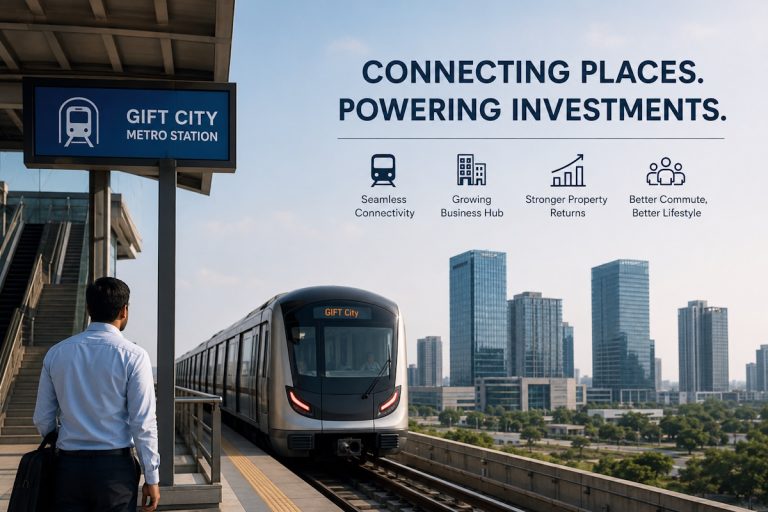
Capital appreciation in the domestic zone is tied to the broader maturation of the Ahmedabad-Gandhinagar growth corridor. As metro rail connectivity expands and integrated residential clusters deliver homes for local executives, commercial land values and office capital values reflect sustained upward pricing pressure. Institutional investors and domestic REITs continuously monitor operational portfolios for block acquisitions, ensuring multiple secondary exit routes for early-stage commercial asset holders.
Critical Due Diligence Checklist for GIFT City DTA Property Investors
Direct real estate investment requires thorough underwriting. Acquiring a GIFT City DTA property demands targeted due diligence to protect investor capital and optimize operational yield.
Developer Pedigree, Construction Timelines, and Approvals
Not all commercial developments deliver equal economic value. When selecting a commercial asset, investors should prioritize established development groups with verified delivery records and strong balance sheets. Key evaluation checkpoints include:
- RERA Compliance and Master Approvals: Verification of project registration numbers under Gujarat RERA along with authorized sanction plans from the GIFT Urban Development Authority.
- Utility Integration: Confirmation of active connections to the centralized District Cooling System (DCS), automated waste collection system, and potable water network, which directly impact operational expenditures.
- Structural Efficiencies: Assessment of core planning, elevator-to-floor ratios, parking allocations, and loading bay capabilities to ensure institutional tenant appeal.
Lease Structuring, Lock-in Periods, and Fit-out Amortization
Commercial lease agreements in India typically feature 3+3+3 or 5+5 year formats with 15% escalation every three years. When evaluating pre-leased commercial assets or structuring new corporate leases, investors must examine lease lock-in clauses, security deposit coverage (usually 3 to 6 months of gross rent), and fit-out capital expenditure amortization. A solid lease structure secures steady rental income while protecting the landlord against unexpected early tenant exits.
Facility Management and Utility Infrastructure Costs
The centralized utility design in GIFT City provides substantial operational savings over traditional commercial parks. District cooling reduces standalone HVAC capital costs and electricity bills, while shared infrastructure lowers common area maintenance (CAM) charges over time. These operational efficiencies translate directly into healthier net operating margins for the asset owner.
Strategic Decision Framework: Structuring Your Commercial Portfolio in GIFT City
Allocating capital to commercial office assets in Gujarat requires a defined strategic framework. HNIs, family offices, and institutional investors should customize their investment approach based on portfolio diversification goals, liquidity timelines, and target yields.
Portfolio Allocation for HNIs and Institutional Funds
For private investors holding capital across traditional residential property or equities, commercial real estate provides essential inflation-hedged yields. Allocating capital into bare-shell commercial units allows for tailored fit-out negotiations with anchor tenants, whereas acquiring pre-leased assets guarantees day-one cash flow. Experienced advisors like Gift City Realty often recommend balancing early-stage construction assets for capital appreciation with fully operational assets for predictable income generation.
Mitigating Vacancy Risk Through Asset Selection
Vacancy risk is the single largest threat to commercial returns. Investors can minimize this exposure by selecting developments with flexible floor plates that can accommodate both large corporate anchors (10,000+ sq. ft.) and growing mid-sized enterprises (1,500 to 3,000 sq. ft.). Flexible configurations ensure broad marketability, allowing landlords to adjust tenant sizing as market demand shifts across financial, technological, and corporate consulting sectors.
Frequently Asked Questions
1. Can foreign nationals or NRIs invest in GIFT City non-SEZ commercial property?
Yes, Non-Resident Indians (NRIs) and Overseas Citizens of India (OCIs) can freely acquire commercial real estate in the GIFT City Domestic Tariff Area under standard Reserve Bank of India (RBI) and FEMA guidelines, utilizing standard NRE or NRO banking channels.
2. What is the primary difference in leasing flexibility between DTA and SEZ offices?
DTA offices can be leased to any corporate entity legally operating in India without specialized regulatory approvals. SEZ office space can only be occupied by entities approved by the Development Commissioner and IFSC authorities for export or international financial activities.
3. What are the standard rental yields for commercial offices in GIFT City DTA?
Commercial assets in the GIFT City domestic zone typically generate gross rental yields between 7.5% and 9.0%, supported by modern infrastructure, professional facility management, and growing tenant demand from domestic companies.
4. How does the centralized utility system in GIFT City affect commercial investors?
Centralized infrastructure like the District Cooling System and automated utility tunnels reduces initial mechanical fit-out costs, decreases recurring tenant electricity expenses, and improves overall asset efficiency, leading to higher tenant retention rates.