
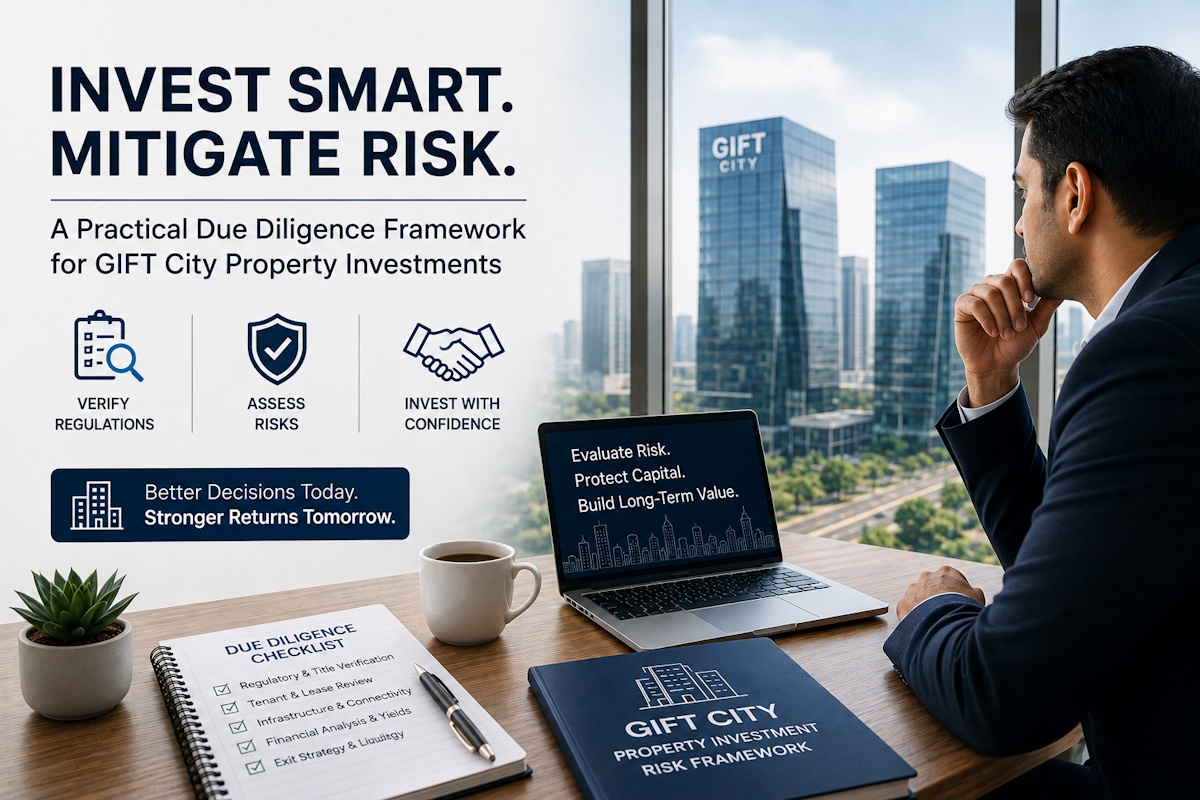
Gujarat International Finance Tec-City represents one of the most ambitious financial district developments in modern Asia. Institutional investors, non-resident Indians, corporate founders, and high-net-worth individuals increasingly look at this master-planned hub as an avenue for capital preservation and growth. However, treating this international financial services centre like a standard domestic real estate micro-market is a critical error. The hybrid governance structure, rapid infrastructure phasing, and distinctive regulatory partitions introduce unique variables that demand a rigorous analytical approach.
Every commercial asset or residential acquisition in this region sits at the intersection of domestic Indian tax laws, international financial services centre guidelines, and specialized municipal operational frameworks. Navigating this environment successfully requires looking past promotional brochures and marketing projections. Establishing a systematic methodology for evaluating GIFT City property investment risks allows investors to differentiate between genuinely high-performing assets and developments burdened by hidden operational friction or regulatory bottlenecks.
Understanding Core GIFT City Property Investment Risks
Institutional capital allocation relies on deconstructing macro-level enthusiasm into measurable operational risks. When evaluating property assets in Gandhinagar, Gujarat, risk does not simply stem from general market cycles. Instead, it originates from the dual-zone economic framework, phased utility execution, and specific leasing guidelines governed by statutory bodies.
The Dual Regulatory Environment: SEZ vs. DTA Distinctions
One of the primary structural risks of investing in GIFT City lies in misunderstanding the strict boundary between the Special Economic Zone and the Domestic Tariff Area. Each zone operates under completely different leasing mandates, tax provisions, and tenant profile criteria. An investor buying commercial square footage in the SEZ zone must ensure that target tenants qualify under International Financial Services Centres Authority regulations.
Tenant Eligibility and Leasing Friction
If you acquire an office unit within the SEZ processing zone, you cannot simply lease it to any domestic enterprise. The occupant must be an authorized unit providing financial services, capital market solutions, professional consulting, or related IT-enabled services to global clients. If an investor purchases an asset without accounting for tenant eligibility restrictions, the property risks enduring prolonged vacancies while waiting for a compliant corporate occupier. Understanding these structural GIFT City investment risks before committing capital prevents costly mismatches between asset location and tenant demand.
Development Timeline and Infrastructure Phasing Risks
While the overall master plan features cutting-edge systems, such as automated waste collection, district cooling systems, and dedicated underground utility tunnels, the operational rollout across individual construction phases varies. Private developers often construct towers at speeds that do not perfectly align with the surrounding municipal utility activations.
Delivery Schedules vs. Actual Occupancy Rates
A residential or commercial tower may receive its official completion certificate, but delayed integration with primary transport links or civic amenities can depress initial occupancy rates. Investors must examine whether physical completion translates immediately to commercial viability, or if the asset will require a holding period before local footfall matches long-term expectations.
Conducting Property Due Diligence in GIFT City Projects
Evaluating individual real estate opportunities in this global financial hub requires moving beyond surface-level finishes and architectural renders. Rigorous property due diligence GIFT City frameworks examine balance sheet solvency, land title integrity, and realistic absorption trends across competing towers.
Developer Track Record and Balance Sheet Solvency
GIFT City projects involve complex structural engineering, specialized district cooling connections, and stringent compliance audits. Developers without deep balance sheets or prior experience in institutional-grade construction often encounter cash-flow strain during execution. Examining the developer’s historical delivery cadence, debt-to-equity ratio, and previous delivery track record across Gujarat or major Indian metros is an indispensable initial step.
Execution Capacity in Specialized High-Rise Formats
High-density commercial towers demand sophisticated mechanical, electrical, and plumbing engineering that integrates seamlessly with the city’s central utility tunnel. A developer lacking institutional backing may struggle with supply chain disruptions or technical approvals, leading to unexpected delivery postponements. A structured GIFT City project due diligence process helps identify whether the development team possesses the financial strength and engineering pedigree to execute projects within projected timeframes.
Supply Overhang and Realistic Yield Projections
Another focal area within GIFT City real estate risks is the divergence between marketing yield claims and achievable gross rental rates. Many speculative brochures quote commercial rental yields based on best-case scenario Grade-A corporate relocations. In reality, rental yields reflect actual corporate absorption rates, the volume of competing floor space coming online simultaneously, and prevailing leasing concessions.
Grade-A Commercial vs. Mid-Tier Office Pricing
When multiple commercial projects reach completion within the same 12-month window, corporate occupiers gain significant bargaining power. Investors who underwrite their acquisitions using peak rental assumptions risk facing compressed yields. Conducting a granular analysis of upcoming square footage across both DTA and SEZ segments provides a clearer picture of competitive pricing dynamics.
Common GIFT City Investment Mistakes and How to Avoid Them
Experienced real estate investors often fall into predictable traps when evaluating an emerging international hub. Recognizing these prevalent GIFT City investment mistakes protects capital from suboptimal allocations and misaligned holding periods.
Misjudging Residential Absorption Dynamics
A frequent error among retail and NRI investors is purchasing residential property under the assumption that commercial office expansion translates overnight into end-user residential demand. GIFT City is located between Ahmedabad and Gandhinagar, meaning a substantial segment of the daily workforce commutes from established residential catchments nearby. Residential absorption within the project boundary requires a clear catalyst, such as walk-to-work culture growth, social infrastructure maturity, and school openings.
The IFSC Workforce Commuting Pattern
Senior executives and international consultants often prioritize integrated township living with established leisure, healthcare, and educational facilities. Until these social components reach critical mass, residential rental yields may lag behind commercial assets. Investors evaluating residential developments must align their liquidity expectations with a multi-year horizon rather than anticipating immediate high-yield short-term leasing.
Overlooking Operational Costs and Maintenance Surcharges
GIFT City operates modern infrastructure utilities, including a centralized district cooling system and automated waste handling. While these sustainable features lower carbon footprints and optimize long-term operational efficiency, their base infrastructure connection charges and maintenance tariffs differ from standard municipal properties. Failing to review these recurring operational expenditures directly inflates your net effective expense ratio.
Utility Costs in District Cooling and Automated Systems
District cooling eliminates individual air-conditioning units, but property owners or tenants pay specialized tonnage and consumption fees. If a commercial space sits vacant, the owner is responsible for baseline standing maintenance charges. Identifying these specific line items early prevents operational surprises and enables accurate net operating income modeling. Reviewing project agreements for potential GIFT City project red flags ensures all maintenance covenants and utility fees are clearly accounted for before finalizing agreements.
The 5-Step GIFT City Project Risk Analysis Checklist
To institutionalize your acquisition strategy, execute a systematic review of every target asset. This comprehensive GIFT City project risk analysis framework serves as a practical filter for corporate and private buyers alike.
Step 1: Regulatory and Title Clearance Verification
Ensure the project holds full approvals from the relevant development authority, Gujarat RERA, and IFSC administrative departments where applicable. Verify whether the underlying plot is on a long-term leasehold from the master developer or held under a specific development concession agreement, as lease terms directly influence title transferability and banking finance.
Step 2: Tenant Base and Occupancy Covenant Review
For commercial pre-leased assets, audit the tenant’s lease tenure, lock-in clauses, security deposits, and corporate balance sheet strength. For vacant properties, evaluate the developer’s leasing partner, existing letters of intent from prospective corporate clients, and the specific zoning categorization governing permitted business activities.
Step 3: Infrastructure Integration and Delivery Timelines
Examine whether the tower is physically connected to the central utility tunnel, active district cooling pipelines, and primary municipal networks. Confirm the actual execution status of planned road access, parking allocations, and mass transit connectivity milestones.
Step 4: Net Cash Flow and Yield Underwriting
Calculate your net operating income by deducting maintenance charges, sinking funds, asset management fees, property taxes, and realistic vacancy contingencies from gross rental income. Stress-test your financial model against a 10 to 15 percent downward adjustment in projected rental rates and prolonged leasing cycles.
Step 5: Liquidity Horizons and Secondary Market Exit Routes
Assess the secondary market liquidity for the asset format you select. Smaller commercial floor plates or flexible office units often offer broader resale liquidity among individual investors, whereas large contiguous floor plates depend on institutional block sales or private equity buyouts.
Institutional Capital Allocation: Balancing Risk and Long-Term Upside
Risk in real estate is rarely absolute; it is a function of acquisition pricing, regulatory alignment, and strategic patience. GIFT City offers a compelling economic premise backed by sovereign policy commitment, expanding international banking units, global fund domiciliation, and modern urban planning. However, capital preservation depends on executing precise due diligence rather than relying on generalized market sentiment.
Working alongside an experienced advisory partner like Gift City Realty enables investors to conduct deep regulatory checks, evaluate developer credentials objectively, and identify assets structured for sustainable rental growth and capital protection. By systematically filtering out regulatory mismatches, inflated yield projections, and developer delivery risks, you position your portfolio to capture the true long-term value created by India’s premier international financial services gateway.
Frequently Asked Questions
1. What is the most critical risk when buying commercial property in GIFT City?
The primary risk is misjudging zoning regulations between the SEZ and DTA areas. SEZ commercial units require tenants to hold valid IFSC authorization, which restricts the potential tenant pool compared to DTA units that can lease to standard domestic Indian firms.
2. How does the leasehold land structure in GIFT City impact property ownership?
Most development parcels in GIFT City are allocated on long-term development leases from the master authority. Investors must review the underlying lease duration, renewal conditions, transfer charges, and sublease permissions to ensure clean property rights.
3. Can non-resident Indians (NRIs) invest in both residential and commercial assets in GIFT City?
Yes, NRIs can legally invest in both residential and commercial real estate across GIFT City under standard Foreign Exchange Management Act guidelines and relevant IFSC investment frameworks. Due diligence should focus on repatriation rules, currency considerations, and applicable withholding taxes.
4. What hidden costs should an investor account for in GIFT City?
Key additional costs include district cooling connection and standing capacity charges, central utility maintenance fees, standard stamp duty and registration fees, and GST on under-construction property. These must be modeled to determine true net yields.
5. Is residential property in GIFT City riskier than commercial property?
Residential real estate carries a different risk profile rather than higher absolute risk. While commercial space benefits directly from corporate relocations, residential demand depends on social infrastructure maturity and local lifestyle adoption, which typically develops across a longer time horizon.