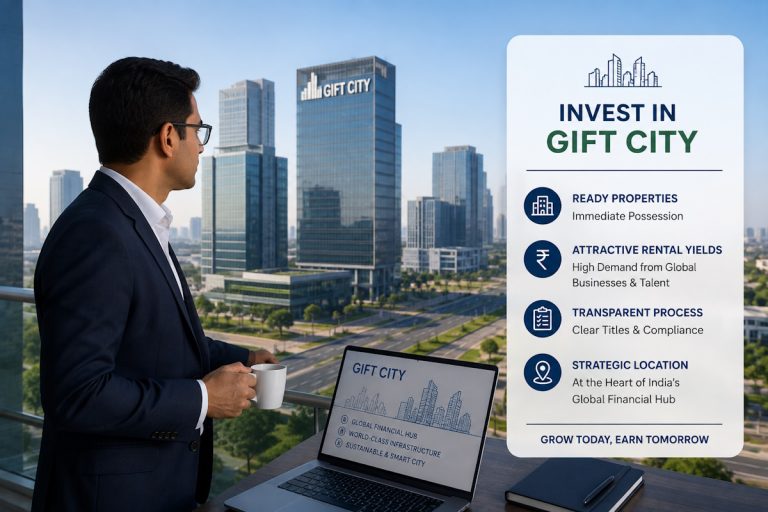

Over the last few years, Gujarat International Finance Tec-City has transitioned from a visionary blueprint into a highly active global financial hub. As India’s premier International Financial Services Centre, this master-planned metropolis attracts global banks, asset management firms, technology giants, and multinational corporations. For domestic investors, high-net-worth individuals, and Non-Resident Indians alike, understanding the current trajectory of GIFT City Property Prices is the critical first step toward successful capital allocation in this unique economic zone.
Evaluating this market requires looking beyond standard real estate metrics. The interplay of special economic zone rules, tax exemptions, and state-backed infrastructure initiatives creates a pricing environment unlike any other micro-market in India. To make an informed, risk-adjusted decision, investors must analyze how these regulatory dynamics directly impact asset valuations, demand-supply gaps, and long-term rental yields. Working with an experienced advisory partner like Gift City Realty can help you navigate these complexities to secure high-performing assets.
Decoding the Valuation: What Drives GIFT City Property Prices?
Real estate valuations in GIFT City do not follow the typical supply and demand patterns of standard metropolitan cities. Instead, they are deeply tied to regulatory approvals, infrastructure milestones, and global corporate interest. Because the city is built on a smart-city framework with centralized infrastructure, developers face higher initial development costs, which naturally sets a premium base price for all inventory.
The Dual-Zone Framework: SEZ vs. Non-SEZ Rates
One of the most important factors influencing GIFT City property rates is the zoning division between the Special Economic Zone and the Non-SEZ domestic area. The SEZ area is designed strictly for offshore financial services, technology exporters, and allied businesses. Properties in the SEZ often command a different pricing structure because of the strict compliance requirements associated with occupying these spaces. On the other hand, the Non-SEZ area caters to domestic businesses, retail operations, and residential developments, making it a highly liquid and versatile investment zone for individual buyers.
Regulatory Catalysts and Tax Advantages
The regulatory environment acts as a massive tailwind for real estate appreciation. With corporate tax holidays, zero Goods and Services Tax on services, and relaxed foreign exchange regulations, multinational corporations are actively acquiring commercial footprints here. This business influx drives a secondary wave of demand for executive housing, which in turn pushes up residential valuations. Investors must view the prevailing property prices through the lens of these policy incentives, as they ensure a steady pipeline of high-earning corporate tenants.
Infrastructure Readiness and Connectivity
GIFT City features world-class infrastructure, including automated waste collection, district cooling systems, and dedicated power grids. These amenities minimize operational overhead for corporate tenants and provide a superior quality of life for residents. As connectivity projects, such as the upcoming metro line expansion and upgraded highway access to Ahmedabad and Gandhinagar, move closer to completion, the premium associated with these amenities is actively compounding, pushing real estate values upward.
Residential Real Estate Pricing and Yield Potential
For a long time, residential real estate in this hub was considered secondary to commercial spaces. However, the regulatory shift allowing individuals not working within the city limits to own residential property has unlocked a wave of private capital. This policy change has triggered a sharp upward movement in residential valuations as buyers realize the long-term scarcity of residential land inside the city boundaries.
Average GIFT City Flat Price Trends
When analyzing the typical GIFT City flat price, buyers will notice a distinct premium compared to the neighboring Gandhinagar and Ahmedabad markets. This pricing premium is justified by the strict master-plan limits on residential high-rises. Because only a limited percentage of the total built-up area is designated for housing, residential units are inherently scarce assets. Buyers looking at luxury configurations or premium executive apartments should prepare for entry prices that reflect this structural supply-demand imbalance.
Premium Cohorts: Co-living vs. Luxury Apartments
The residential market is broadly divided into two distinct investment categories. The first consists of compact, functional co-living spaces and studio apartments tailored for the thousands of young technology and finance professionals commuting daily. The second category comprises luxury multi-bedroom apartments designed for CXOs, senior banking partners, and expatriates who demand premium finishes, clubhouses, and private amenities. Both cohorts command distinct price points and require different capital commitment strategies.
Understanding Rental Yield Projections
In mature Indian metropolitan cities, residential rental yields typically hover around two to three percent. However, the unique corporate ecosystem in GIFT City supports significantly higher yields. Because many multinational employers provide housing allowances or lease apartments directly for their senior executives, landlords can secure premium rents. Well-located properties are currently yielding exceptional returns, making the initial acquisition cost highly justifiable for cash-flow-focused investors.
Commercial Property Dynamics in the IFSC
Commercial real estate remains the foundational bedrock of GIFT City’s economic model. Institutional investors and corporate buyers are aggressively acquiring office spaces to capitalize on the rapid influx of global financial institutions, domestic mutual funds, and international tech firms setting up offices in Gujarat. Recent commercial activity, including Incuspaze’s 60,000 sq ft office expansion deal in the Ahmedabad-GIFT City corridor, highlights the growing demand for Grade-A workspace around the financial hub.
Commercial Property Price GIFT City Benchmarks
The typical commercial property price GIFT City offers depends heavily on whether the asset is Grade-A office space, retail storefront, or specialized IT park inventory. Grade-A commercial spaces, which feature column-free designs, high energy efficiency, and advanced security protocols, command the highest pricing tier. Institutional buyers often look at these assets for their stable long-term lease covenants, where tenant commitments typically span five to nine years with structured rental escalations.
Grade-A Office Space Demand Drivers
The primary driver of commercial valuations is the rapid setup of Global Capability Centers and International Branch Campuses of foreign universities. These institutions require massive square footage that complies with international building codes. For individual retail investors, fractional commercial ownership or purchasing smaller commercial office units offers an accessible entry point to benefit from these high-profile corporate tenants without committing massive institutional-scale capital.
Comparing GIFT City Property Rates with Key Indian Micro-Markets
To put GIFT City Property Prices into perspective, it is useful to compare them with other prominent commercial and residential financial districts across India, such as Mumbai’s Bandra-Kurla Complex or Gurgaon’s Cyber City.
GIFT City vs. Mumbai (BKC) and Gurgaon
While Mumbai’s BKC and Gurgaon’s Cyber City are mature, high-density business hubs, they also feature incredibly high entry costs and saturated infrastructure. In contrast, GIFT City property rates are currently priced at a fraction of these mature markets, despite offering comparable smart-city utility services and superior tax exemptions. This pricing gap represents a highly lucrative arbitrage opportunity for early to mid-stage investors who want to capture significant capital appreciation as the city matures over the next decade.
The Arbitrage Opportunity for Institutional Buyers
Institutional buyers, family offices, and HNIs are increasingly shifting a portion of their real estate portfolios away from saturated Tier-1 micro-markets to this financial hub. The combination of lower acquisition costs, tax-free business environments, and a growing tenant base of high-paying global firms creates an investment profile that is difficult to replicate anywhere else in South Asia.
Critical Factors and Risks to Evaluate Before Investing
While the growth narrative surrounding GIFT City is incredibly strong, sophisticated investors must approach the market with a balanced, risk-aware perspective. Not all projects will appreciate at the same rate, and choosing the wrong developer or configuration can impact your long-term liquidity.
Developer Track Record and Execution Risk
With capital flooding into the region, many new developers are launching projects. Investors must prioritize developers who have a proven track record of timely delivery, construction quality, and successful commercial leasing. Look for projects backed by institutional funding or developers who have successfully executed complex structural designs in other major cities. Working with trusted advisory platforms like Gift City Realty ensures that you only review fully vetted, legally compliant, and high-quality inventory.
Liquidity and Exit Strategy Considerations
Real estate is inherently an illiquid asset class, and GIFT City is no exception. Before buying, you should clearly define your exit strategy. Are you investing for long-term rental cash flow, or do you plan to exit via capital appreciation in five to seven years? Understanding the local transfer charges, resale market dynamics, and the target audience for secondary sales will help you structure your purchase for maximum flexibility when the time comes to liquidate your asset.
Capital Allocation Strategy: How to Approach Your Purchase
To maximize your return on investment, we recommend a highly structured approach to property selection in this unique financial zone. First, clearly define your investment objective, deciding whether your primary goal is stable monthly yield or aggressive capital appreciation. Commercial spaces and co-living apartments are excellent for cash flow, while premium residential apartments offer higher potential for long-term capital gains as the city’s executive population expands.
Next, perform rigorous due diligence on the developer’s approvals and RERA status. Ensure that the project aligns with the Master Plan and does not face any zoning hurdles. Finally, secure professional local representation to handle regulatory compliance, registration, and tenant sourcing, especially if you are an NRI or institutional buyer managing your investments remotely.
Frequently Asked Questions
1. What is the average price range for a residential flat in GIFT City?
The residential pricing in GIFT City varies based on the configuration, project premium, and location. Currently, a premium GIFT City flat price starts higher than neighboring regional markets due to the limited availability of residential land within the smart city boundaries and the high standard of integrated infrastructure provided to residents.
2. Are NRI investors allowed to buy property in GIFT City?
Yes, Non-Resident Indians can easily purchase both residential and commercial properties in GIFT City. The regulatory framework, supported by the Reserve Bank of India and the IFSC Authority, offers a highly streamlined, investor-friendly process for inbound capital, making it one of the most attractive investment destinations for global Indians.
3. How do commercial property rates in GIFT City compare to nearby cities?
While the average commercial property price GIFT City offers is higher than the broader Gandhinagar and Ahmedabad municipal limits, it is significantly more affordable than prime commercial areas in Mumbai, Bangalore, or Delhi NCR. This pricing difference, coupled with unique tax benefits, makes it highly competitive for corporate occupiers.
4. What makes GIFT City a better investment than standard Indian real estate markets?
GIFT City is India’s only operational IFSC, offering unparalleled tax incentives, single-window clearances, and world-class, centralized utility infrastructure. These unique advantages attract top-tier global corporate tenants, which helps maintain high occupancy levels, stable rental yields, and consistent capital appreciation over time.