The Definitive Guide to GIFT City Property Prices: Trends and Projections (2020–2026)
For high-net-worth individuals, NRIs, and institutional investors, real estate valuation in India’s International Financial Services Centre (IFSC), GIFT City, is not a typical calculation. Unlike conventional markets driven primarily by demographic growth, GIFT City property prices are dictated by regulatory certainty, institutional migration, and the operational momentum of the SEZ.
The period between 2020 and 2026 represents a critical transformation phase for the city, shifting from foundational construction to high-velocity operational status. Evaluating current GIFT City property rates and projecting future appreciation requires a deep understanding of these non-traditional demand drivers. This advisory guide provides a framework for investors seeking long-term value, focusing on the factors that will shape GIFT City real estate trends in the coming years.
The Core Drivers of GIFT City Property Prices: Policy Over Demographics
When assessing investment viability, the first step is separating GIFT City from surrounding markets. Its pricing power is derived from its unique status, specifically the regulatory arbitrage it offers to financial entities.
Regulatory and Fiscal Arbitrage: The Value Catalyst
The primary driver sustaining premium GIFT City property prices is the IFSC framework. Tax holidays, capital market exemptions, and relaxed regulatory environments for foreign entities translate directly into a guaranteed demand for high-grade commercial and supporting residential space. Investors are buying into an ecosystem underpinned by central government policy, reducing the commercial risk inherent in local market fluctuations.
Why IFSC Status Inflates Property Rates
- Captive Demand: Financial institutions are mandated or heavily incentivized to operate within the SEZ/IFSC limits, guaranteeing sustained commercial occupancy.
- Tax Shielding: The tax advantages associated with IFSC operations allow tenants to tolerate higher rental costs, supporting premium GIFT City property rates.
- Global Benchmarking: As GIFT City competes with Singapore, Dubai, and Hong Kong, its Grade-A assets are benchmarked against global financial centers, pushing valuations upward.
Infrastructure Velocity and Completion Status
Investment value is highly correlated with execution risk. In the context of GIFT City property prices, the speed at which central infrastructure (utility tunnels, district cooling, smart services, and connectivity) becomes fully operational significantly de-risks new projects. The closer a project is to completion and connectivity, the lower the inherent pricing discount.
Investors must closely track the handover timelines of key complementary assets, such as the operational status of the metro line extension and key bridge connections to Ahmedabad and Gandhinagar. These factors directly influence liquidity and rental feasibility for the residential segments, which lagged in the initial phase but are now showing strong signals in GIFT City real estate trends.
Investment Action Point: Understanding how regulatory certainty translates to asset value is crucial. Are you confident in your current property valuations? Schedule an Investment Consultation to receive project-specific ROI projections and evaluate how IFSC policies stabilize GIFT City property prices.
Schedule an Investment Consultation | Explore GIFT City Projects
Retrospective Analysis: Navigating GIFT City Property Prices (2020–2023)
The 2020–2023 cycle was defined by two major factors: the global pivot toward operational resilience post-pandemic and the accelerated regulatory support for the IFSC. This period saw a shift from speculative interest to transaction-based valuation, confirming the robustness of GIFT City property rates.
Commercial Segment Performance and Early Appreciation
During this timeframe, the commercial segment (SEZ and Non-SEZ Office Spaces) acted as the primary growth engine. GIFT City price appreciation in Grade A office space stabilized dramatically, seeing an approximate 15–25% increase in capital values for ready-to-move inventory between late 2020 and the end of 2023, depending on the developer and location within the zone.
The key takeaway from this phase is the concept of “scarcity premium.” As prime SEZ space became operational and swiftly occupied by large anchor tenants (banks, insurance, fintech), the remaining inventory commanded higher GIFT City property prices. Investors who entered the market pre-2020 benefitted from the initial regulatory boost and subsequent operationalization.
Residential Segment Stabilization and Latent Demand
Residential GIFT City real estate trends lagged commercial growth initially, which is typical for a new business district. However, by 2023, high occupancy rates in the commercial towers began to exert pressure on the surrounding residential supply. We observed two key shifts:
- Increased rental yields in premium residential offerings catering to CXOs and senior management.
- The compression of the capital value gap between high-quality residential apartments and mid-tier commercial assets, indicating increased confidence in future population influx.
Residential GIFT City property rates in the most sought-after projects began their sharp ascent only after the commercial segment achieved critical mass, confirming the dependency of the live-work ecosystem.
Forward Projection: Mapping GIFT City Real Estate Trends (2024–2026)
The investment thesis for the 2024–2026 window is centered on scale, institutional validation, and diminishing available land parcels. This phase is projected to realize the most significant GIFT City price appreciation as the ecosystem approaches full capacity.
The Influx of Institutional Demand
As GIFT City matures, the risk perception among large institutional investors, Private Equity funds, and REITs diminishes. Their entry into the market is typically non-negotiable on price and focuses on bulk acquisition of yielding assets. This competition dramatically influences GIFT City property prices.
Retail and individual investors must recognize that the remaining window to acquire assets before institutional players fully dominate the yielding inventory is narrowing. This pressure from institutional capital seeking stable, policy-backed assets will serve as a strong floor for current GIFT City property rates.
Supply Side Dynamics and Upcoming Inventory
While several large developers have upcoming launches, the supply of fully approved, high-quality Grade A space within the notified SEZ is inherently finite. The approval and construction cycle for large commercial towers ensures that supply cannot instantly meet accelerated demand. This creates temporary imbalances that result in sharp, non-linear jumps in GIFT City price appreciation.
Prudent investors are evaluating projects based on the developer’s capacity to deliver within the 2024–2026 window, specifically targeting projects that will become available during peak demand cycles. The greatest mistake is investing in projects that will deliver late, missing the critical inflection point of institutional validation.
Investor Advisory: The market is moving quickly toward maturity. To secure access to projects positioned to deliver peak returns in the 2024–2026 cycle, expert guidance is non-negotiable. Request detailed property specific data, including phase completion projections and comparative GIFT City property rates.
Calculating Realistic GIFT City Price Appreciation Targets
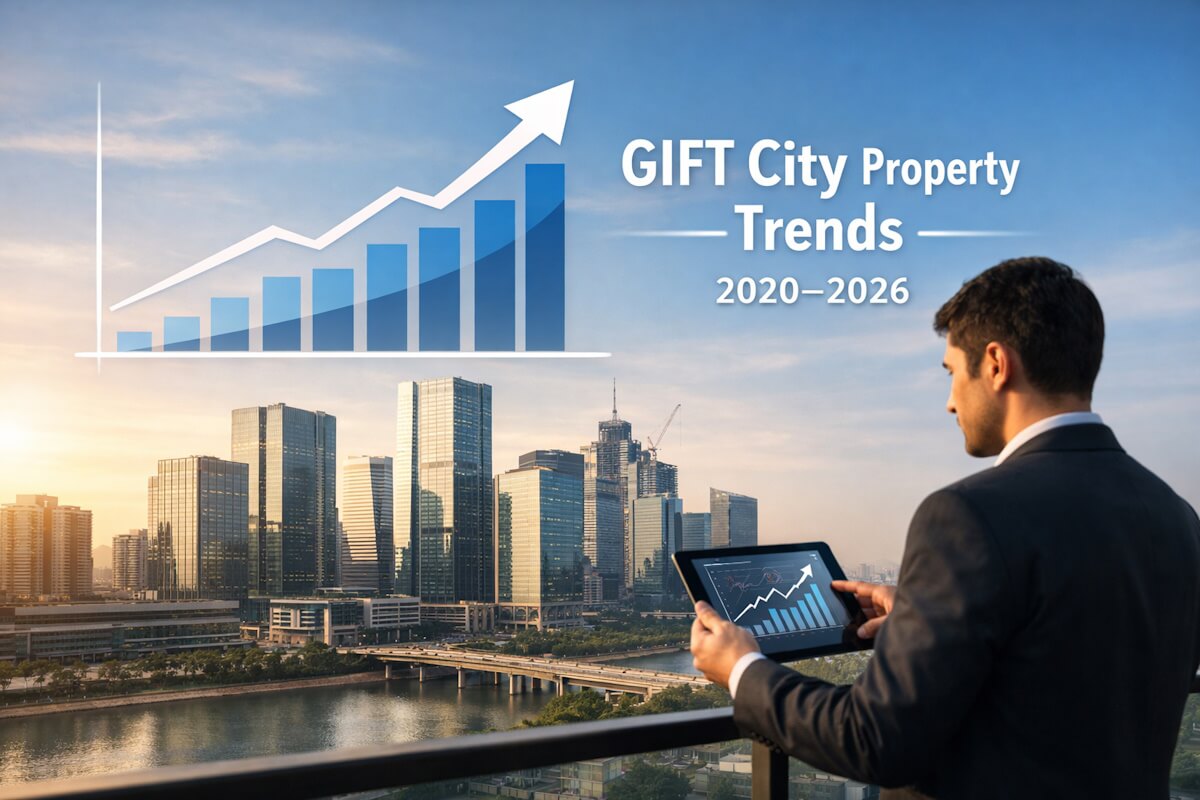
We project that high-quality commercial assets could see annualized capital growth in the high single digits to low double digits (7–12%) throughout this period, overlaid on stable rental yields (5–7%). This combined Return on Investment (ROI) makes the proposition exceptionally attractive compared to capital markets or traditional Indian metropolitan real estate.
For residential segments, the appreciation will be more front-loaded as the city achieves a normalized resident population. We anticipate a faster growth rate in residential GIFT City property prices between 2024 and 2025 (as much as 15–20% cumulative appreciation) followed by stabilization, mirroring the initial surge seen in commercial assets years earlier.
Strategic Investment Assessment: Mitigating Risk and Maximizing ROI
Investment success in GIFT City hinges on making the right allocation choices—commercial or residential—based on risk tolerance and financial goals.
Commercial vs. Residential: Yield vs. Appreciation
The decision to invest in commercial versus residential property is fundamentally a choice between immediate yield and aggressive capital appreciation potential, respectively. Commercial assets offer high stability, thanks to long lock-in leases with creditworthy tenants (banks, exchanges). These properties are ideal for income-focused investors who prioritize steady cash flow and stability in their GIFT City property rates.
Residential assets offer lower initial yields but higher leverage for capital growth, particularly for pre-leased or ready-to-move inventory that benefits immediately from the influx of professionals. The risk is slightly higher due to potentially slower leasing velocity compared to large commercial anchors, but the potential for GIFT City price appreciation is more pronounced in the short term (2024–2025).
Analyzing Developer Track Records and Project Phasing
In a rapidly developing SEZ like GIFT City, the developer’s execution history is more critical than the specific project name. Investors must assess whether the developer has successfully completed large-scale projects within the zone, particularly those requiring complex regulatory compliance and high-quality construction standards necessary for IFSC tenants.
A reputable developer minimizes execution risk, ensuring assets are delivered on time, maximizing the probability that your investment capitalizes on projected GIFT City real estate trends rather than missing the window due to delays. We at Gift City Realty focus on vetting developers based on their operational history within the GIFT environment, providing a layer of due diligence for our clients.
The Liquidity Challenge in an Emerging Market
While GIFT City property prices are strong and appreciating, investors must acknowledge the liquidity profile of an emerging financial city. Transaction volumes are lower than in established tier-one metros. The market favors patient, long-term investors. Early exit strategies require realistic pricing expectations and targeted marketing to specialized investor pools.
We advise clients to adopt a minimum 5–7 year horizon. This duration aligns with the full realization of operational tax benefits and ensures the investment is fully validated by market maturity, protecting the realized GIFT City price appreciation.
Navigating the Maturation of GIFT City Real Estate Investment
The journey of GIFT City from a policy vision to an operational reality offers a clear roadmap for investors. The 2020–2026 phase encapsulates the transition from high risk/high reward to stabilized, policy-backed growth. Investors who analyze the market through the lens of regulatory arbitrage and operational velocity, rather than generic real estate commentary, are best positioned to capitalize on sustained GIFT City real estate trends.
Understanding the micro-drivers—such as the occupancy rate of anchor IFSC institutions and the timeline for critical infrastructure completion—is essential for accurately projecting future GIFT City property prices. The window for achieving pre-validation capital appreciation is closing; expert guidance is necessary now to structure a portfolio optimized for security, yield, and appreciation within this dynamic financial ecosystem.
Final Step for Investors: Don’t rely on broad market projections. Request ROI Estimates tailored to specific property types (commercial SEZ, non-SEZ, or premium residential) to finalize your investment strategy based on verifiable GIFT City property rates and future forecasts.
Frequently Asked Questions (FAQs) on GIFT City Property Investment
What is driving the current high demand for GIFT City property prices?
The demand is primarily driven by the policy mandates and tax incentives provided by the IFSC/SEZ status. Financial institutions must occupy space to avail these benefits, creating inelastic demand for commercial real estate, which in turn supports adjacent residential GIFT City property rates.
Is it too late to benefit from GIFT City price appreciation?
No. While the early speculative appreciation has passed, the 2024–2026 phase is characterized by validation-driven appreciation. Returns will be realized as the ecosystem reaches full operational scale and institutional buyers enter the market, solidifying current GIFT City real estate trends and prices.
How do GIFT City property rates compare between SEZ and Non-SEZ areas?
SEZ commercial property commands a premium due to the exclusive regulatory benefits available only within that notified area. Non-SEZ commercial and residential property prices are generally lower but offer strong appreciation potential derived from the necessity to house the workforce and provide supporting services outside the core financial zone.
What is the typical rental yield for commercial properties in GIFT City?
Prime, stabilized commercial assets often provide gross rental yields in the 5% to 7% range. When combined with the projected capital appreciation and significant tax advantages, the net ROI often exceeds that of established metros like Mumbai or NCR.