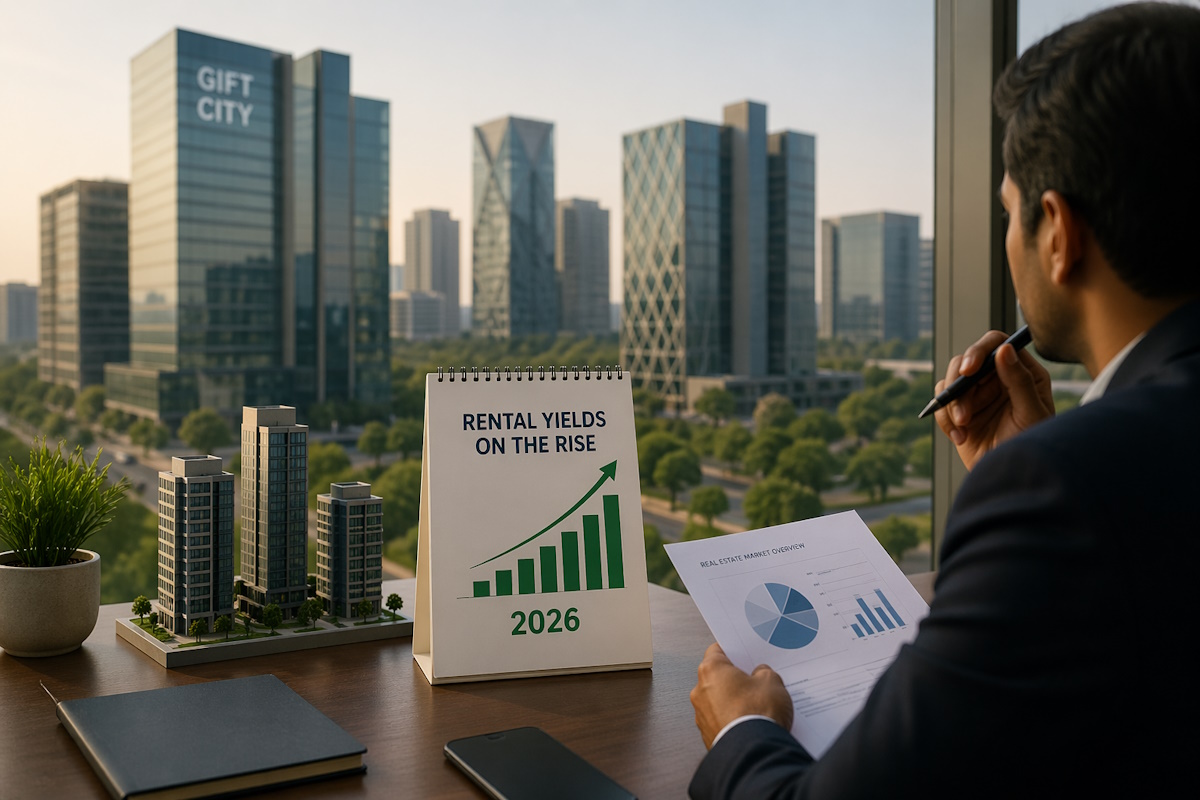
The transition of GIFT City from a visionary master plan to a functional international financial services center is entering its most critical phase. For early investors, the primary motivation was capital appreciation driven by infrastructure development. However, as we approach 2026, the narrative is pivoting toward income generation. The influx of multinational corporations, global banks, and fintech startups is creating a structural demand for both high-end commercial spaces and premium residential housing that current supply is struggling to meet.
Understanding the trajectory of GIFT City rental yields requires a move beyond optimistic projections toward a data-driven analysis of market absorption. By 2026, several million square feet of commercial office space will be occupied by a workforce that demands proximity, quality, and modern amenities. For the sophisticated investor, this represents a window to secure assets that offer not just stable cash flow but a yield profile that competes with established global financial hubs like Dubai or Singapore, adjusted for the Indian growth context.
The Macroeconomic Drivers of GIFT City Rental Yields in 2026
The primary driver for rising rental yields in any emerging economy is the concentration of high-value human capital. In GIFT City, this is facilitated by the IFSC (International Financial Services Centre) framework, which attracts firms by offering a competitive tax environment. As these firms scale their operations, the demand for “walk-to-work” residential options becomes acute. This demand is not just about quantity but about a specific standard of living that executives from global entities expect.
By 2026, the ecosystem will have moved past the initial setup phase. Most major banking units and aircraft leasing firms will have fully transitioned their staff to the zone. This creates a reliable tenant base consisting of high-earning professionals, which is the cornerstone of high rental yields. Investors should evaluate projects not just on their current price per square foot, but on their ability to attract this specific demographic. To understand the broader market, investors often look at GIFT City property investment trends to gauge entry points.
The Demand-Supply Imbalance in Residential Segments
One of the most compelling reasons why GIFT City rental yields are expected to climb is the current lag in residential completions relative to commercial occupancy. While office towers are being filled rapidly, the delivery of premium residential units is following a slower curve. This imbalance is a classic precursor to rental spikes. Investors who identify projects nearing completion in 2025 or early 2026 are likely to capture the highest initial yields as the first wave of resident professionals competes for limited housing stock.
Commercial Occupancy and Yield Compression
In the commercial sector, the yields are being driven by long-term leases with institutional tenants. Unlike retail residential markets, these leases often include escalations and are backed by corporate guarantees. As the vacancy rates in Grade-A offices drop below 10% by 2026, we anticipate a shift from a tenant-favorable market to an owner-favorable market. This shift is where yield compression begins to happen, eventually leading to higher asset valuations.
Comparing Asset Classes: Residential vs. Commercial Yields
A frequent question among HNIs and NRIs is whether to allocate capital toward residential apartments or commercial office units. In the context of 2026, both have distinct advantages. Residential properties in GIFT City typically offer higher liquidity and a lower entry barrier, whereas commercial properties provide higher stability and longer lease terms. However, the emergence of serviced apartments as a sub-category is creating a middle ground that targets the transient executive population.
Residential yields in GIFT City have historically hovered around 3 to 4 percent, but as the 2026 milestone approaches, we anticipate these moving toward the 5 to 6 percent range for well-located assets. This is significantly higher than the average in other Indian metropolitan areas. For commercial assets, net yields are expected to stabilize around 7 to 9 percent, depending on the quality of the tenant and the lease structure. Many investors are now reviewing NRI real estate investment frameworks to optimize their tax outgo on these yields.
The Rise of Managed Living and Co-living Spaces
The workforce in GIFT City is predominantly young, mobile, and tech-savvy. This has led to a surge in interest for managed living spaces. For an investor, these units often command a premium rental price because they include services like housekeeping, high-speed internet, and community management. From a yield perspective, managed spaces can outperform traditional residential rentals by 15 to 20 percent, provided the management agency is reputable.
Strategic Importance of Grade-A Office Space
Not all commercial space is created equal. Investors must distinguish between generic office space and Grade-A IFSC-compliant buildings. The latter are the only ones capable of housing international banks and financial institutions. These tenants are less price-sensitive regarding rent but highly sensitive regarding building specs and compliance. Investing in these specialized assets is a direct play on the growth of the IFSC, offering more resilient GIFT City rental yields during market fluctuations.
Regulatory and Tax Implications on Net Rental Income
For a serious investor, gross yield is a vanity metric; the net yield is what defines success. GIFT City offers unique fiscal advantages that directly impact the bottom line. The absence of certain local taxes and the specific provisions for units operating within the IFSC mean that the operational costs for commercial tenants are lower, allowing them to sustain higher base rents. Furthermore, for the investor, the tax treatment of rental income, especially for NRIs, is a critical factor to calculate.
By 2026, the regulatory environment is expected to be even more streamlined. The Gift City Realty advisory team notes that investors should look closely at the “net-of-tax” yield. In many cases, an 8 percent yield in GIFT City can be more profitable than a 9 percent yield elsewhere once you factor in the efficiency of the tax regime and the lower maintenance costs associated with the city’s centralized cooling and waste management systems. Utilizing tax-efficient investment structures is essential for maximizing these returns.
Impact of the Unified Regulator (IFSCA)
The International Financial Services Centres Authority (IFSCA) provides a single-window clearance and a unified regulatory environment. This reduces the friction of doing business, which in turn increases the “stickiness” of tenants. When tenants stay longer and face fewer bureaucratic hurdles, the vacancy periods for investors decrease. Lower vacancy is the most effective way to protect and grow GIFT City rental yields over a five-to-ten-year horizon.
Future-Proofing Assets Through Sustainability
GIFT City is designed as a greenfield smart city. Properties that adhere to high ESG (Environmental, Social, and Governance) standards are increasingly preferred by multinational tenants. By 2026, many global firms will have internal mandates to only lease spaces in LEED-certified or equivalent buildings. Investors who prioritize green-certified assets are essentially future-proofing their rental income against evolving corporate social responsibility requirements.
Common Investment Pitfalls and How to Mitigate Risk
While the outlook for GIFT City rental yields is positive, investors must remain vigilant against certain risks. The most common mistake is over-leveraging on projects that are in the very early stages of development with distant completion dates. While the entry price might be lower, the “yield-on-cost” is zero until the building is occupied. Another risk is miscalculating the demand for specific unit sizes. For example, an oversupply of small studio apartments could lead to high turnover and increased maintenance costs.
To mitigate these risks, investors should focus on developer track records and the specific micro-location within the city. Proximity to the automated waste collection centers, district cooling taps, and utility tunnels is not just a technical detail—it impacts the long-term desirability of the property. Those looking for stability should prioritize GIFT City commercial real estate with pre-leased options or strong letters of intent from reputable firms.
Evaluating Developer Credibility and Delivery Timelines
In a rapidly developing zone, the ability of a developer to deliver on time is the difference between a high-yield asset and a stalled liability. Before committing capital, investors should investigate the developer’s history in GIFT City specifically. Have they delivered previous phases? Are their buildings occupied? At Gift City Realty, we emphasize that the 2026 yield projections are only valid for assets that are operational by that time. A delay of even 12 months can significantly alter the internal rate of return (IRR).
Assessing the Depth of the Secondary Market
Yield is a function of price. If the secondary market for these assets remains thin, the ability to realize gains or accurately price the rental becomes difficult. However, by 2026, we expect a robust secondary market to have developed, supported by institutional buyers and Real Estate Investment Trusts (REITs). This institutional interest provides a “floor” for property prices and helps stabilize rental benchmarks across the city.
The 2026 Outlook: A Tipping Point for Institutional Interest
As we look toward 2026, the profile of the average GIFT City investor is changing. We are seeing a move from individual retail investors to family offices and institutional funds. This shift is significant because institutional investors typically prioritize yield over speculative appreciation. Their entry into the market usually signals that the asset class has matured. For the individual investor, this is the time to consolidate holdings before yield-driven institutional buying pushes entry prices higher.
The total ecosystem in Gujarat is being positioned as a gateway for global capital into India. This means that GIFT City rental yields are not just local figures; they are part of a global comparison. As the infrastructure becomes more lived-in and the social fabric of the city—schools, hospitals, and retail—fully develops by 2026, the “risk premium” associated with the city will decrease. This reduction in perceived risk is a primary catalyst for long-term rental growth and investor confidence. Reviewing residential opportunities in GIFT City now allows investors to capture this transition.
The Role of Social Infrastructure in Driving Rents
A city is more than just office buildings. The completion of high-end retail zones and international schools by 2026 will make GIFT City a viable primary residence for families, not just a weekday base for bachelors. This transition is crucial for the residential rental market. Family-oriented housing tends to have longer lease durations and lower turnover, which stabilizes the rental yield and reduces management overhead for the landlord.
Strategic Allocation for 2026 and Beyond
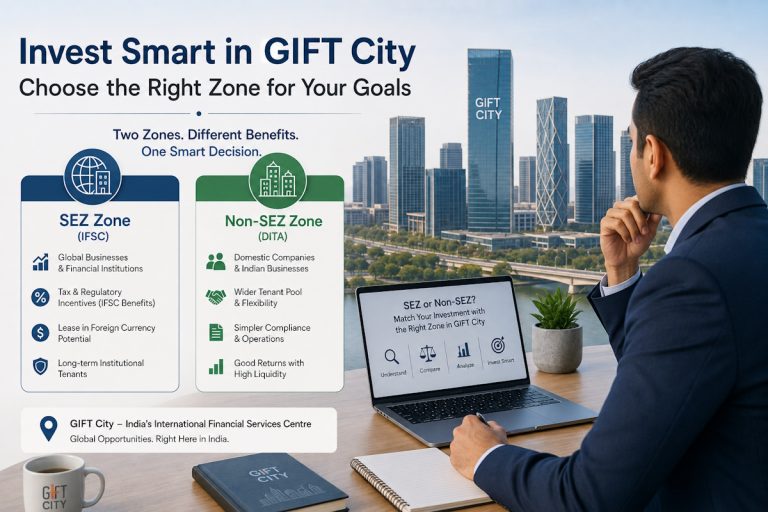
Investment in GIFT City should be viewed through a five-to-ten-year lens. While 2026 represents a major milestone for rental yields, it is merely the beginning of the city’s operational life. Investors should aim for a balanced portfolio that includes a mix of immediate-yield commercial assets and high-growth potential residential units. By diversifying across the SEZ and Non-SEZ areas, investors can hedge against specific regulatory changes while maximizing their exposure to the city’s overall growth.
Decision-Making Framework for GIFT City Investors
Deciding where to allocate capital in GIFT City requires a clear understanding of your financial objectives. If your goal is immediate cash flow, the commercial sector remains the strongest contender. If you are looking for a mix of high rental growth and future personal use, the residential sector in the Non-SEZ zone offers more flexibility. The 2026 horizon is a unique moment where the infrastructure is ready, the demand is proven, but the prices have not yet fully priced in the future rental potential.
Before moving forward, ask yourself if your chosen asset aligns with the 2026 occupancy trends. Is the project within walking distance of the major commercial blocks? Does the developer have a plan for facility management? These are the factors that will ultimately determine your success. At Gift City Realty, we help investors navigate these questions with objective data and deep local expertise, ensuring that your investment is positioned for maximum yield in the evolving landscape of India’s first smart city.
Frequently Asked Questions
1. What is the average expected rental yield in GIFT City by 2026?
While residential yields are projected to reach 5-6%, commercial Grade-A offices are expected to yield between 7% and 9%. These figures depend heavily on the specific project’s location and building quality.
2. Are yields higher in the SEZ or Non-SEZ areas?
Commercial yields are generally higher and more stable within the SEZ (IFSC) due to institutional demand. Residential yields are currently more robust in the Non-SEZ areas where a wider variety of tenants can reside.
3. How does the 2026 timeline affect my investment today?
Investing now allows you to enter at a lower cost basis before the 2026 “operational surge.” As the city reaches a critical mass of residents and workers, both rents and property values are expected to adjust upward.
4. Do NRIs face different tax rules on rental income in GIFT City?
NRIs are subject to Indian tax laws on rental income, but those investing through IFSC-registered entities or specific structures may benefit from tax treaties and the specific fiscal advantages offered by the GIFT City regulatory framework.
5. Is it better to invest in a finished property or an under-construction one for yield?
Under-construction properties offer higher capital appreciation potential, but finished or near-completion properties are better for investors prioritizing immediate rental yields and lower delivery risk.