
The investment narrative surrounding Gujarat International Finance Tec-City, widely known as GIFT City, has entered a critical new phase. For years, institutional capital focused strictly on Grade-A commercial office spaces, banking units, and global treasury centers. Today, however, a profound structural shift is underway as the master plan transitions from a pure-play financial district into a comprehensive, high-density residential ecosystem. Serious investors are looking beyond commercial leases to analyze the long-term potential of gift city residential flats, recognizing that a world-class financial center cannot function without premium housing options for its highly paid workforce.
As we look toward the year 2030, the demand for residential real estate in this special economic zone is poised to outstrip supply. High-net-worth individuals, non-resident Indians, and corporate executives are assessing the landscape to determine how this unique regulatory jurisdiction will impact residential values over the next decade. Choosing the right entry point requires a deep, analytical look at demographic shifts, urban planning milestones, and regulatory frameworks that differentiate GIFT City from traditional micro-markets in India. To make an informed decision, you can explore our curated selection of residential properties in GIFT City to align your capital with the highest-performing developments.
The Strategic Shift: Transitioning from a Financial Hub to a Live-Work-Play Ecosystem
Understanding the macro trajectory of GIFT City is essential for any real estate investor. The master planners designed this urban center with a specific vision: a smart city where professionals do not have to commute long distances. This walk-to-work philosophy is the foundational pillar driving the residential real estate market here.
Commercial Growth as a Catalyst for Residential Demand
The acceleration of commercial occupancy is directly fueling the need for high-quality housing. As global investment banks, multinational tech giants, and international universities establish their physical presence, thousands of high-earning professionals are relocating to the region. This influx creates an immediate, highly captive demographic that seeks sophisticated housing near their workplaces. The ongoing GIFT City future development plan outlines a massive expansion of commercial spaces, which will inevitably multiply the local white-collar population. Investors who secure premium residential spaces today are positioning themselves to capture this wave of incoming tenant demand.
The Walk-to-Work Concept and Urban Planning
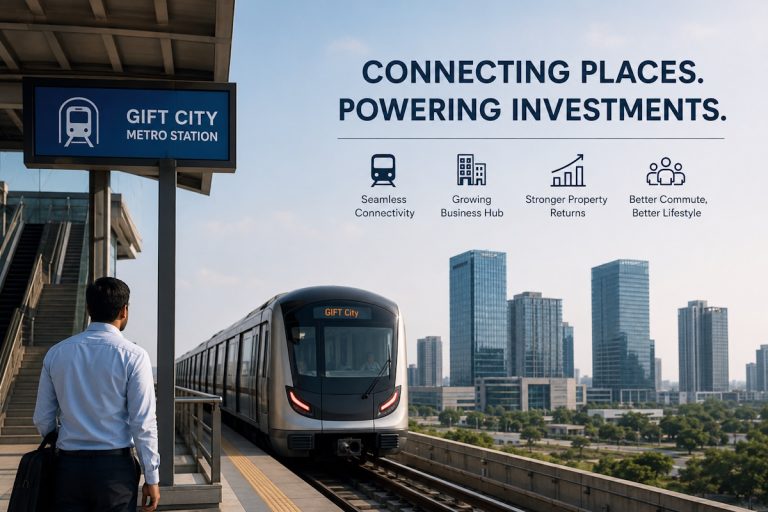
Unlike standard Indian metropolitan areas where commuting consumes hours of daily life, GIFT City emphasizes a highly integrated structure. The residential zones are physically connected to the commercial and social districts via advanced transit systems, pedestrian-friendly pathways, and smart utility grids. This level of planned integration ensures that demand for housing remains concentrated within the city limits. Investors should evaluate how projects leverage this layout to maximize convenience for tenants, as properties with superior connectivity to the international financial services centre zone will command the highest premiums.
Schedule an Investment Consultation
Analyzing the Financial Fundamentals of Gift City Residential Flats
Investing in real estate requires a rigorous focus on financial metrics, specifically capital appreciation curves and rental returns. The residential sector in GIFT City is unique because it operates within a highly regulated, tax-advantaged environment that directly influences asset values.
Tracking GIFT City Property Prices: Current vs. 2030 Projections
Historically, real estate values in this micro-market have experienced steady upward pressure, driven by infrastructure completion and policy announcements. Current GIFT City property prices reflect a market that is transitioning from early-stage speculation to mature, demand-driven growth. As we move closer to 2030, the scarcity of land inside the co-developer zones will become a primary driver of price escalation. When analyzing prices, investors must look beyond basic per-square-foot rates and evaluate the quality of the developer, structural amenities, and the ratio of open space to built-up area. Early investors stand to benefit from substantial capital appreciation as the master plan nears completion and the remaining residential parcels are fully developed.
Yield Analysis: Capitalizing on GIFT City Rental Yield
For cash-flow-focused investors, the rental market represents an exceptionally strong opportunity. Because the resident workforce consists of senior executives, financial analysts, and foreign expatriates, the demand is heavily weighted toward high-end, fully managed spaces. This dynamic supports a robust GIFT City rental yield that comfortably outpaces traditional residential yields in nearby Ahmedabad or Gandhinagar. When evaluating a potential purchase of gift city residential flats, investors should model their returns based on corporate leasing potential, as multi-year corporate contracts often offer superior stability and higher lease rates than individual tenancies.
Regulatory Catalysts and the Evolving Lifestyle Infrastructure
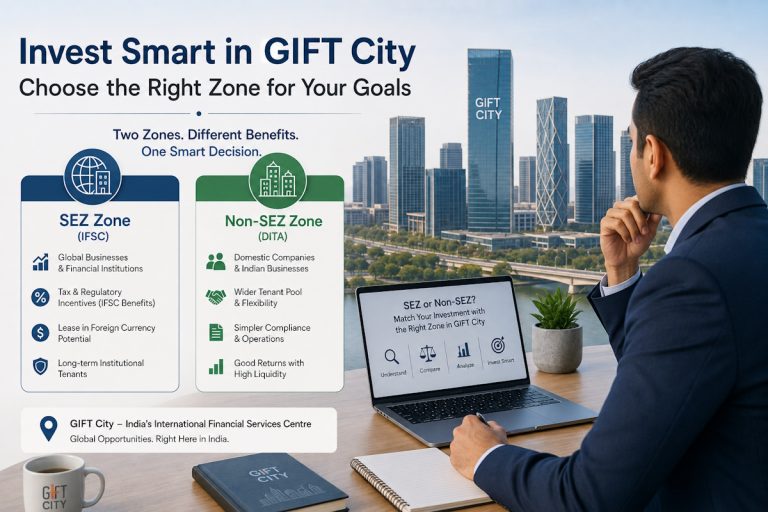
A real estate investment is only as strong as the regulatory framework and social ecosystem that support it. GIFT City benefits from a unique dual-status environment, combining domestic economic rules with international financial services zone benefits.
Double Income Tax Benefits and IFSC Advantages
The Indian government has introduced several tax incentives to attract capital to the region. While many of these benefits target corporate entities, their indirect impact on the residential market is profound. Companies operating within the IFSC enjoy tax holidays, which allows them to allocate substantial budgets for executive relocation and housing allowances. Furthermore, the absence of certain municipal surcharges and optimized stamp duty structures can lower the acquisition costs for buyers. For non-resident Indians, purchasing property here represents a secure way to hold assets in a highly compliant, transparent environment that is less prone to the legal disputes common in unplanned markets.
Social Infrastructure: The Keys to Long-Term Liveability
A thriving residential market cannot exist on commercial demand alone. The long-term outlook for living in GIFT City depends heavily on the rapid development of social infrastructure. By 2030, the city will host multiple operational international schools, state-of-the-art medical facilities, retail high-streets, and premium hospitality projects. This transition from an office-heavy district to a well-rounded metropolitan hub is critical for sustainable residency. When evaluating gift city residential flats, investors must ensure that the projects they select have immediate access to these social amenities, as family-oriented tenants will prioritize proximity to schools and healthcare over work proximity alone.
Risk Mitigation: What Investors Must Evaluate Before Buying
While the growth narrative for GIFT City is compelling, sophisticated investors must approach the market with a critical eye. Identifying potential risks early is the key to protecting capital and ensuring consistent long-term returns.
Developer Track Record and Execution Risk
With the surge of interest in the region, numerous developers have entered the market. Execution quality and timely delivery are paramount, particularly when purchasing under-construction gift city residential flats. Investors must rigorously vet the developer’s historical track record, financial solvency, and adherence to RERA guidelines. Gift City Realty recommends focusing on Tier-1 developers who have successfully completed complex urban projects and possess the financial liquidity to navigate shifting market cycles without delaying construction timelines.
Supply-Demand Dynamics: Avoiding Oversaturation
As residential development accelerates, there is a risk of short-term oversupply in specific asset classes, such as standard two-bedroom apartments. To mitigate this risk, smart investors should look for projects that offer clear differentiation. This could mean investing in ultra-premium penthouses, low-density developments, or properties that feature smart home automation and advanced green building certifications. Understanding the specific demographic needs of incoming corporate tenants will help you select an asset that remains highly desirable even when more supply enters the market.
Strategic Investment Roadmaps for 2030
Navigating the GIFT City real estate market requires a clear investment thesis. Depending on your financial goals, your approach to purchasing residential assets should vary based on your risk tolerance and liquidity requirements.
Entry Strategies for NRIs and HNIs
For non-resident Indians and high-net-worth buyers, GIFT City offers a level of regulatory clarity and infrastructure quality that is hard to find elsewhere in India. When planning an investment, it is advisable to leverage structured payment plans offered by reputable developers. These plans mitigate early-stage risk by aligning payments with construction milestones. Additionally, NRIs should explore the repatriation rules governing real estate transactions within the IFSC zone to ensure seamless capital movement in the future.
Balancing Capital Appreciation vs. Immediate Yield
Investors must decide whether their primary objective is long-term capital appreciation or near-term cash flow. Under-construction properties typically offer the highest potential for capital appreciation as the surrounding infrastructure matures toward 2030. Conversely, ready-to-move-in assets or those nearing completion are ideal for investors who prioritize immediate GIFT City rental yield and want to minimize vacancy risks. A balanced portfolio might combine both strategies, securing early-stage assets for long-term growth while holding completed units to generate consistent monthly income.
Navigating the Decision: Your Next Steps in GIFT City
The transformation of GIFT City into a bustling, global residential address by 2030 is supported by strong institutional backing, world-class infrastructure, and a rapidly expanding corporate workforce. For investors, the window to acquire premium gift city residential flats at competitive prices is gradually closing as infrastructure milestones are achieved and commercial occupancy spikes. Successfully capitalising on this growth requires careful project selection, rigorous developer due diligence, and a clear understanding of your long-term financial objectives. Partnering with dedicated market experts ensures that your investment decisions are guided by deep local knowledge and objective, data-driven analysis.
Frequently Asked Questions
1. What makes gift city residential flats a good investment compared to Ahmedabad?
GIFT City operates under a unique administrative and regulatory framework, offering tax incentives, direct high-quality social infrastructure, and a walk-to-work culture. This results in higher rental yields and superior long-term capital appreciation compared to traditional metropolitan micro-markets in Gujarat.
2. How is the GIFT City rental yield calculated for residential properties?
Rental yields are driven by the high concentration of corporate professionals and expatriates working in the IFSC. Yields are calculated by dividing the annual rental income by the total asset acquisition cost, and they consistently outperform average yields found in non-SEZ residential markets.
3. What are the primary drivers of GIFT City future development through 2030?
The primary growth drivers include the expansion of the IFSC, the influx of global financial institutions, the establishment of international university campuses, and the development of premium social infrastructure such as schools, hospitals, and retail zones.
4. Are there any specific restrictions for NRIs buying residential property in GIFT City?
NRIs can invest in residential real estate within GIFT City seamlessly. The transactions are highly transparent, fully compliant with FEMA regulations, and offer clean exit routes, making it one of the most investor-friendly regulatory environments in India.