
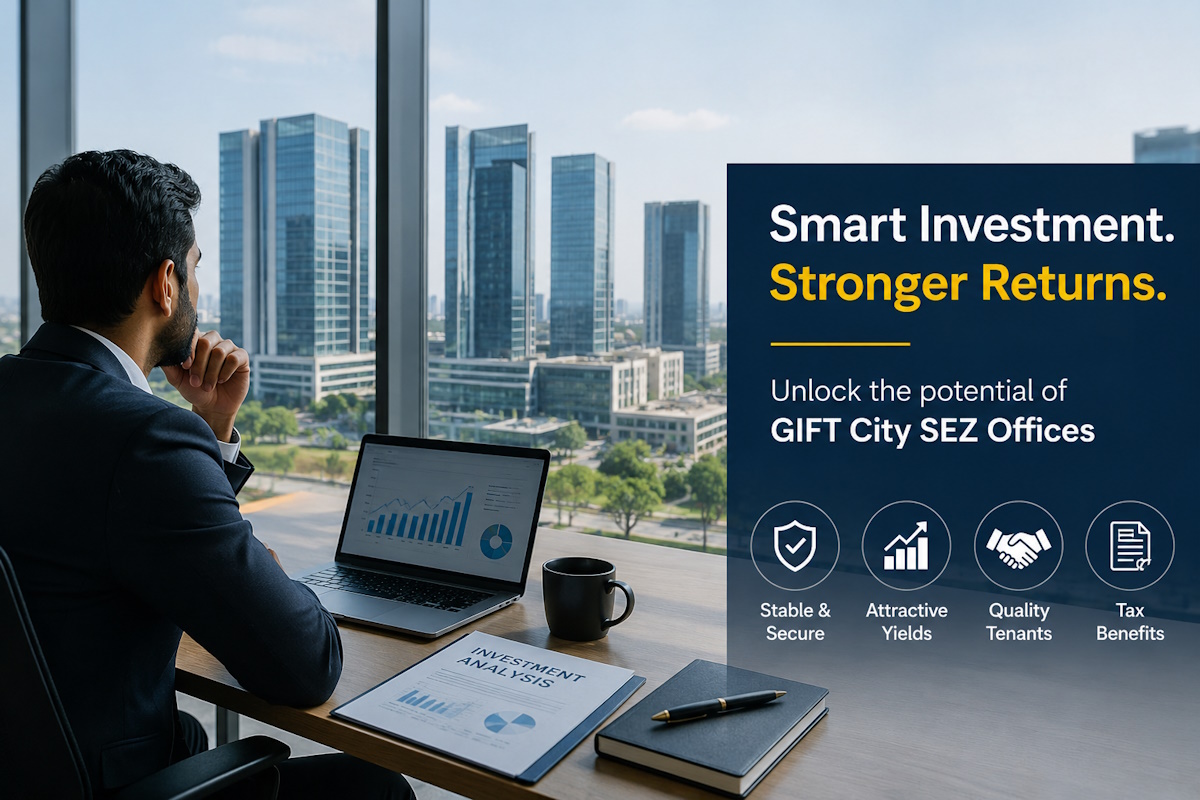
Institutional capital and high-net-worth investors are increasingly focusing on specialized commercial real estate assets within India. Among the most compelling opportunities emerging today is the Special Economic Zone (SEZ) commercial sector within Gujarat International Finance Tec-City (GIFT City). As India’s maiden International Financial Services Centre (IFSC), GIFT City provides an operational ecosystem that bridges domestic enterprise with global financial markets. However, deploying capital into this micro-market requires an analytical approach that goes beyond standard commercial property metrics.
A successful GIFT City SEZ office investment depends on a thorough understanding of regulatory frameworks, tenant profiles, leasing mechanics, and liquidity timelines. Unlike standard domestic real estate, SEZ assets operate under distinct statutory rules, offering specific tax exemptions and operational incentives to qualifying entities. For buyers seeking stable yields, long-term capital preservation, and exposure to foreign currency-earning tenants, SEZ office spaces present a distinctive risk-adjusted profile. This guide evaluates the financial rationale, structural advantages, potential risks, and due diligence benchmarks necessary to allocate capital effectively.
Why GIFT City SEZ Office Investment Attracts Institutional and HNI Capital
Investing in designated SEZ zones within GIFT City is primarily an investment in institutional infrastructure and high-credit tenancy. The zone is designed to attract international banks, asset management firms, global in-house centers, and insurance conglomerates that require an onshore presence with offshore regulatory benefits.
The Multi-Tiered Regulatory and Tax Shield
The core value driver of any commercial property investment in GIFT City within the SEZ boundary is the cluster of fiscal incentives granted to occupiers. Tenants registered in the IFSC enjoy a 100 percent corporate tax exemption for 10 consecutive years out of a 15-year block, zero Goods and Services Tax (GST) on input services, and exemptions from basic customs duties on capital goods. These savings significantly reduce total occupancy costs for multinational corporations, allowing landlords to sustain premium base rentals.
Global Financial Institutions and Tenant Quality
Commercial lease performance depends directly on tenant creditworthiness. The demand for SEZ office space GIFT City is dominated by Grade-A financial institutions, cross-border fintech firms, and multinational advisory companies. These corporate tenants typically negotiate long-term leases ranging from 5 to 9 years, complete with structured escalation clauses. The risk of sudden vacancy or rental default is significantly lower when compared to retail or unorganized office spaces, creating a predictable cash flow environment for commercial landlords.
SEZ vs. DTA Commercial Assets: Strategic Portfolio Differentiation
When underwriting commercial properties in GIFT City, investors must distinguish between assets in the Special Economic Zone (SEZ) and those in the Domestic Tariff Area (DTA). Each serves a distinct market segment and introduces different risk-return characteristics.
Tenant Universe and Leasing Limitations
The defining operational difference lies in tenant eligibility. While DTA properties can lease to any domestic operating company, SEZ spaces can only be occupied by entities holding valid approvals to deliver export-oriented or international financial services. Understanding the nuances between DTA vs SEZ office space in GIFT City ensures that investors do not misjudge their target occupancy pool. The SEZ tenant pipeline is specialized, meaning that while tenant quality is exceptionally high, the pool of eligible occupants is tightly defined by regulatory mandates.
Rental Yield Profiles and Cash Flow Predictability
Historically, an office investment in GIFT City within the SEZ perimeter yields between 7.5 percent and 9.5 percent gross, depending on building quality, floor plate efficiency, and lease structure. DTA spaces often command slightly broader tenant demand from domestic companies, but SEZ properties benefit from corporate balance sheets that are insulated from local market volatility. For long-term investors, the credit stability of an offshore bank or multinational clearing corporation often offsets the narrower leasing target.
Lease Tenure and Lock-in Stability
Corporate occupiers inside the SEZ invest significant capital into interior fit-outs and regulatory-compliant IT security systems. Because of these large upfront capital commitments, SEZ tenants routinely commit to three to five-year lock-in periods within extended multi-year leases. This substantial capital investment on the occupier side substantially reduces midterm turnover risk for asset owners.
Underwriting GIFT City SEZ Property: Key Financial and Regulatory Drivers
Evaluating a GIFT City SEZ property requires a careful review of the legal, structural, and financial frameworks governing the broader ecosystem. Capital appreciation here is directly tied to the growth of international transactions funneled through the district.
Understanding the IFSC Framework
GIFT City is not simply a regional technology park; it is recognized as a unified financial jurisdiction under the International Financial Services Centres Authority (IFSCA). Investors must remain familiar with evolving GIFT City IFSC real estate rules, which govern developer responsibilities, operational boundaries, and subleasing authorizations. This unified regulatory framework minimizes bureaucratic delays, streamlining approvals and compliance management for corporate occupiers.
Operating Cost Efficiencies for Offshore Entities
Beyond federal tax incentives, entities operating within the IFSC benefit from lower operating costs compared to international hubs like Singapore, Dubai, or London. The combination of competitive commercial real estate rates, centralized district cooling systems, and automated utility infrastructure allows global firms to cut total operating expenses by up to 60 percent. This cost advantage solidifies sustained absorption for Grade-A developments across both current and upcoming phases.
Foreign Currency Leasing Flexibility
A distinct advantage of an IFSC office investment is the mechanism allowing certain commercial transactions to be settled in foreign currencies, primarily USD. This framework offers international investors, NRIs, and institutional funds a built-in hedge against domestic currency depreciation, creating an attractive alternative to traditional emerging-market assets.
Evaluating Risks in SEZ Office Space GIFT City Investments
Prudent commercial underwriting requires an objective assessment of systemic and asset-level risks. While the economic fundamentals are sound, buyers must address distinct friction points before committing capital.
Regulatory Compliance and Notification Delays
SEZ properties are regulated by the SEZ Act along with IFSCA directives. Any modification in unit usage, floor space demarcation, or subletting arrangements requires formal approvals from the Development Commissioner. Investors who fail to adhere strictly to compliance procedures can face procedural delays, impacting move-in schedules and rent start dates.
Re-leasing Risk and Secondary Market Liquidity
Because the buyer and tenant pool for SEZ properties is restricted to qualified financial, technological, and international service providers, exit timelines during a vacancy can exceed those of traditional retail or DTA commercial properties. An investor holding a standalone small-format unit may face longer re-leasing cycles if a tenant vacates unexpectedly. Partnering with advisory firms like Gift City Realty helps mitigate these exposure windows through structured institutional tenant placement.
Developer Track Record and Grade-A Spec Delivery
The success of an SEZ commercial asset is heavily tied to building specifications. Global corporations require high floor-to-ceiling heights, advanced HVAC systems, redundant power feeds, and strict sustainability credentials like LEED or IGBC certifications. Acquiring space in a poorly designed building with subpar core-to-floor ratios can lead to prolonged vacancies, regardless of overall market demand.
Due Diligence Checklist for IFSC Office Investment
Prior to executing a commercial purchase agreement within GIFT City, institutional buyers and private investors should apply a structured due diligence framework. Evaluating the following core parameters helps protect capital and secure steady yields.
Pre-Acquisition Legal and Title Checks
Ensure that the commercial development has clear, unencumbered land allotment from the GIFT SEZ authority. Verify that the developer has secured all necessary building plan approvals, environmental clearances, and formal SEZ co-developer or developer status from the Ministry of Commerce. Title certainty is essential for securing institutional financing and eventual asset liquidation.
Floor Plate Efficiency and CAM Transparency
Calculate the super built-up to carpet area ratio across the asset. In premium GIFT City commercial investment projects, loading ratios generally fall between 30 percent and 40 percent. Inefficient core designs directly inflate real occupancy costs for tenants, making the property less competitive against newer Grade-A deliveries. Additionally, review the Common Area Maintenance (CAM) structures to confirm that district cooling and utility operational costs are clearly separated from base maintenance charges.
Tenant Credit and Lock-in Enforceability
For pre-leased commercial acquisitions, examine the underlying lease deed closely. Key elements to confirm include:
- The credit rating and balance sheet health of the parent corporate guarantor.
- The exact remaining lock-in duration and the specific financial penalties for early termination.
- Escalation structures, verifying standard industry benchmarks of 12 percent to 15 percent every 3 years.
- Security deposit amounts held in escrow, which should ideally cover 3 to 6 months of gross rental obligations.
- Clear division of maintenance, municipal tax, and statutory compliance responsibilities between landlord and occupier.
Strategic Next Steps for Capital Deployment
Allocating capital into a GIFT City SEZ office investment offers attractive yields, creditworthy corporate tenants, and unique regulatory advantages. However, market success requires matching your investment horizon with the appropriate development stage, developer profile, and leasing setup. Investors should evaluate whether their objective is immediate cash yield through pre-leased commercial units or capital appreciation through early-stage Grade-A construction.
As the international financial district continues to welcome major global investment firms, technology centers, and banking operations, demand for compliant office space will remain strong. Working with seasoned market specialists ensures your acquisition strategy aligns with the latest statutory updates, leasing terms, and long-term liquidity targets.
Frequently Asked Questions
1. Can individual investors or NRIs acquire SEZ office space in GIFT City?
Yes, individual investors, NRIs, and corporate entities can purchase commercial property within the SEZ zone of GIFT City, provided the property is leased or intended for lease to authorized SEZ or IFSC units that meet regulatory criteria.
2. What is the typical rental yield for GIFT City SEZ office investment?
Gross commercial yields for Grade-A SEZ office assets generally range between 7.5 percent and 9.5 percent. Final returns vary depending on entry valuations, tenant covenant strength, floor plate efficiency, and lease escalation schedules.
3. How does leasing work if an SEZ tenant decides to vacate?
When an SEZ office becomes vacant, the owner must lease the space to another qualifying unit approved by the Development Commissioner and IFSCA authorities. The space cannot be re-allocated to a general domestic enterprise without formal de-notification procedures.
4. Are lease rentals in GIFT City SEZ taxable?
Rental income received by the landlord is subject to applicable Indian income tax provisions based on the owner’s residential and tax filing status. However, certain structural operational incentives and deductions apply depending on whether the investment is held through individual holdings, an LLP, or an institutional investment vehicle.
5. What distinguishes GIFT City SEZ from traditional Indian SEZs?
Unlike standard domestic multi-product or IT SEZs, GIFT City contains an International Financial Services Centre (IFSC) status. This status grants unique regulatory exemptions under a unified regulator (IFSCA), foreign currency transaction capabilities, and extensive global financial ecosystem integrations.