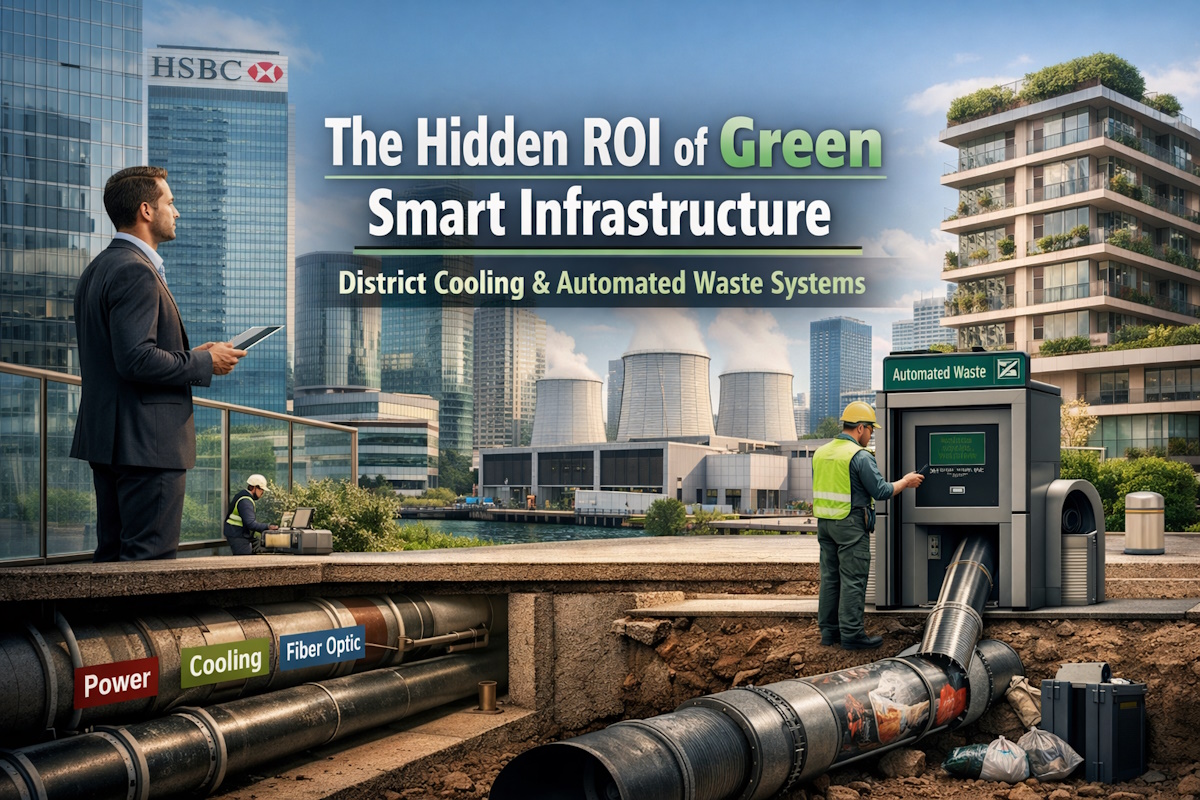
For the modern real estate investor, the value of a commercial or residential asset is no longer confined to its physical walls or its proximity to a central business district. In the evolving landscape of global finance, particularly within the Gujarat International Finance Tec-City, the true value of an investment is often hidden beneath the surface. Institutional buyers, including global banks, sovereign wealth funds, and private equity firms, are now prioritizing infrastructure that guarantees operational resilience and environmental sustainability. This shift is not merely a trend, it is a fundamental change in how global entities evaluate real estate risk and long-term viability.
When evaluating the GIFT City smart city infrastructure benefits, one must look beyond the gleaming glass facades to the sophisticated systems that power the district. Global banks such as JP Morgan, Deutsche Bank, and HSBC do not choose their office locations based on aesthetics alone. They are bound by strict internal mandates to occupy ESG compliant office space GIFT City that aligns with their global net-zero commitments. For an investor, understanding why these global giants only lease “green” is the key to unlocking superior rental yields and ensuring long-term asset liquidity in the competitive Gujarat real estate market.
The Institutional Mandate for Green Infrastructure
Global financial institutions operate under intense scrutiny regarding their carbon footprints. This pressure comes from shareholders, regulatory bodies, and a global client base that demands corporate responsibility. Consequently, these organizations have transitioned from viewing sustainable office space as a luxury to viewing it as a core operational requirement. When a global bank enters the Indian market, particularly a specialized zone like the GIFT City IFSC, they look for infrastructure that mitigates operational risk while checking every box on their ESG checklist.
ESG Compliance as a Non-Negotiable Leasing Requirement
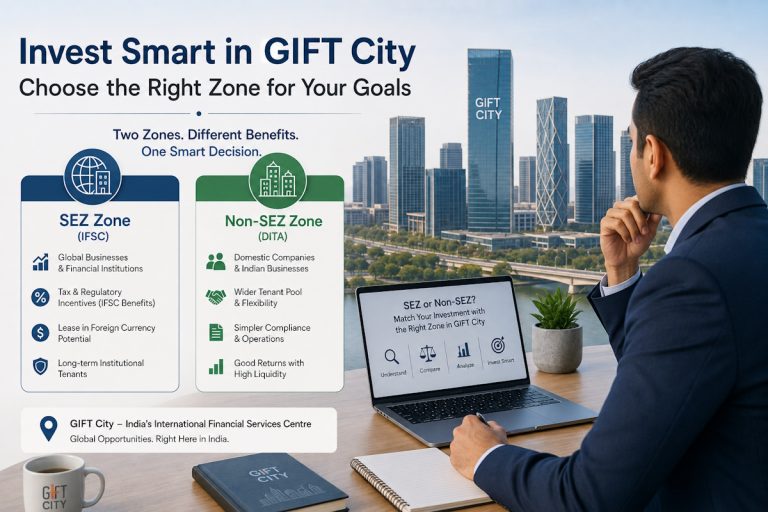
In the past, real estate was judged on the “three Ls”: Location, Location, Location. Today, for institutional tenants, those have been replaced by “three Es”: ESG, Efficiency, and Environment. An ESG compliant office space GIFT City offers these banks a way to report lower energy consumption and reduced waste to their stakeholders. This compliance is a primary driver for the high occupancy rates seen in top-tier buildings within the SEZ and non-SEZ areas of the city.
Aligning with Global Net-Zero Goals
Most Fortune 500 companies have committed to reaching net-zero emissions by 2030 or 2050. Occupying a building that utilizes a district cooling system India real estate allows these firms to instantly reduce their Scope 2 emissions. For an investor, owning a property that facilitates these corporate goals means your asset will always be at the top of the list for high-quality, long-term tenants who are willing to pay a premium for compliance.
Risk Mitigation and Future-Proofing Assets
Regulatory frameworks are tightening globally. Assets that do not meet high environmental standards risk becoming “stranded assets”—properties that are difficult to lease or sell because they are obsolete by modern standards. By investing in projects that leverage GIFT City smart city infrastructure benefits, you are effectively future-proofing your capital against upcoming environmental regulations in India and abroad.
District Cooling Systems: Redefining Operational Efficiency
One of the most significant technological advantages in the district is the cooling infrastructure. A district cooling system India real estate represents a departure from traditional air conditioning methods where each building maintains its own massive, energy-hungry chillers. Instead, a centralized plant produces chilled water and distributes it through a network of insulated pipes to all buildings in the city. This system is a primary reason why global banks are drawn to this ecosystem.
Financial Benefits of Centralized Cooling for Asset Owners
From an investment perspective, district cooling is a massive ROI driver. Traditional HVAC systems account for approximately 40% to 50% of a building’s energy consumption. By tapping into a centralized system, buildings in GIFT City can reduce energy costs by up to 30%. These savings are often passed down to tenants, making the office space more attractive, or retained by the owner to improve the net operating income of the property.
Capital Expenditure vs. Operational Expenditure
Investors should note that buildings using district cooling require less heavy machinery on-site. There is no need for large rooftop chillers or cooling towers. This reduces the initial capital expenditure for the developer and the long-term maintenance costs for the building association. For the investor, this means lower monthly maintenance bills and fewer “special assessments” for equipment replacement over the building’s lifecycle.
Space Optimization and Revenue Generation
Because there is no need for bulky HVAC equipment on the roof or in the basement, developers can utilize that space for more productive uses. In residential towers, this often means penthouse units or rooftop amenities that command higher prices. In commercial towers, it translates to more leasable square footage. This optimization directly impacts the price per square foot and the overall valuation of the asset.
Reliability and 24/7 Operations
Global financial markets do not sleep. A bank’s data center or trading floor cannot afford a cooling failure. The redundancy built into the GIFT City district cooling network ensures that even if one plant has an issue, the rest of the network continues to supply chilled water. This level of reliability is nearly impossible to achieve with individual building chillers without massive additional investment.
Automated Waste Collection and the Hygiene Premium
While waste management might seem like a secondary concern, it is a critical component of the GIFT City smart city infrastructure benefits. The Automated Waste Collection System (AWCS) utilizes a network of underground vacuum tubes to transport waste from individual buildings to a central processing plant at speeds of up to 90 kilometers per hour. This eliminates the need for garbage trucks roaming the streets and manual handling of waste within the buildings.
Reducing Labor Dependency and Maintenance Costs
Traditional waste management in India is labor-intensive and often inconsistent. The AWCS reduces the building’s reliance on manual labor, which in turn reduces the risk of strikes, labor shortages, or rising wages impacting the building’s opex. For a real estate investor, this translates to more predictable and lower annual maintenance costs, which is a key metric for calculating long-term yield.
Superior Hygiene and Tenant Retention
In a post-pandemic world, hygiene is a top priority for premium tenants. A building that has no open trash bins, no smell of waste, and no pests attracted by garbage is significantly more attractive to high-end residential buyers and corporate tenants. This “hygiene premium” allows landlords to maintain higher rental rates compared to buildings in surrounding areas that rely on traditional waste collection.
Environmental Impact and LEED Certification
The automated system segregates waste at the source, leading to higher recycling rates. This contributes to the building’s overall sustainability rating. High LEED or IGBC ratings are essential for attracting institutional buyers during an exit, as many global funds are prohibited from buying assets that do not meet specific “Green” certifications.
The Utility Tunnel: Ensuring Uninterrupted Business Operations
Perhaps the most impressive but least seen of the GIFT City smart city infrastructure benefits is the utility tunnel. This is a massive, walk-in underground trench that houses all the city’s essential services, including power cables, water pipes, cooling pipes, and high-speed fiber optics. The utility tunnel technology benefits the city by ensuring that the “dig-and-repair” culture prevalent in most Indian cities is completely eliminated.
Resilience in Data-Driven Financial Environments
For a global bank or a fintech startup, connectivity is their lifeline. In most urban centers, fiber optic cables are frequently damaged by road construction or weather events. In GIFT City, because all cables are protected within a concrete tunnel, the risk of accidental cuts is zero. This 99.999% uptime is a major selling point for banks that need to maintain constant contact with global markets.
Ease of Upgrades and Maintenance
As technology evolves, the city’s infrastructure must evolve too. In a traditional city, upgrading a power grid or a fiber network involves digging up roads, causing traffic and business disruptions. In GIFT City, technicians simply walk into the tunnel and lay new cables. This means the city stays at the cutting edge of technology without ever disrupting the businesses operating above ground. For an investor, this means the city will not “age” in the same way other districts do.
Preventing Asset Deterioration
Roads in GIFT City last longer because they are never dug up. This preserves the aesthetic appeal of the district and prevents the “broken window” effect where deteriorating public infrastructure leads to a decline in private property values. Your investment maintains its “new” feel for decades, protecting your capital appreciation.
How Smart Infrastructure Impacts Valuation and Liquidity
The core question for any serious investor is how these technical features translate into financial gain. The answer lies in the quality of the tenant and the compression of the cap rate. Institutional grade assets in GIFT City command a lower risk premium because the infrastructure takes so many variables out of the equation. You are not just buying four walls, you are buying a share in a high-performing machine.
Higher Rental Yields from Multi-National Tenants
Multi-national corporations (MNCs) have “deep pockets” but also high expectations. They are willing to pay 15% to 25% higher rents for an ESG compliant office space GIFT City compared to Grade A spaces in nearby Ahmedabad or even other Indian metros. This is because the total cost of occupancy, when factoring in energy savings and productivity gains from uptime, is actually lower in GIFT City.
Lower Vacancy Rates and Longer Lease Terms
Global banks do not like to move. The cost of fitting out a high-security banking office is immense. Once they find a location that meets their ESG and infrastructure needs, they tend to sign 10 to 15-year leases. For an investor, this provides a level of income security that is rare in the Indian real estate market, making these assets highly attractive for REITs (Real Estate Investment Trusts) and institutional buyers looking for stable cash flows.
Capital Appreciation Driven by Scarcity
While there is plenty of land in India, there is a very limited supply of truly “smart” infrastructure. As more global firms move to India to take advantage of the IFSC regulations, the demand for office space that meets global standards will far outstrip supply. This scarcity is a primary driver of capital appreciation for early and mid-stage investors in GIFT City.
Avoiding Common Investment Mistakes in Smart Cities
Despite the overwhelming benefits, investors must remain diligent. Not every building in GIFT City utilizes the infrastructure in the same way. Some developers may have better integration with the district cooling system than others. Some may offer superior fiber-to-the-desk capabilities that leverage the utility tunnel more effectively.
Evaluating Developer Integration
When reviewing a project, ask for the technical specifications of how the building connects to the city’s central command and control center. A building that is “smart-ready” is vastly more valuable than one that is merely located within the city limits. At Gift City Realty, we help investors look past the marketing brochures to see the actual technical integration of a project.
Understanding the Fee Structure
Smart infrastructure is not free. Investors should understand the “City Management Fees” and how they are structured. While these fees cover the maintenance of the district cooling and automated waste systems, they must be factored into your ROI calculations. Usually, the energy savings from the district cooling system more than offset these fees, but a detailed forensic look at the numbers is always recommended before a large commitment.
Strategic Guidance for Institutional and Individual Investors
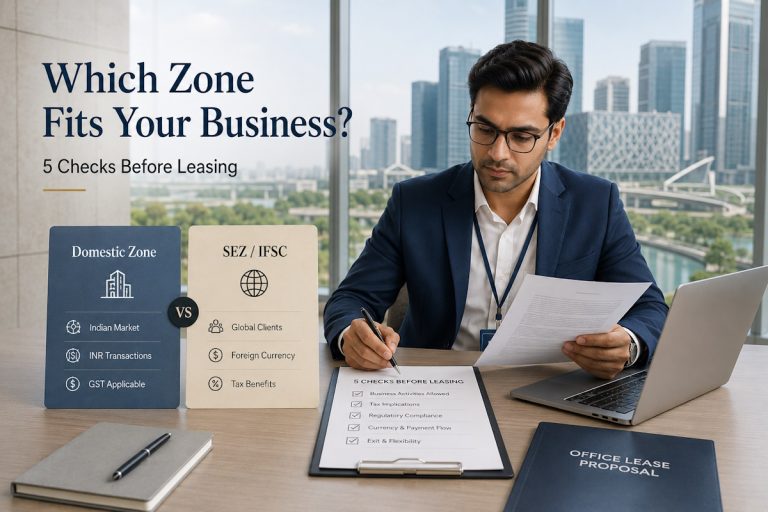
The decision to invest in GIFT City should be viewed through the lens of institutional requirements. If you are buying a commercial unit, ask yourself: “Would a global bank lease this?” If you are buying residential, ask: “Would a CXO of a fintech firm want to live here?” If the answer is yes, it is almost certainly because the property leverages the GIFT City smart city infrastructure benefits to offer a lifestyle and operational efficiency that cannot be replicated elsewhere in India.
As the city matures, the gap between “smart” assets and “traditional” assets will only widen. Investors who recognize the value of the district cooling system India real estate and the utility tunnel technology benefits today are positioning themselves for significant gains as GIFT City becomes the primary gateway for global capital entering India. The infrastructure is not just a technical feat, it is the foundation of the city’s economic value proposition.
For those looking to navigate this complex but rewarding market, specialized advisory is essential. Gift City Realty provides the deep-dive analysis required to identify assets that are truly institutional-grade. Whether you are an NRI looking for a stable rental income or a domestic HNI seeking capital growth, the “green” infrastructure of GIFT City is your strongest ally in achieving your investment objectives.
FAQs
1. Does the district cooling system really lower my electricity bill?
Yes. Because the central plant is highly efficient and operates at scale, the cost of “chilled water” for cooling is typically lower than the cost of running individual compressors and fans in a traditional AC system. Furthermore, maintenance costs for your specific unit are lower because there are fewer moving parts to repair.
2. Why is ESG compliance so important for getting good tenants?
Global firms, especially those in the financial sector, have public-facing commitments to sustainability. They often cannot lease space in a building that doesn’t meet specific energy efficiency or waste management standards. By owning an ESG-compliant asset, you open your property to the highest tier of international tenants.
3. How does the utility tunnel protect my investment?
The utility tunnel prevents the physical degradation of the city’s streets and ensures that essential services like power and data have 100% uptime. This reliability makes the city a preferred destination for high-value businesses, which in turn keeps property demand and prices high.
4. Is the automated waste system available for residential buildings too?
Yes, the AWCS is a city-wide initiative. Both commercial and residential towers in GIFT City are connected to the network. This ensures a high level of cleanliness and hygiene across the entire district, which is a major draw for premium residential tenants and buyers.
5. Are there extra costs associated with these smart systems?
There are city management fees that cover the operation of these systems. However, these are generally offset by the lower insurance premiums, reduced energy bills, and lower individual building maintenance costs that the smart infrastructure provides.