
India’s fiscal landscape is witnessing a significant shift, centered around the Gujarat International Finance Tec-City. For the sophisticated investor, the GIFT City tax holiday is not merely a government incentive; it is a fundamental pillar of the local real estate ecosystem. As we approach 2026, the maturation of these tax benefits is creating a unique window for capital entry, where regulatory advantages directly translate into tangible property value and sustained rental demand.
The convergence of a world-class financial district with an aggressive tax regime has positioned GIFT City as a preferred destination for global capital. Understanding how these exemptions impact the underlying real estate is crucial for anyone evaluating institutional-grade assets. This briefing examines the direct correlation between fiscal policy and investment performance, offering a roadmap for decision-makers looking to capitalize on the IFSC framework.
Understanding the GIFT City Tax Holiday Framework
The core of the GIFT City value proposition lies in its status as an International Financial Services Centre (IFSC). The tax holiday specifically offers units a 100% corporate tax exemption for 10 consecutive years out of a 15-year block. For a real estate investor, this implies a consistent influx of high-value corporate tenants who can afford premium office spaces due to their significantly reduced operational tax burdens.
The 10-Year Exemption Window
The ability for companies to select a 10-year window of 100% tax exemption within their first 15 years of operation provides immense flexibility. This long-term fiscal certainty encourages global banks, aircraft leasing firms, and fintech startups to commit to long-term leases. From a real estate perspective, this stabilizes the occupancy rates of Grade-A commercial buildings and ensures that the tenant profile remains high-caliber.
Minimum Alternate Tax (MAT) and Alternate Minimum Tax (AMT)
Beyond the primary tax holiday, companies in the IFSC benefit from reduced MAT and AMT rates, often at 9% for units in the IFSC compared to 15% elsewhere. This reduction in the effective tax rate further increases the profitability of businesses located within the city, which in turn drives up the demand for high-end commercial infrastructure and supportive residential development.
Investors must recognize that the GIFT City tax holiday acts as a powerful magnet for domestic and international entities. As more businesses move in to claim these benefits, the competition for prime real estate intensifies. If you are looking to secure a position in this growing market, it is essential to evaluate projects that align with the technical requirements of these institutional tenants.
The Direct Impact on Commercial Real Estate ROI
Commercial real estate in GIFT City is the most immediate beneficiary of the GIFT City tax holiday. When a company calculates its net profitability, the tax savings at the IFSC level often outweigh the cost of premium office rentals. This dynamic allows developers to maintain higher price points while still offering a compelling value proposition to tenants.
Demand Influx from AIFs and Banking Units
With the liberalization of Alternative Investment Funds (AIFs) and the presence of international banking units, the demand for specialized office spaces has surged. These entities require specific infrastructure that meets global standards. For an investor, this means that the GIFT City tax holiday is directly responsible for creating a low-vacancy environment, which is the primary driver of high rental yields.
Capital Appreciation Driven by Occupancy
As the 2026 milestone approaches, the second phase of GIFT City’s development is expected to hit full stride. The tax-driven demand is not just about current rental income; it is about the long-term capital appreciation of the land and the structures. As more firms exhaust their initial setup phase and enter their most profitable tax-exempt years, the value of the surrounding commercial real estate is projected to rise in tandem with their growth.
Operational Cost Advantages for Service Providers
It is not just the core financial units that benefit. Ancillary service providers, including legal firms and consultancies, also seek proximity to these tax-exempt units. This creates a secondary layer of demand for commercial assets, diversifying the risk for real estate investors. The broader the tenant mix, the more resilient the investment remains against sector-specific downturns.
Residential Demand Cascading from Fiscal Incentives
While the GIFT City tax holiday is primarily targeted at corporate entities, its impact on the residential real estate market is profound. The “walk-to-work” concept in GIFT City is fueled by the thousands of professionals employed by these tax-exempt firms. As high-income earners migrate to the city, the demand for premium housing follows a predictable upward trajectory.
Professional Migration and Housing Absorption
Executives and CXOs working in the IFSC require housing that matches their professional standing. The concentration of high-paying jobs, enabled by the corporate tax savings of their employers, translates into a tenant base with high paying capacity. This is a critical factor for residential investors looking for stable, high-yield rental properties in Gujarat.
Exemption on Dividend Distribution
For investors operating through corporate structures or REIT-like entities, the tax treatment of dividends and capital gains within the IFSC framework can be more favorable than in the domestic tariff area. This makes the holding of residential portfolios within GIFT City an attractive proposition for institutional-grade residential investors and HNIs.
Infrastructure and Lifestyle Drivers
The tax-induced wealth in the city also funds superior municipal infrastructure. Since the city is managed by a single authority, the revenue generated from the growing commercial base is reinvested into the city’s maintenance, ensuring that residential property values do not suffer from the urban decay seen in other rapidly developing Indian hubs.
Regulatory Advantages for NRIs and Foreign Investors
For Non-Resident Indians (NRIs) and institutional buyers, the GIFT City tax holiday is a gateway to the Indian market with a reduced regulatory burden. The IFSC offers a unique environment where the rules of the Reserve Bank of India (RBI) and the Securities and Exchange Board of India (SEBI) are calibrated to global standards, making real estate transactions smoother and more transparent.
Repatriation and Currency Stability
One of the biggest concerns for foreign investors in Indian real estate is currency risk and the ease of repatriation. Within the GIFT City framework, many transactions can be structured in foreign currency, providing a hedge against rupee depreciation. This regulatory comfort, combined with the tax holiday, significantly lowers the barrier to entry for international capital.
Taxation on Capital Gains
Investors should pay close attention to how capital gains are treated for units within the IFSC. While real estate itself is subject to standard Indian property laws, the corporate structures used to hold these assets can often leverage the GIFT City tax holiday to optimize the net return on investment. Consulting with a specialist like Gift City Realty can help clarify these structural advantages.
Evaluating Long-Term Appreciation and 2026 Projections
Investing in 2024 or 2025 provides a strategic advantage before the major 2026 infrastructure milestones are reached. The GIFT City tax holiday will continue to attract firms, but the supply of prime real estate is finite. As the city reaches a critical mass of residents and office workers, the price per square foot is expected to decouple from the surrounding Ahmedabad and Gandhinagar markets.
Supply-Demand Imbalance in the IFSC
The strict zoning laws in GIFT City mean that residential and commercial supply cannot be expanded indefinitely. When the demand generated by the tax holiday meets this limited supply, the resulting price appreciation can be substantial. Investors who act now are essentially buying into a controlled-supply market with a guaranteed demand driver.
The Role of the Gift City Realty Advisory
Navigating this market requires more than just looking at floor plans. It requires an understanding of which developers have the best track record of delivery and which projects are best positioned to benefit from future infrastructure expansions. Gift City Realty provides the necessary ground-level intelligence to make these high-stakes decisions with confidence.
Common Mistakes When Investing in a Tax-Advantaged Zone
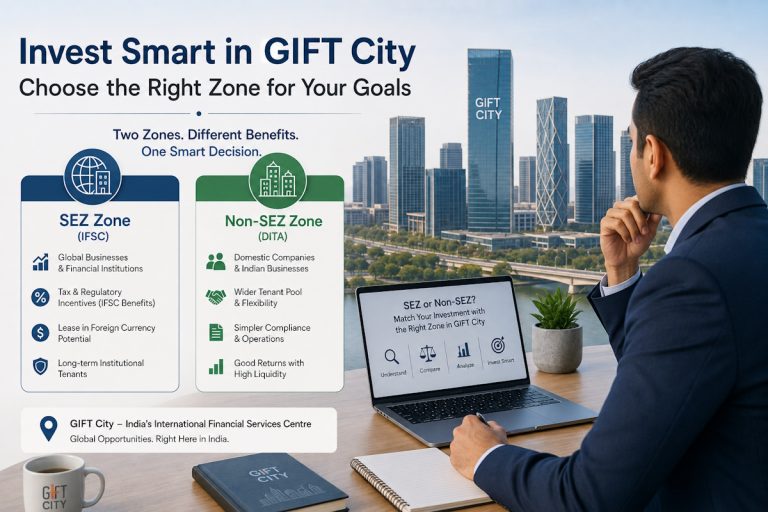
While the GIFT City tax holiday offers immense benefits, investors must avoid the trap of assuming that every project will be a winner. Market selection and due diligence remain paramount. One common mistake is ignoring the distinction between the SEZ (Special Economic Zone) and the DTA (Domestic Tariff Area) within GIFT City, as each has different tax implications and tenant restrictions.
Overlooking Compliance and Structural Requirements
Investing through the wrong legal entity can negate many of the tax benefits offered by the IFSC. It is vital to ensure that your investment structure is compliant with the latest IFSC Authority (IFSCA) guidelines. Failure to do so can lead to unexpected tax liabilities that erode the very ROI you sought to protect.
Relying Solely on Tax Benefits
A tax holiday is a catalyst, not a substitute for real estate fundamentals. A poorly located building with bad management will still underperform, regardless of the tax environment. Investors should prioritize location, developer reputation, and building quality as much as they do fiscal incentives.
The Strategic Path to 2026 and Beyond
The GIFT City tax holiday is a generational opportunity to participate in India’s financial rise. By 2026, the city will likely be the primary hub for all offshore Indian financial activity. The real estate market there is currently in a state of healthy transition from early-stage speculation to institutional-grade maturity. This is the ideal time for serious investors to consolidate their positions.
For those looking for long-term wealth creation, the combination of a 10-year tax holiday, world-class infrastructure, and a robust regulatory environment creates a compelling case. The key to success lies in making informed, data-driven decisions that account for both the fiscal advantages and the practical realities of the Gujarat real estate market.
Is GIFT City Real Estate the Right Move for You?
The decision to invest should be based on your specific financial goals, risk appetite, and investment horizon. Whether you are looking for high-yield commercial leases or long-term residential appreciation, the GIFT City tax holiday provides a safety net of demand that is rarely found in other emerging markets. The focus now should be on selecting the right asset class and project to maximize these unique advantages.
Frequently Asked Questions
1. How long does the GIFT City tax holiday last for businesses?
Businesses in the GIFT City IFSC can claim a 100% corporate tax exemption for any 10 consecutive years out of their first 15 years of operation. This allows firms to align their tax benefits with their most profitable years.
2. Does the tax holiday apply to individual real estate investors?
While the holiday is targeted at corporate units, it indirectly benefits investors by driving up property demand, rental yields, and capital appreciation. Additionally, certain structures used for investment within the IFSC may offer specific tax efficiencies for HNIs and NRIs.
3. What happens to real estate prices when the tax holiday ends?
The tax holiday is intended to seed the ecosystem. By the time the initial 10-year periods end for the first wave of companies, the city will have established itself as a self-sustaining financial hub. The long-term value of real estate is driven by this established ecosystem rather than just the initial tax breaks.
4. Is it better to invest in the SEZ or the DTA area?
The choice depends on your target tenant. The SEZ/IFSC area is ideal for attracting global financial firms and enjoying maximum regulatory benefits. The DTA is better for domestic-focused companies and residential projects that do not require IFSC-specific permissions. Both areas benefit from the general growth of GIFT City.
5. How does the GIFT City tax holiday compare to other Indian SEZs?
The GIFT City IFSC offers a much broader range of incentives, including exemptions on Goods and Services Tax (GST), Dividend Distribution Tax (DDT), and significantly lower MAT rates, making it far more competitive than traditional SEZs focused solely on manufacturing or IT exports.