
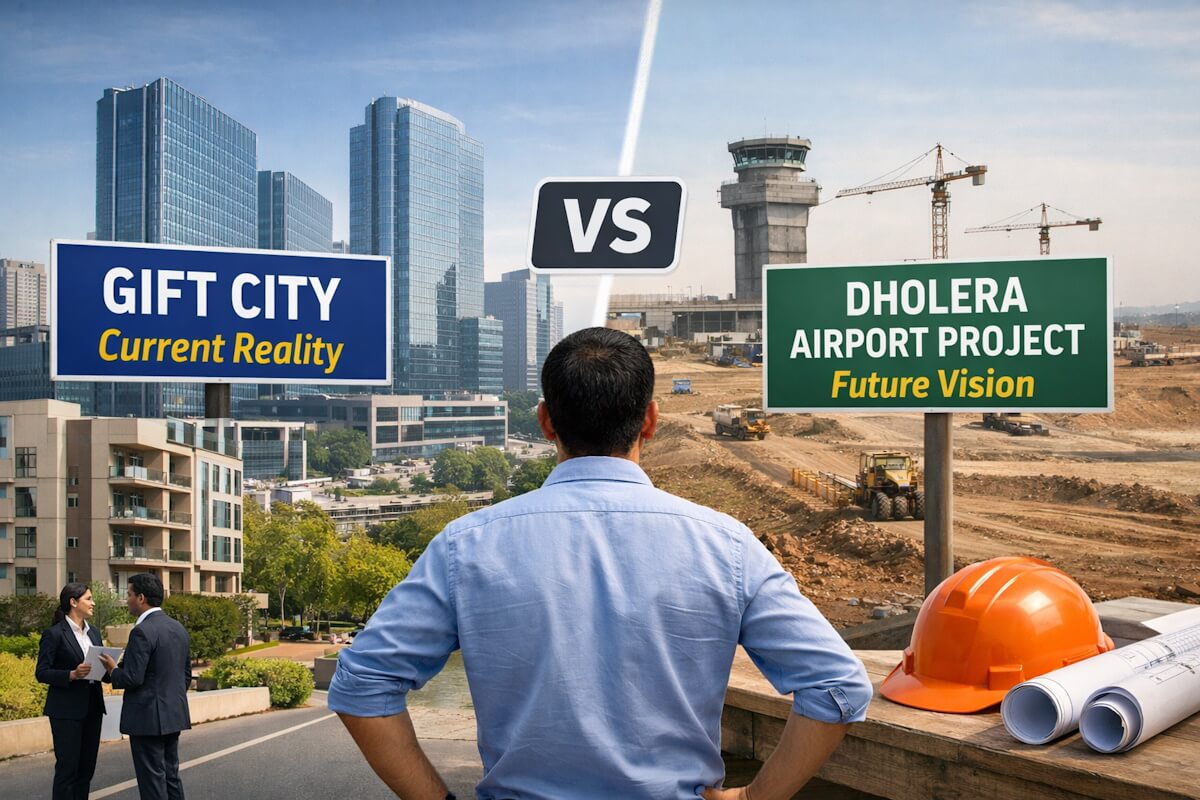
If you are evaluating Gujarat as your next real estate move, you are probably hearing two names repeatedly. GIFT City and Dholera near the upcoming airport.
One is operational, structured, regulated, and already leasing space to global banks.
The other is a large-scale planned city with infrastructure under development and long-term potential.
So which one fits your money, your timeline, and your risk appetite?
Let’s break this down in practical terms.
What GIFT City Actually Is Today
GIFT City is not a proposed project. It is functioning.
It sits between Ahmedabad and Gandhinagar. Offices are operational. Residential towers are occupied. The International Financial Services Centre is live and regulated.
When you buy here, you are entering a system that already has:
- IFSC banking units
- Insurance and reinsurance companies
- Fintech firms
- Stock exchange activity
- Residential clusters
This matters because rental demand in real estate comes from people who already work there, not from future promises.
There are two main zones you need to understand:
- SEZ and IFSC areas for financial services
- Non-SEZ areas where regular residential and commercial property is bought
If you are buying residential property, you are usually buying in the Non-SEZ zone.
If you are buying office space to lease to financial firms, you are looking at SEZ space.
The rules, tax treatment, and tenant types differ.
And that changes your returns.
Who Typically Invests in GIFT City?
- NRIs looking for structured India exposure
- Domestic investors comparing Mumbai or Bangalore prices
- Professionals working inside IFSC
- Buyers focused on rental yield more than land speculation
This is income-focused real estate. Not land banking.
If you want predictable leasing from working professionals, GIFT City makes sense to evaluate.
If you are expecting land prices to multiply because of future announcements, this may not be your style.
Rental Demand Reality in GIFT City
Residential rentals come mainly from:
- IFSC employees
- Senior banking professionals
- Expat executives
- Consultants working on long-term contracts
Yields vary based on tower, size, and furnishing.
On average, investors look at 3 to 5 percent rental yield. Some units do slightly better if fully furnished and positioned well.
But here’s the key.
Rental demand is linked directly to employment growth inside IFSC. So your investment performance tracks job growth.
Not highway announcements.
Not speculative township brochures.
Actual office occupancy.
Tax Structure in GIFT City
If you are an NRI from Australia, Canada, Fiji, France, Germany, Malaysia, New Zealand, Singapore, South Africa, Spain, Thailand, United Arab Emirates, United Kingdom, or United States, you probably care about repatriation and tax clarity.
IFSC-based companies receive certain tax incentives. That indirectly supports tenant demand.
For residential buyers:
- GST applies on under-construction property
- Stamp duty applies at state rates
- Rental income is taxable as per Indian law
- NRIs can repatriate rental income under FEMA guidelines
There is no magical zero-tax residential loophole.
What you are investing in is regulated structure and demand stability.
Dholera Airport and Dholera SIR: The Big Vision
Dholera is a planned smart industrial city spread across a very large area.
Land parcels are being marketed heavily. Airport construction is progressing. Roads and trunk infrastructure are underway in phases.
This is early-stage urban development.
You are not buying into an already functioning rental ecosystem. You are buying land or plotted development in anticipation of industrial and airport-led growth.
Very different mindset.
What Drives Value in Dholera?
Three things:
- Infrastructure completion
- Industrial occupancy
- Migration of workforce
Until factories operate at scale and people relocate in large numbers, residential rental demand remains limited.
Land appreciation depends on future execution.
So ask yourself.
Are you comfortable holding for 8 to 15 years?
Are you okay with minimal rental income initially?
If yes, Dholera fits speculative long-term land banking.
If not, you may feel stuck.
Vision vs Reality: Side-by-Side Thinking
Let’s compare this the way a serious investor would.
1. Stage of Development
- GIFT City is operational
- Dholera is developing
One generates rent today. The other depends on phased growth.
2. Investment Type
- GIFT City mostly apartment or office purchase
- Dholera often land or plotted development
Built asset versus raw land exposure.
3. Liquidity
GIFT City resale is easier because:
- There is existing demand
- There are working tenants
- There are banks financing purchases
In Dholera, resale depends on future investor interest. End-user demand is still forming.
Liquidity risk is real in early-stage projects.
4. Appreciation Expectations
Be realistic.
GIFT City appreciation will likely track financial sector expansion and infrastructure maturity. It is steady, not explosive.
Dholera could see large appreciation if industrialization accelerates. But if timelines stretch, returns may stay flat for years.
You are choosing between:
Moderate clarity
Versus
High uncertainty with upside potential
That is the real comparison.
Which One Fits Your Investor Profile?
If You Are an NRI
If you live in the United Kingdom, United States, Singapore, United Arab Emirates, or Australia and want structured, regulated, rental income-backed property in India, GIFT City feels more familiar.
You get:
- Clear zoning
- Organized development
- Banking presence
- Documented transactions
Dholera suits NRIs who are comfortable with land holding and longer patience.
If You Are a Domestic Investor
Compare this with buying in Ahmedabad, Mumbai, or Pune.
GIFT City gives you exposure to a financial hub at early expansion stage.
Dholera gives you exposure to a planned industrial corridor.
One behaves like income real estate.
The other behaves like future urban land.
What do you need right now?
Cash flow or capital growth speculation?
If You Plan to Live There
Living in GIFT City today is possible. Schools, offices, connectivity, and services are improving steadily.
Living in Dholera today is not practical for most families.
This matters more than people admit.
Risks Most Buyers Don’t Think About
Overestimating Speed of Development
Announcements are not completion.
Infrastructure phases take time.
Industrial relocation takes longer than expected.
Liquidity Trap
In speculative areas, resale can become dependent on new marketing cycles.
If buyer sentiment slows, exits slow.
Rental Overestimation
In GIFT City, not every tower commands premium rent.
Furnishing, view, layout, and proximity to office clusters matter.
You cannot assume all units rent equally.
Stamp Duty, GST, and Holding Costs
For both locations:
- Stamp duty payable at purchase
- GST on under-construction properties
- Property tax annually
- Maintenance charges
Land in Dholera may have lower upfront ticket size compared to an apartment in GIFT City.
But zero rental income means you carry holding cost without cash inflow.
Small difference on paper. Big difference emotionally.
So, Vision or Reality?
If your personality leans toward structured, operational ecosystems with visible tenant base, GIFT City aligns better.
If you are comfortable holding undeveloped land for long duration with uncertainty, Dholera fits that appetite.
Neither is universally better.
They serve different investor psychology.
That’s the honest view.
Who Should Avoid Each?
Avoid GIFT City if:
- You expect 3x price jump in two years
- You dislike apartment ownership
- You want agricultural or plotted land
Avoid Dholera if:
- You need rental income
- You want immediate livability
- You are uncomfortable with timeline risk
Clarity saves stress later.
Final Thought
GIFT City is execution in motion.
Dholera is execution in progress.
Your job is not to chase headlines.
Your job is to match your money with your timeline.
Think about when you need liquidity.
Think about whether you want rent.
Think about how patient you really are.
That usually answers the question.
FAQs
1. Is GIFT City safer than Dholera for investment?
GIFT City carries lower development risk because it is operational. Dholera carries higher potential upside but depends heavily on future infrastructure completion.
2. Can I get good rental income in Dholera near the airport?
At present, rental demand is limited. Most buyers there are holding land for long-term appreciation.
3. What is average rental yield in GIFT City residential property?
Typically between 3 to 5 percent depending on furnishing, tower quality, and tenant profile.
4. Is Dholera International Airport operational?
Construction is progressing in phases. Full operational ecosystem will take time to mature.
5. Which is better for NRIs?
NRIs seeking structured income-backed property may prefer GIFT City. Those comfortable with long holding periods may explore Dholera land.