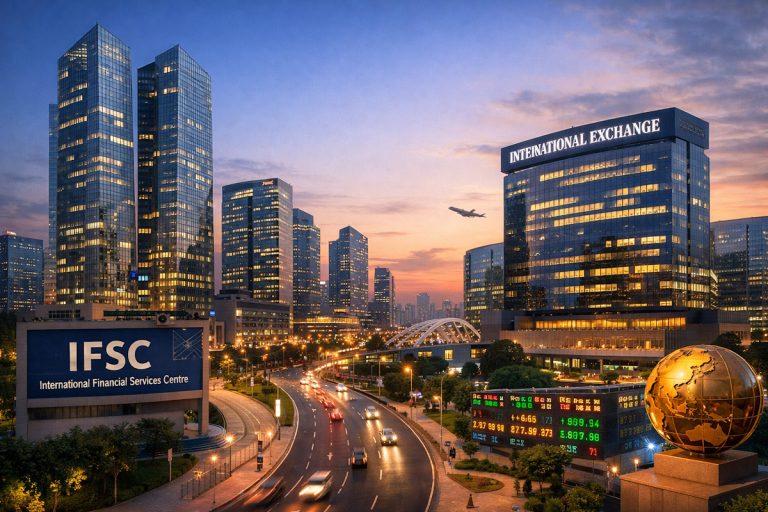

For decades, Dubai has served as the primary destination for Indian HNIs and global institutional capital looking for a tax-efficient, world-class financial environment. Its skyline and regulatory framework set the benchmark for what a modern International Financial Services Centre (IFSC) should look like. However, the emergence of GIFT City in Gujarat has fundamentally shifted the conversation. Investors are no longer just looking for luxury, they are looking for value, scalability, and untapped growth potential. When we compare gift city vs dubai, the most immediate differentiator is the sheer cost of entry and the long-term fiscal runway provided by the Indian government.
The decision to invest in GIFT City over Dubai is rarely about choosing one over the other in a vacuum. Instead, it is about recognizing where we are in the market cycle. Dubai is a mature, high-cost market where capital appreciation has largely stabilized in prime zones. GIFT City, conversely, is in its high-growth phase. For the strategic investor, the question is not just where the most prestigious address is, but where the capital can work the hardest with the least amount of friction and tax leakage. This article breaks down the fiscal and operational advantages that make GIFT City a more cost-effective choice for modern real estate portfolios.
Capital Expenditure: Comparing the Entry Barrier
The first metric any seasoned investor evaluates is the price per square foot relative to the quality of the infrastructure. Dubai, while offering world-class amenities, comes with a significant premium. Prime commercial and residential real estate in Dubai International Financial Centre (DIFC) or Downtown Dubai often commands prices that are three to five times higher than equivalent Grade-A assets in GIFT City. For an institutional buyer or a family office, this means that for the same capital outlay, one can acquire a much larger footprint in GIFT City, providing greater leverage and diversification.
Commercial Real Estate Valuations
In GIFT City, commercial office spaces are currently priced at a fraction of those in Dubai. While Dubai’s commercial market has seen significant rental hikes post-pandemic, GIFT City remains highly competitive. The objective here is to capture the relocation of global capability centers (GCCs) and financial firms. When these firms look at their bottom line, the cost of acquiring or leasing office space in Gujarat is significantly lower, which translates to higher demand for developers and, ultimately, higher rental yields for investors.
Transactional Costs and Registration Fees
Beyond the sticker price, the “hidden” costs of acquisition play a major role in the gift city vs dubai comparison. Dubai requires a 4% DLD (Dubai Land Department) fee on property purchases. While GIFT City involves stamp duty and registration, the government of Gujarat has historically provided various waivers and incentives for units within the IFSC and SEZ areas. When you calculate the total cost of ownership, the initial transaction costs in GIFT City are often more favorable for those moving large volumes of capital into the market.
Impact on Immediate Liquidity
Lower entry costs directly impact an investor’s liquidity. By committing less capital to a single asset in GIFT City, investors can maintain a healthier cash reserve or diversify across multiple asset classes within the city, such as high-end residential apartments and co-working spaces. This flexibility is harder to achieve in Dubai’s high-ticket environment without significantly higher levels of debt.
Tax Efficiency and Fiscal Incentives
The most compelling argument for the cost advantage of GIFT City lies in its tax structure. For a long time, Dubai was known as a tax-free haven. However, the introduction of a 9% corporate tax in the UAE has changed the fiscal landscape. In contrast, the Indian government has tailored the IFSC framework to offer unparalleled tax holidays that directly benefit the bottom line of businesses and real estate investors alike.
The 10-Year Tax Holiday
Units in GIFT City IFSC enjoy a 100% income tax exemption for any 10 consecutive years out of 15. This is a massive advantage for commercial real estate investors because the firms leasing these spaces are significantly more profitable due to tax savings. This profitability ensures long-term lease stability and the ability for tenants to absorb periodic rent escalations. In the gift city vs dubai comparison, this 10-year window provides a level of certainty that is increasingly rare in global financial hubs.
Minimum Alternate Tax (MAT) and GST Benefits
Investors in GIFT City also benefit from reduced Minimum Alternate Tax (MAT) or Alternate Minimum Tax (AMT) rates, which are significantly lower than the rest of India. Furthermore, services provided to units in the IFSC are generally exempt from Goods and Services Tax (GST). For a real estate developer or a large-scale office buyer, these exemptions reduce the operational cost of managing the asset, directly enhancing the net operating income (NOI).
Dividend Distribution and Capital Gains
For NRIs and foreign investors, the repatriation of funds and the tax on dividends are critical. GIFT City offers specific exemptions on Dividend Distribution Tax (DDT) and provides a favorable regime for capital gains for non-residents. While Dubai also offers ease of repatriation, the tax-shielded environment of GIFT City within the Indian regulatory framework provides a unique dual advantage: the safety of an Indian asset with the fiscal freedom of an offshore hub.
Operational Overheads and Talent Arbitrage
Real estate value is inextricably linked to the success of the businesses that occupy the buildings. One of the reasons GIFT City is becoming a formidable competitor to Dubai is the cost of human capital. A financial institution operating out of Dubai faces high costs for staff housing, school allowances, and general cost-of-living adjustments. In GIFT City, the cost of living and the cost of talent are significantly lower, while the quality of the workforce remains high.
Cost of Running a Business
The operational expenditure (OPEX) for a firm in GIFT City is estimated to be 20% to 40% lower than in Dubai. This includes everything from electricity and water utilities to facility management services. For a real estate investor, this is vital because it means service charges and CAM (Common Area Maintenance) costs are more manageable for tenants, reducing the risk of vacancies during economic downturns.
Manpower and Professional Services
The proximity to Ahmedabad and Gandhinagar provides GIFT City with a deep pool of legal, accounting, and technical talent. Hiring a chartered accountant or a legal consultant in Gujarat costs a fraction of what it would cost in Dubai. This lowers the “soft costs” of maintaining an investment vehicle or a corporate headquarters in the city, making the gift city vs dubai choice much clearer for cost-conscious CXOs and founders.
Infrastructure and Maintenance Quality
Despite the lower cost, the infrastructure in GIFT City is built to global standards. With district cooling systems, automated waste collection, and dedicated power plants, the city offers the same “smart city” benefits as Dubai’s newer districts but at an Indian price point. This efficiency further reduces long-term maintenance costs for property owners.
Residential Yields and Lifestyle Costs
While much of the focus is on commercial assets, the residential market in GIFT City is where many individual investors are seeing the most immediate cost advantage. The price of a luxury three-bedroom apartment in GIFT City is incomparable to a similar unit in Dubai Marina or Jumeirah Lake Towers. As the workforce in GIFT City grows, the demand for high-quality housing is skyrocketing, creating a supply-demand imbalance that favors early investors.
Comparative Rental Yields
In mature markets like Dubai, rental yields typically hover between 5% and 8%. While these are respectable, the entry price is high. In GIFT City, because the initial investment is lower and the demand from incoming expats and finance professionals is high, investors are seeing competitive yields with the added benefit of much higher capital appreciation potential. When analyzing gift city vs dubai, the growth curve in GIFT City is much steeper because it is starting from a lower base.
Expat Quality of Life vs. Cost
For NRIs considering a “home base” in India, GIFT City offers a lifestyle that mimics the international experience of Dubai but at a domestic cost. International schools, hospitals, and social clubs are being developed to cater to the global elite. The cost of maintaining this lifestyle—hiring domestic help, dining out, and local travel—is significantly lower in Gujarat than in the UAE, making it an attractive destination for retirees and returning professionals.
Long-term Appreciation Drivers
The expansion of the Ahmedabad metro and the high-speed rail link will further integrate GIFT City with the broader economic engine of Gujarat. This connectivity will drive up residential land values in a way that is no longer possible in the already-developed zones of Dubai. For an investor, this represents a “buy and hold” opportunity with a very high ceiling.
Regulatory Framework and Ease of Exit
A common concern for investors comparing gift city vs dubai is the ease of doing business and the regulatory environment. Dubai has long been the gold standard for ease of business, but GIFT City has closed the gap rapidly through the Unified Regulator—the International Financial Services Centres Authority (IFSCA). This body acts as a single window for all approvals, significantly reducing the bureaucratic friction that used to define Indian real estate.
Repatriation of Funds
One of the primary reasons investors choose Dubai is the ease of moving money in and out. GIFT City, through its IFSC status, allows for similar freedom. Investments made in foreign currency can be repatriated with minimal hassle, providing a level of comfort to global institutional buyers. This regulatory alignment with international standards makes the cost of compliance in GIFT City much lower than in other parts of India.
Transparency and Title Safety
GIFT City operates under a very strict master plan and regulatory oversight. Unlike the broader Indian market where land titles can sometimes be complex, GIFT City offers a high degree of transparency and title safety. This reduces the legal cost of due diligence for investors, making the acquisition process faster and more cost-effective. Gift City Realty emphasizes this transparency to help buyers move forward with confidence.
Market Maturity and Liquidity Risks
While Dubai is highly liquid, it is also prone to volatility based on global oil prices and regional geopolitics. GIFT City is backed by the domestic growth of the Indian economy, which is currently the fastest-growing major economy in the world. This provides a fundamental “floor” to the investment, mitigating the risk of a total market collapse and ensuring that the cost of holding the asset is justified by steady, long-term demand.
Choosing the Right Path for Your Capital
Deciding between gift city vs dubai ultimately comes down to your investment horizon and risk appetite. Dubai remains a prestigious, stable, and highly liquid market for those seeking a mature environment. However, for investors who prioritize value, tax-shielded growth, and the opportunity to get in on the ground floor of a global financial hub, GIFT City is the clear winner. The cost advantage is not just about a lower purchase price, it is about a more efficient fiscal structure, lower operational overheads, and a massive demographic tailwind that Dubai simply cannot replicate at this stage of its development.
As you evaluate your next move, consider the long-term implications of tax holidays and the sheer scale of the Indian financial services sector. GIFT City is not just a cheaper alternative to Dubai, it is a strategic evolution for the modern investor. Whether you are looking for commercial Grade-A assets or luxury residential units, the window for maximum capital appreciation is open now. Taking a consultative approach with experts who understand the nuances of the IFSCA regulations will ensure that your investment is positioned for maximum yield and minimum risk.
FAQs
1. How does the corporate tax in GIFT City compare to Dubai?
GIFT City offers a 100% tax holiday for 10 out of 15 years for IFSC units. Dubai recently introduced a 9% corporate tax for certain income thresholds, making GIFT City more tax-efficient for many financial entities and investment vehicles.
2. Is it easy for NRIs to repatriate rental income from GIFT City?
Yes, because GIFT City is treated as a foreign territory for exchange control purposes under the IFSC framework, NRIs can repatriate their income and capital more easily than from investments in the rest of the Indian mainland, subject to IFSCA guidelines.
3. What is the typical entry price for commercial property in GIFT City?
While prices vary by project and location within the city, Grade-A commercial spaces in GIFT City are generally priced significantly lower than in Dubai’s DIFC, often offering a 60% to 70% cost advantage on the initial capital outlay.
4. Does GIFT City have the same infrastructure quality as Dubai?
GIFT City is built as a smart city with world-class infrastructure, including district cooling, automated waste management, and 24/7 redundant power. While it is still growing, the core utility infrastructure is on par with leading global financial hubs like Dubai.
5. What are the main drivers for property appreciation in GIFT City?
The primary drivers are the rapid influx of global banks, the relocation of Indian and international fund managers, the expansion of the Ahmedabad metro, and the government’s aggressive push to make it the primary gateway for Indian capital markets.