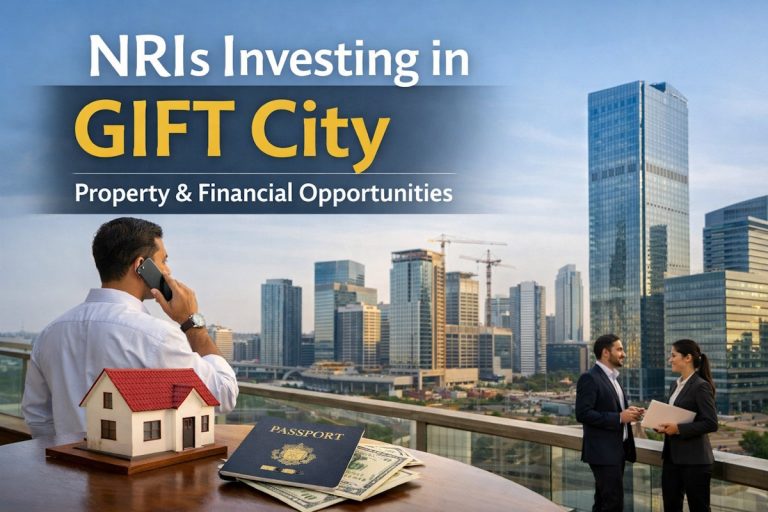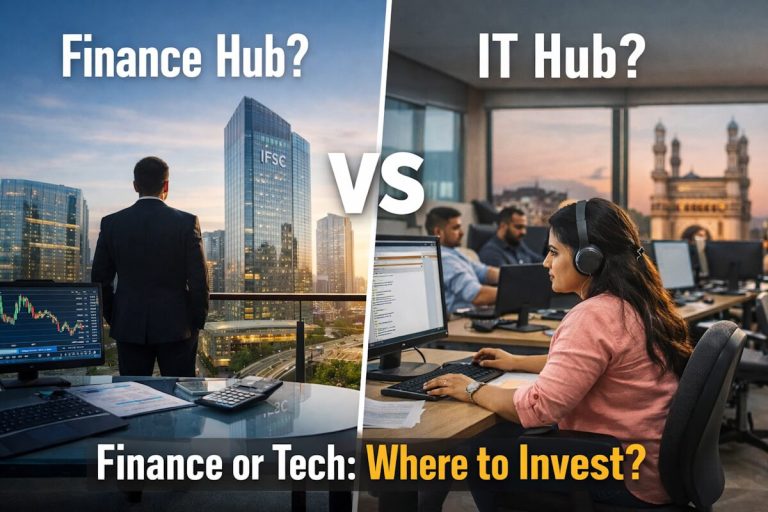

If you are choosing between investing in GIFT City property and buying into infrastructure-led growth in Mumbai, you are really choosing between two very different growth stories.
One is a purpose-built financial hub with regulatory advantages and global positioning. The other is a mature metro expanding outward through massive infrastructure upgrades.
Both can work. But not for the same type of buyer.
Let’s break this down the way you would evaluate it if your own capital was on the line.
What GIFT City Actually Is in Practical Terms
GIFT City is not a suburb. It is not a spillover market. It is a planned financial district built between Ahmedabad and Gandhinagar.
It has two main parts from a property perspective:
- IFSC and SEZ zone
- Non-SEZ residential and commercial zone
The IFSC side is where international banks, fintech firms, fund management companies, and global financial services operate under a separate regulatory framework. This is what gives GIFT City its identity.
The residential side exists mainly to support this workforce.
So if you invest here, you are indirectly betting on India’s ambition to build a global financial services hub.
That’s very different from buying in Mumbai.
What Mumbai Infra Projects Represent
Mumbai is already India’s financial capital. The story here is not about creation. It is about expansion.
Key infrastructure drivers include:
- Mumbai Coastal Road
- Mumbai Trans Harbour Link
- Navi Mumbai International Airport
- Mumbai Metro expansion
When you buy in Mumbai’s upcoming corridors, you are betting on improved connectivity unlocking land value in areas like Navi Mumbai, Thane, Panvel, or Mira Road.
This is classic infrastructure-led appreciation.
Now the real question.
Which one suits your goals?
Appreciation: Structured Growth vs Organic Expansion
GIFT City
Price growth in GIFT City depends on:
- IFSC office absorption
- Hiring by global financial firms
- Regulatory stability
- Residential demand from employees
Appreciation tends to move in phases. When office leasing picks up, residential demand follows. When new policy incentives are announced, sentiment improves.
It is concentrated growth. Focused on one economic engine.
If that engine runs strong, upside can be meaningful. If it slows, growth can flatten.
You are not buying broad city growth. You are buying sector-specific growth.
Mumbai Infra Corridors
Mumbai growth is multi-layered:
- Financial services
- Bollywood
- Trade and logistics
- IT and startups
- Manufacturing clusters
Infrastructure simply unlocks better connectivity and reduces commute times. That improves livability and pushes demand outward.
Growth is more diversified.
But here is the trade-off.
Mumbai prices are already high. Even in emerging corridors, land cost is baked into pricing.
So percentage appreciation may be moderate, not explosive.
Which matters more to you. Higher upside with concentration risk, or steadier growth with premium entry cost?
Rental Demand: Where Cash Flow Is More Predictable
This is where most investors misjudge both markets.
Rental in GIFT City
Rental demand comes mainly from:
- IFSC professionals
- Short-term corporate housing
- Expats working in financial services
Yields can look attractive on paper compared to Mumbai because entry prices are lower.
But demand is directly tied to office occupancy.
If hiring slows, rental absorption slows.
If you are buying purely for rental income, ask yourself one thing.
Are you comfortable tying rental performance to one sector?
Rental in Mumbai
Mumbai has diversified rental demand:
- Corporate professionals
- Students
- Migrant workforce
- Families
- Business owners
Vacancy risk is generally lower in established micro-markets.
Yields are often modest because property prices are high. But occupancy tends to be stable.
If cash flow stability matters more than yield percentage, Mumbai usually feels safer.
SEZ vs Non-SEZ in GIFT City vs Regular Mumbai Ownership
In GIFT City, understanding SEZ vs Non-SEZ is critical.
SEZ commercial properties can offer tax benefits and business advantages. But they also come with usage restrictions.
Residential property is typically in Non-SEZ.
Mumbai does not have this structural distinction at this scale. Ownership is straightforward.
So if you prefer simplicity in title, regulation, and resale process, Mumbai feels familiar.
GIFT City requires you to understand zoning properly before buying.
If you are unsure about this difference, pause before committing.
Tax Considerations: Where It Can Shift the Equation
GIFT City IFSC entities enjoy certain tax incentives under central policy. This indirectly strengthens commercial demand.
For residential buyers, the benefits are not direct like a tax-free property. But:
- Higher commercial activity supports rental demand
- Corporate leasing can improve yield visibility
Mumbai does not offer special IFSC-style tax incentives.
But it offers something else. Predictability. The tax structure is well understood.
If you are an NRI from countries like Australia, Canada, United States, United Kingdom, Singapore, United Arab Emirates, Germany, France, Spain, Malaysia, Thailand, South Africa, New Zealand, or Fiji, you should also evaluate double taxation agreements and repatriation rules.
That analysis matters more than headline tax benefits.
Liquidity and Exit: The Underestimated Factor
Let’s talk resale.
Mumbai has a deep secondary market. Even in slower cycles, there is buyer movement.
In GIFT City, the resale market is still developing.
You may get strong appreciation during expansion phases. But liquidity can be thinner compared to Mumbai.
Ask yourself:
If you need to exit in 5 to 7 years, which market gives you more confidence?
For long-term holders who are comfortable waiting, GIFT City can make sense.
For those who value flexibility, Mumbai has an edge.
Risk Profile: What Most Buyers Don’t Think About
Risk in GIFT City
- Concentration in financial services
- Policy dependence
- Supply pipeline risk
- Slower social ecosystem development compared to metro life
It is still growing as a city in terms of schools, lifestyle, and full residential culture.
Risk in Mumbai Infra Bets
- Project delays
- Overpriced pre-launch inventory
- Micro-market oversupply
- Infrastructure timeline uncertainty
Many buyers enter early and underestimate how long infra completion can take.
So neither option is risk-free.
The risk type is just different.
Who Should Consider GIFT City
You may find GIFT City suitable if:
- You believe in India’s global financial positioning
- You want exposure to IFSC-driven growth
- You are comfortable with medium-term holding
- You are okay with a sector-focused bet
- You prefer lower entry ticket compared to Mumbai core
It works well for professionals already working in IFSC firms.
It can also suit NRIs who want structured, policy-backed growth rather than metro sprawl.
Who May Prefer Mumbai Infra Corridors
You may lean toward Mumbai if:
- You want diversified economic drivers
- You value liquidity
- You prefer established social infrastructure
- You are buying for end-use in a large metro
- You are risk-averse
Mumbai rarely gives dramatic upside in short periods. But it rarely goes silent either.
Sometimes stability is underrated.
Long-Term Bet: It Depends on Your Time Horizon
If your horizon is:
5 years or less
Mumbai may feel more liquid and predictable.
7 to 12 years
GIFT City could deliver stronger relative upside if IFSC expansion continues.
Beyond 12 years
Both can work, but the nature of wealth creation will differ. One through policy-driven financial clustering. The other through metro urban growth.
There is no universal answer.
There is only alignment with your risk comfort.
Final Clarity Before You Decide
Ask yourself:
Are you investing because everyone says GIFT City is the future?
Or because you understand how IFSC growth translates into residential demand?
Are you buying Mumbai because it feels safe?
Or because you have studied the micro-market, pricing stage, and infra timeline?
Your clarity matters more than the market.
FAQs
1. Is GIFT City safer than Mumbai for long-term investment?
Neither is universally safer. GIFT City depends heavily on financial sector growth. Mumbai benefits from diversified economic drivers.
2. Does GIFT City offer better rental yield than Mumbai?
Entry prices are lower, so yields can appear higher. But rental demand is tied closely to IFSC employment levels.
3. Are SEZ properties better for investors?
SEZ commercial properties can offer advantages for businesses. For residential buyers, Non-SEZ property is usually more relevant.
4. Which market has better resale liquidity?
Mumbai currently has a deeper and more active secondary market.
5. Is GIFT City good for NRIs?
It can be, especially for NRIs looking at structured financial growth exposure. But tax residency and repatriation rules should be reviewed carefully.