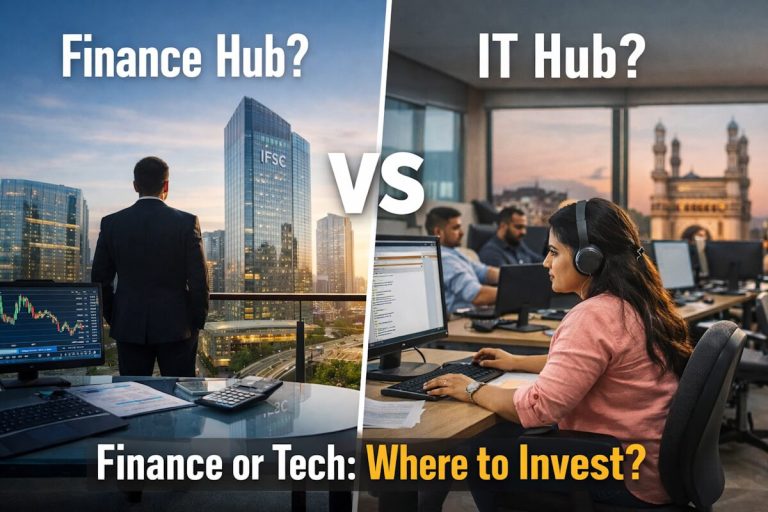

If you are an NRI comparing GIFT City and Navi Mumbai Airport as investment destinations, you are not just comparing two locations. You are comparing two completely different investment stories.
One is policy-driven and finance-focused.
The other is infrastructure-led and metro-driven.
Both can work. Both can disappoint. It depends on who you are and what you expect from your money.
Let’s break this down clearly so you can decide without confusion.
Understanding the Core Difference
GIFT City – A Financial Ecosystem
GIFT City is not a traditional city expansion. It is a planned financial zone in Gujarat designed around the IFSC framework. Banks, global financial firms, fintech companies, insurance players, and offshore businesses operate here under a special regulatory setup.
Residential demand here is linked directly to:
- Employees working in IFSC units
- Expats and senior management
- Professionals relocating within the financial sector
It is policy-backed. Its growth depends on regulatory momentum and global financial participation.
Navi Mumbai Airport Region – Infrastructure Expansion Story
Navi Mumbai Airport is about connectivity and urban sprawl. The airport is expected to shift a large part of Mumbai’s air traffic and unlock development around Ulwe, Panvel, Dronagiri, and surrounding nodes.
Here, growth is tied to:
- Airport operationalization
- Corporate offices shifting
- Logistics hubs
- Residential spillover from Mumbai
This is not a financial policy play. It is an infrastructure and urban expansion play.
Two very different engines.
If You Live Abroad – What Matters More?
As an NRI from countries like Australia, Canada, United Kingdom, United States, Singapore, United Arab Emirates, Germany, France, Malaysia, New Zealand, South Africa, Spain, Thailand, or even Fiji, you probably look at Indian real estate differently.
You might ask:
- Will this generate stable rental income?
- Is the legal structure clear?
- Can I exit easily in 7–10 years?
- Is it too speculative?
- Is the currency risk worth it?
Let’s compare both locations through that lens.
Rental Demand Reality
GIFT City Rental Outlook
Rental demand in GIFT City is closely tied to IFSC employment. There is limited emotional buying here. Most residential demand is practical.
Typical tenants:
- Bank employees
- Expat finance professionals
- Senior executives
- Contract-based consultants
Yields often range in the 3.5% to 5.5% bracket depending on unit size and acquisition price.
But here’s the catch.
Demand is concentrated in specific towers and specific budgets. Oversupply in luxury units can slow absorption.
If your goal is structured rental income linked to finance-sector growth, GIFT City makes sense.
If you are expecting Mumbai-style rental depth, this is not that market.
Navi Mumbai Airport Rental Outlook
Rental demand near Navi Mumbai Airport will likely grow gradually, not instantly.
Initially, rental traction may be slow until:
- The airport becomes fully operational
- Commercial offices start functioning
- Connectivity stabilizes
Long term, this region may offer wider tenant categories:
- Airport staff
- Logistics professionals
- Corporate employees
- Local families shifting from Mumbai
Yields may start lower but could strengthen over time if the ecosystem builds properly.
This is a patience game.
Appreciation Expectations – Be Realistic
This is where many NRIs get influenced by marketing.
Let’s be grounded.
GIFT City Appreciation
Price growth in GIFT City depends on:
- IFSC policy stability
- Global financial participation
- Commercial absorption rates
- Controlled supply
It will not behave like a speculative boom market. Appreciation is likely structured and gradual.
If IFSC expands aggressively over the next decade, capital appreciation can be meaningful. If expansion slows, price movement may flatten.
So ask yourself:
Do you believe in India’s long-term financial services growth?
Navi Mumbai Airport Appreciation
Airport-led markets often see sharp early speculation, then consolidation, then gradual growth once operational clarity comes.
Aviation infrastructure typically creates surrounding development, but timelines stretch.
If you enter too early, you wait.
If you enter too late, you lose upside.
This market is more sentiment-driven in the short term compared to GIFT City.
Tax Structure – Which Is More NRI Friendly?
GIFT City Tax Edge
The IFSC framework offers tax advantages to businesses operating inside it. That is attractive for companies.
For residential investors, the benefit is indirect. Rental income is still taxable under Indian laws, but:
- Professional tenants often sign formal leases
- Payment discipline is stronger
- Transactions are transparent
If you are holding through an NRI structure with proper compliance, it can be smooth.
Navi Mumbai Airport Tax Consideration
There are no special tax zones here. It operates under standard Maharashtra real estate regulations.
You will deal with:
- Stamp duty
- Registration charges
- GST on under-construction property
- Standard capital gains tax
From a tax simplicity perspective, both are manageable. GIFT City feels cleaner because of its planned structure.
SEZ vs Non-SEZ Confusion – Especially in GIFT City
Many NRIs get confused here.
In GIFT City:
- IFSC commercial units fall under special regulatory frameworks
- Residential towers usually fall in Non-SEZ sections
As a residential investor, you are typically not buying an SEZ asset.
So do not assume that tax benefits given to IFSC companies automatically apply to your apartment.
This misunderstanding creates unrealistic expectations.
Liquidity and Exit Strategy
Let’s talk about resale.
GIFT City Liquidity
The buyer pool is narrower:
- Finance professionals
- Investors who understand IFSC
- Long-term believers
Resale may take time unless pricing is realistic.
If your holding horizon is less than 5 years, liquidity risk increases.
Navi Mumbai Airport Liquidity
The buyer pool is broader:
- Local Mumbai investors
- End-users
- Speculators
- Airport-linked businesses
But liquidity still depends on infrastructure clarity. Pre-airport hype markets can cool down quickly.
Neither is instantly liquid like South Mumbai or central Pune.
Be prepared for a strategic exit window.
Who Should Consider GIFT City?
You might find GIFT City suitable if:
- You work in global finance or banking
- You understand regulatory ecosystems
- You prefer policy-backed growth over pure speculation
- You are comfortable holding 7 to 10 years
- You want structured rental tenants
It works well for professionals in IFSC-linked roles.
It may not work for someone seeking quick flips.
Who Should Consider Navi Mumbai Airport?
This could suit you if:
- You believe in infrastructure-driven appreciation
- You are okay with phased development
- You want broader resale demand
- You understand Mumbai’s long-term urban expansion
It is more conventional real estate logic.
Airport growth. City expansion. Gradual absorption.
Risks Most NRIs Don’t Think About
Currency risk.
If you earn in USD, GBP, AED, SGD, or AUD, rupee depreciation affects real returns.
Also consider:
- Property management quality
- Builder execution track record
- Vacancy risk
- Regulatory delays
- Infrastructure delays
In airport-led markets, delay risk is real.
In policy-led markets, regulatory shift risk exists.
Different risks. Same responsibility to evaluate.
What Type of NRI Should Avoid Both?
If you:
- Want guaranteed short-term returns
- Cannot monitor Indian compliance
- Prefer fully passive REIT-style investments
- Need high liquidity within 3 years
Then both locations may frustrate you.
Direct property ownership in India requires involvement.
So Where Should You Invest?
Instead of asking which is better, ask:
What aligns with your financial identity?
If you are finance-driven and see India becoming a serious global financial hub, GIFT City aligns with that belief.
If you believe infrastructure reshapes cities and Mumbai’s expansion is inevitable, Navi Mumbai Airport makes sense.
Both are long-term plays.
Neither is a shortcut.
Quick Comparison Snapshot
| Factor | GIFT City | Navi Mumbai Airport |
|---|---|---|
| Growth Driver | Financial services & IFSC | Airport & infrastructure |
| Rental Profile | Finance professionals | Mixed tenant base |
| Liquidity | Niche buyer pool | Broader but timing-sensitive |
| Risk Type | Policy momentum | Infrastructure timelines |
| Investment Horizon | 7–10 years ideal | 7–12 years ideal |
Final Thought
If you want structured growth tied to financial policy, GIFT City feels more predictable.
If you want infrastructure-led urban appreciation, Navi Mumbai Airport feels broader.
But your personal risk tolerance, holding capacity, and belief in the story matter more than headlines.
Ask yourself one honest question.
If prices stay flat for 3 years, will you still be comfortable holding?
Your answer decides everything.
FAQs
1. Is GIFT City safer than Navi Mumbai Airport for NRIs?
Neither is automatically safer. GIFT City is policy-driven while Navi Mumbai Airport is infrastructure-driven. Risk type differs, not risk level.
2. Which location offers better rental yield?
GIFT City may offer slightly more structured rental yields due to IFSC professionals, but it depends on supply and entry price.
3. Can NRIs easily repatriate rental income from both locations?
Yes, subject to RBI and FEMA guidelines. Proper banking compliance is required in both cases.
4. Is Navi Mumbai Airport already operational enough to justify investment?
Operational clarity is still evolving. Investors should track actual infrastructure milestones before committing.
5. Is GIFT City only suitable for finance professionals?
No, but understanding its financial-services-driven ecosystem helps in making a confident investment decision.