For decades, Mumbai was the default financial gateway to India.
If a global bank wanted to operate in India, it went through Mumbai. That was simply the way things worked.
But over the last few years, something unusual has been happening.
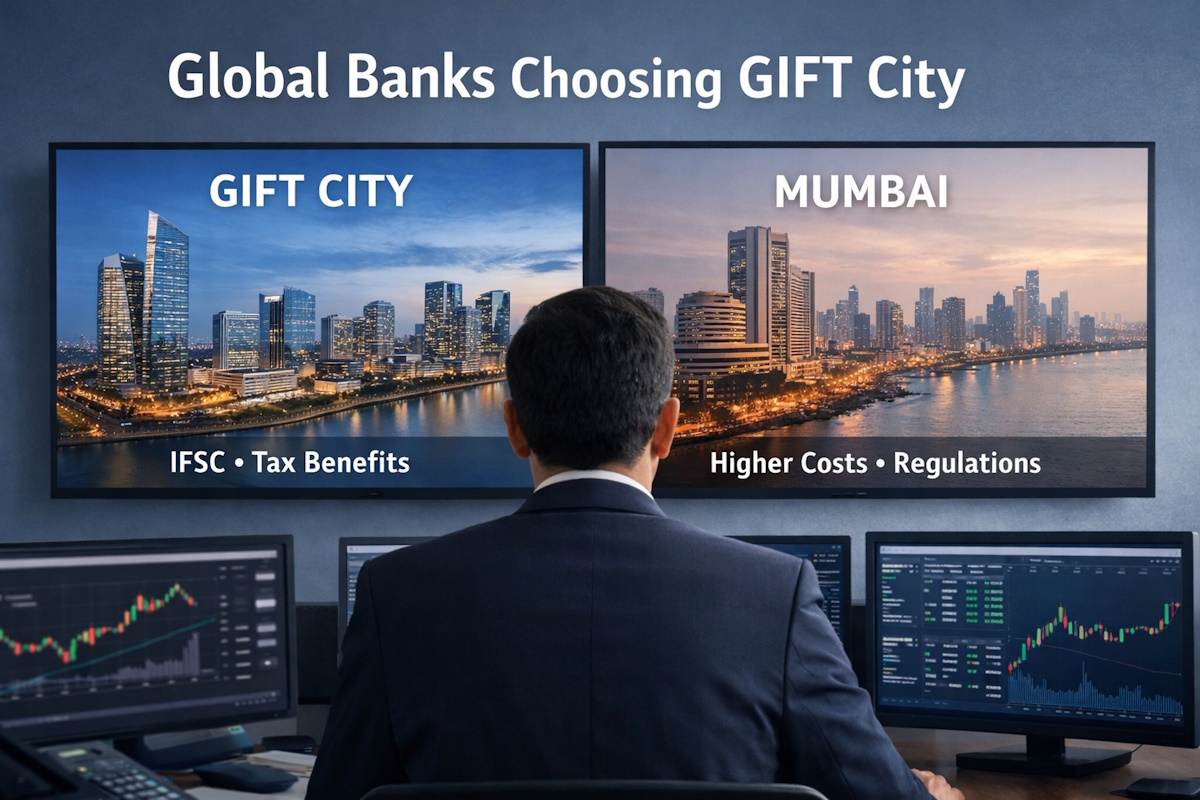
Many global banks are expanding their India presence through GIFT City instead of Mumbai. Some are even building entire desks, trading operations, and treasury functions there.
If you’re evaluating property or business opportunities in GIFT City, this shift matters.
Because when global banks move operations somewhere, the real estate market, rental demand, and economic activity usually follow.
So the natural question becomes:
Why are these banks choosing GIFT City instead of India’s traditional financial capital?
Let’s break it down in practical terms.
First, What GIFT City Actually Is
Gujarat International Finance Tec-City is India’s attempt to build an international financial services hub.
Think of it as India’s controlled financial zone designed to compete with places like Singapore, Dubai, or London.
Inside this city sits the International Financial Services Centres Authority (IFSCA) regulated zone called the GIFT City IFSC.
This area operates differently from the rest of India’s financial system.
Different tax rules.
Different regulatory structure.
Foreign currency operations allowed.
Global financial products permitted.
In short, it behaves closer to an international financial centre than a normal Indian business district.
And that difference is exactly why global banks are interested.
Mumbai Is Still India’s Financial Capital
Before understanding the shift, it helps to understand what Mumbai represents.
Mumbai hosts major institutions such as:
- Reserve Bank of India
- Bombay Stock Exchange
- National Stock Exchange of India
It also houses headquarters of many global banks operating in India.
Yet, despite being the financial capital, Mumbai operates under domestic financial regulations.
That creates limits.
For global banks dealing in international markets, those limits matter a lot.
The Key Reason: International Banking Flexibility
Inside GIFT City IFSC, banks can operate in foreign currencies.
This changes everything.
In Mumbai:
- Most financial operations are INR based
- Foreign currency activities are tightly regulated
- Cross-border transactions involve multiple approvals
Inside IFSC:
- Banks can operate in USD, EUR, GBP and other global currencies
- They can offer international financial products
- Many transactions happen without the layers seen in domestic banking
For global institutions, that flexibility is a huge operational advantage.
It allows them to serve international clients directly from India.
Tax Structure Is Much More Attractive
Tax structure plays a major role in location decisions.
Banks look carefully at where profits are taxed.
Inside GIFT City IFSC, financial firms receive several tax benefits:
- 10-year tax holiday
- No GST on certain financial services
- Reduced withholding taxes
- Exemptions on some international transactions
Compare that with Mumbai, where normal Indian corporate taxation applies.
When global banks run trading desks, derivatives desks, or treasury operations, tax differences can mean millions of dollars.
So shifting operations to GIFT City becomes financially logical.
Regulatory Simplicity Through a Single Authority
Another factor often overlooked is regulation.
In Mumbai, financial firms may deal with multiple regulators:
- Reserve Bank of India
- Securities and Exchange Board of India
- Insurance Regulatory and Development Authority of India
Inside GIFT City, many of these functions fall under one regulator:
- International Financial Services Centres Authority
For banks, dealing with a single regulatory body simplifies compliance and approvals.
That might sound like a technical detail.
But operational teams care deeply about regulatory clarity.
Lower Operational Costs Compared to Mumbai
Let’s talk about something practical: cost.
Mumbai is one of the most expensive office markets in India.
Prime financial districts like Bandra Kurla Complex have extremely high office rentals.
GIFT City offers:
- Lower commercial rents
- Purpose-built financial infrastructure
- Newer office towers designed for financial operations
For global banks running large back-end teams or trading support units, cost differences add up quickly.
Lower operational costs make scaling easier.
Government Is Actively Encouraging the Shift
The Indian government has been pushing strongly to develop Gujarat International Finance Tec-City into a global finance hub.
Several initiatives support this:
- International exchanges operating in IFSC
- Offshore banking units
- Global derivative trading
- Aircraft leasing businesses
These policies are designed to attract global financial firms that might otherwise operate from Singapore or Dubai.
For banks already serving Asian markets, opening operations in GIFT City becomes strategically attractive.
Which Global Banks Have Entered GIFT City
Several international banks have already established operations in the IFSC.
Examples include:
- HSBC
- JPMorgan Chase
- Citibank
- Standard Chartered
Many of these banks operate Offshore Banking Units (OBUs) inside GIFT City.
These units handle international transactions, structured finance, and global treasury functions.
Some banks are also exploring expanding trading desks and investment services there.
What This Means for Real Estate Demand
When banks move operations somewhere, professionals follow.
That affects real estate.
GIFT City is already seeing demand from:
- Financial analysts
- Investment bankers
- Fintech professionals
- Compliance and risk teams
- Technology teams supporting financial services
Many of these professionals prefer living close to their workplace.
This creates demand for:
- Residential apartments
- Rental housing
- Short-term corporate stays
But demand is still developing.
It’s not yet comparable to major metro markets.
Rental Demand Is Growing Slowly, Not Exploding
If you’re considering buying property in GIFT City, this is an important reality.
Rental demand exists, but it is gradual rather than immediate.
Some units are rented by:
- IFSC professionals
- Consultants working on financial projects
- Employees relocating temporarily
Rental yields vary widely depending on the project and timing of purchase.
Expect the market to mature alongside job growth in the financial sector.
Liquidity and Resale Still Need Time
Another practical consideration is resale liquidity.
Mumbai real estate markets have decades of buyer activity.
GIFT City is still young.
This means:
- Fewer resale transactions
- Price discovery still evolving
- Buyers often holding for longer periods
For investors, this matters.
GIFT City works better for longer-term investors, not quick resale strategies.
Who GIFT City Property May Suit
You may find GIFT City interesting if:
- You work in finance or fintech
- You plan to rent property to professionals working in IFSC
- You’re comfortable holding property for several years
- You want exposure to a growing financial hub
Some NRIs are also exploring it because of India exposure combined with international financial activity.
Countries where NRI interest often appears include:
Australia, Canada, Fiji, France, Germany, Malaysia, New Zealand, Singapore, South Africa, Spain, Thailand, United Arab Emirates, United Kingdom, and the United States.
Many of these investors are familiar with financial centres like Singapore or Dubai, so the concept of IFSC feels familiar.
Who GIFT City May Not Suit
On the other hand, GIFT City might not suit you if:
- You want immediate rental income
- You prefer highly liquid resale markets
- You expect metro-style price growth quickly
- You want established social infrastructure today
The city is still developing.
That development is happening steadily, but it takes time.
The Bigger Picture
Global banks expanding into Gujarat International Finance Tec-City signals something important.
India is trying to build its own international financial services hub.
If the ecosystem continues growing, GIFT City could play a similar role to financial centres in other countries.
That doesn’t mean overnight success.
But the presence of global banks is one of the strongest indicators of long-term financial activity.
And financial activity is usually what drives demand for office space, housing, and services.
FAQs
Why are global banks choosing GIFT City instead of Mumbai?
GIFT City allows international financial operations with foreign currencies, tax incentives, and a single regulator. These advantages make it more suitable for global banking activities than Mumbai’s domestic regulatory framework.
What is the IFSC in GIFT City?
The IFSC (International Financial Services Centre) is a special financial zone inside GIFT City where global financial services like offshore banking, derivatives trading, and international finance operations are permitted.
Are banks moving completely from Mumbai to GIFT City?
No. Most banks still keep major operations in Mumbai. GIFT City usually hosts specific international desks, treasury operations, and offshore banking units.
Does bank expansion increase property demand in GIFT City?
Yes, but gradually. As financial firms hire professionals, demand for residential apartments and rental housing tends to grow alongside employment.
Is GIFT City real estate a long-term investment?
Generally yes. The market is still developing, so buyers often view it as a medium to long-term hold rather than a short-term resale opportunity.