
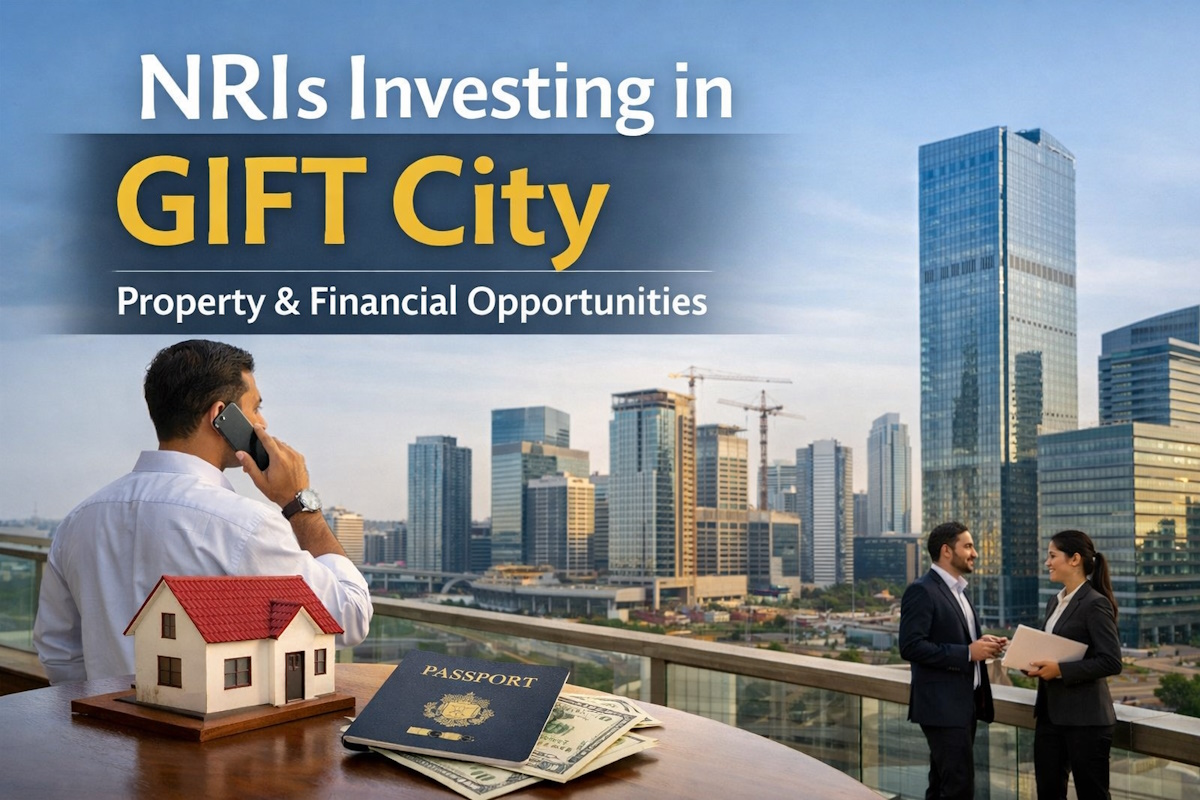
For many NRIs, investing in Indian real estate is not just about owning property. It is about staying financially connected to India while placing money in a market that still has room to grow.
But here’s the problem most NRIs face.
Which city?
Mumbai is expensive.
Bangalore is crowded.
Dubai gives rental yield but not Indian exposure.
This is where GIFT City starts entering the conversation.
Over the last few years, NRIs from the United States, United Kingdom, Canada, Australia, Singapore, United Arab Emirates, Germany, France, Malaysia, Thailand, Spain, South Africa, New Zealand, and Fiji have started looking closely at property inside Gujarat International Finance Tec-City.
Not because of hype.
Because the structure of the city is very different from normal Indian real estate.
And that difference matters.
Let’s break down why many NRIs are now exploring property investment in GIFT City.
First, What GIFT City Actually Is
Before talking about investment, it helps to understand what GIFT City actually is in practical terms.
GIFT City stands for Gujarat International Finance Tec-City. It sits between Ahmedabad and Gandhinagar.
But this is not just another township.
It was designed as India’s global financial services hub, similar to places like Singapore or Dubai International Financial Centre.
Inside the city, you’ll find:
- Global banks
- Fintech companies
- Insurance firms
- Asset management companies
- International exchanges
- IFSC financial firms
These businesses operate inside the International Financial Services Centre (IFSC).
Think of it like a special financial zone with its own regulatory structure.
That creates a steady base of professionals who work there.
And where professionals work, housing demand eventually follows.
Why NRIs Are Paying Attention Now
Five years ago, most NRIs had barely heard about GIFT City.
Today, many investment discussions include it.
Why the shift?
A few reasons.
1. India’s First Operational IFSC
GIFT City is currently the only operational International Financial Services Centre in India.
Financial institutions that once operated out of Singapore, Dubai, or London for India-focused business are slowly setting up offices here.
That means more professionals relocating to the city.
For property investors, that usually translates to future rental demand.
Not immediately massive.
But gradually growing.
2. Dollar-Linked Financial Activity
Many IFSC firms operate in foreign currency transactions, international banking, and global fund management.
This attracts professionals who are used to global financial markets.
Their housing expectations are different from typical Indian tenants.
NRIs understand this well because they live in similar financial ecosystems abroad.
So when they see an emerging financial district forming in India, it naturally catches their attention.
3. Familiar Financial Ecosystem
NRIs working in banking, fintech, or finance often find the GIFT City concept familiar.
It resembles financial zones they already know:
- DIFC in Dubai
- Canary Wharf in London
- Marina Bay Financial Centre in Singapore
That familiarity reduces uncertainty.
Many NRIs feel they understand the long-term direction of such financial hubs.
Residential Property Demand in GIFT City
This is where things get interesting.
GIFT City was initially planned as a commercial financial district.
Residential development came later.
That means housing supply has grown slowly.
At the same time, companies inside IFSC are hiring more professionals each year.
These employees usually prefer to live close to the workplace rather than commute from Ahmedabad.
That creates demand for:
- Apartments
- Serviced residences
- Rental housing
Right now, residential inventory is still limited compared to large metro markets.
And limited supply is one reason investors started paying attention.
Rental Yield Expectations
Many NRIs ask one direct question.
“What kind of rental yield can I expect?”
The answer is not one fixed number.
In early projects within GIFT City, rental yields have typically ranged around 4 percent to 6 percent annually.
But yields vary based on:
- Apartment size
- Project location inside the city
- Furnishing
- Tenant type
For comparison, many metro cities in India deliver around 2 to 3 percent rental yield.
So GIFT City can look attractive from that perspective.
Still, rental income depends heavily on actual tenant demand, not just theoretical projections.
That’s something every investor should evaluate carefully.
Tax Benefits That Attract NRI Attention
Tax structure is another reason NRIs look at GIFT City.
The IFSC ecosystem offers several tax incentives for financial firms operating there.
For property buyers, the benefits are more indirect.
For example:
- Higher concentration of high-income professionals
- Global financial firms relocating staff
- International financial activity happening locally
These factors influence tenant demand, which then affects property value and rental prospects.
NRIs who already understand international tax structures often find this environment easier to evaluate.
Non-SEZ vs SEZ Residential Property
This part confuses many buyers.
So let’s simplify it.
GIFT City has two main zones:
SEZ Area
The Special Economic Zone mainly houses financial institutions.
Commercial offices dominate this zone.
Residential property inside SEZ areas is limited.
Non-SEZ Area
This is where most residential projects are located.
Apartments, housing towers, and mixed-use developments sit here.
If you are an NRI planning to buy an apartment in GIFT City, you will almost always be purchasing in the Non-SEZ residential zone.
Understanding this difference matters because rules and approvals vary between zones.
Why NRIs Prefer Structured Cities
Many overseas investors worry about the unpredictability of Indian real estate.
Project delays
Infrastructure issues
Unplanned neighborhoods
GIFT City tries to solve some of these problems through centralized planning.
For example:
- District cooling system
- Underground utility tunnels
- Walkable business district
- Modern infrastructure
NRIs often prefer this kind of master-planned environment because it feels closer to cities they already live in.
Liquidity and Exit Concerns
One question many investors hesitate to ask is this.
“If I want to sell later, will I find a buyer?”
GIFT City property is still a young market.
Transaction volumes are lower than cities like Mumbai or Bangalore.
That means resale liquidity may take time to develop.
Investors who enter the market should usually think in longer holding periods, not quick flips.
Who GIFT City Property Might Suit
Certain types of NRI investors find GIFT City particularly interesting.
For example:
- Professionals working in finance
- NRIs planning long-term India exposure
- Investors comfortable with emerging markets
- Buyers looking for rental yield instead of pure appreciation
These buyers tend to evaluate the city as a financial ecosystem, not just a real estate project.
Who It Might Not Suit
Not every investor will find GIFT City suitable.
For instance:
If you are looking for:
- Immediate high liquidity
- Short-term price jumps
- A holiday home destination
GIFT City may not fit those expectations.
It is still primarily a financial district, not a lifestyle resort city.
Risks Buyers Don’t Always Think About
Every emerging market carries uncertainty.
GIFT City is no different.
Some factors investors should think about include:
- Pace of corporate expansion inside IFSC
- Future residential supply
- Rental absorption speed
- Government policy continuity
These variables shape the long-term property market.
No one can guarantee exact outcomes.
But understanding the ecosystem helps reduce surprises.
The Bigger Picture
When NRIs evaluate property investment in India, they usually compare three things:
1. Rental income potential
2. Long-term economic growth
3. Ease of ownership
GIFT City enters this conversation because it sits at the intersection of finance, policy support, and infrastructure planning.
That combination doesn’t appear often in Indian real estate.
Still, the city is evolving.
And investors who look at it should approach it with patience and realistic expectations.
FAQs
1. Can NRIs legally buy property in GIFT City?
Yes. NRIs can purchase residential property in India under RBI guidelines, including apartments located in GIFT City’s Non-SEZ residential zones.
2. Is GIFT City property suitable for rental income?
Rental demand mainly comes from professionals working in IFSC companies. Yields often depend on tenant demand and apartment quality.
3. Are residential properties available inside the SEZ area?
Most residential developments are located in the Non-SEZ part of GIFT City. The SEZ area is primarily used for commercial offices.
4. Is GIFT City a long-term investment?
Most investors treat it as a medium-to-long holding period because the market is still developing.
5. Do NRIs need special approvals to invest here?
NRIs generally follow the same property purchase regulations applicable to residential property across India.