Capital allocation into India’s premier international financial services center requires a methodical approach that balances projected commercial job creation with available housing supply. For institutional buyers, high net worth individuals, and non resident investors, navigating residential properties in GIFT City means looking beyond surface level marketing to analyze absorption patterns, rental liquidity, and regulatory shifts in Gujarat, India. The interplay between growing corporate headcounts across global banking units and the limited footprint of residential land makes timing and property selection critical.
Investing in this market is not merely about securing an apartment. It is about understanding who your future tenant or buyer will be, what configuration yields the highest return per square foot, and how infrastructure delivery aligns with capital appreciation cycles. Selecting the right asset requires categorizing available developments through three distinct lenses: total acquisition budget, planned usage model, and specific yield expectations.
Evaluating the Residential Framework in GIFT City
To identify the best housing options, investors must first evaluate the macro supply constraints governing this special jurisdiction. Unlike sprawling suburban real estate markets, the master plan here deliberately caps residential development density relative to commercial and social infrastructure.
Supply Constraints and Commercial Workforce Growth
The core economic engine of the district is its dual-zone structure, comprising the International Financial Services Centre (IFSC) Multi-Services Special Economic Zone (SEZ) and the Domestic Tariff Area (DTA). As financial institutions, fintech platforms, global capability centers, and international universities scale their operations, the demand for on-site corporate housing rises substantially. Investors who evaluate residential projects in GIFT City must recognize that the residential footprint is structurally limited compared to the projected influx of executives, analysts, and domain specialists.
Zone Classifications and Residency Rights
Recent regulatory relaxations have removed previous restrictions that limited residency solely to individuals employed within the zone boundaries. Anyone can now buy, lease, and occupy residential real estate here. This policy expansion instantly widened the tenant demographic, allowing professionals working in Ahmedabad and Gandhinagar to live in the district while enjoying integrated smart city utilities such as district cooling, automated waste collection, and continuous utility reliability.
Classifying Residential Properties by Investment Budget
Capital outlays for residential developments vary based on tower positioning, construction progress, amenity packages, and proximity to major commercial hubs. Aligning your capital allocation with the appropriate asset tier ensures realistic expectations for appreciation and cash flow.
Core Entry-Level Assets (Under INR 1 Crore)
Entry-level options typically consist of studio layouts and compact one-bedroom flats in GIFT City. These developments prioritize efficiency and functional living for single professionals, short-term project consultants, and early-career analysts entering the financial district.
Cash Flow Dynamics and Liquidity
From an investment standpoint, these smaller units often demonstrate the fastest absorption rates in the rental market. Their low absolute ticket size reduces the barrier to entry, decreases vacancy turnaround time between leases, and minimizes total stamp duty and maintenance outlays. However, their long-term capital appreciation may face an upper ceiling compared to family-sized apartments as the city transitions toward permanent, multi-year resident communities.
Mid-Tier Professional Housing (INR 1 Crore to INR 2.5 Crore)
The middle segment represents the bulk of institutional and private investor interest, primarily consisting of standard two-bedroom and compact three-bedroom apartments in GIFT City. These units target mid-level managers, tech leads, and young corporate families relocating to Gujarat for long-term career assignments.
Balancing Resale Depth with Rental Stability
Assets within this pricing bracket offer a healthy balance between stable rental yield and secondary market liquidity. Corporate leasing teams actively seek two-bedroom inventory because it fits standard corporate relocation allowances, creating multi-year tenancy agreements with built-in annual escalation clauses.
Premium and Ultra-Luxury Allocations (Above INR 2.5 Crore)
The upper tier comprises expansive three-bedroom, four-bedroom, and penthouse GIFT City homes equipped with bespoke concierge amenities, private club memberships, and panoramic views of the central park or riverfront zone. These properties cater to CXOs, fund managers, managing directors, and high net worth individuals seeking a global standard of living.
Capital Preservation and Scarcity Value
While gross yields on ultra-luxury units may settle slightly lower as a percentage of total acquisition cost, these properties command exceptional scarcity value. High-ranking financial executives require premium finishes and private amenities, creating a reliable, high-credit tenant profile that treats the property with care and maintains extended tenure.
Selecting Properties Based on Usage Intent
Your strategic objective dictates the exact developer tier, possession timeline, and layout you should prioritize. Mismatching property characteristics with usage goals is one of the most common mistakes seen among prospective buyers.
Pure Rental Yield Strategy
Investors focused solely on recurring income should look at unit density, furnishability, and recurring operational costs. When analyzing buying vs investing in GIFT City residential property, pure cash flow investors prioritize projects that offer turnkey furnishing options or integrated property management partnerships.
Optimizing Maintenance and Management Drag
High common area maintenance fees and specialized district cooling charges can erode gross rental yields if not calculated accurately before acquisition. Experienced advisors like Gift City Realty evaluate whether lease contracts can pass utility charges directly to corporate tenants, preserving the investor’s net cash flow margins.
End-Use and Long-Term Relocation
Buyers planning personal occupancy, whether immediately or as part of a phased retirement and business transition, must evaluate community infrastructure over short-term rental demand. Social infrastructure, including international schools, healthcare facilities, retail promenades, and social clubs, takes precedence.
Evaluating Walkability and Urban Amenities
If you intend to live in the development, examine transit connectivity to the commercial district, parking allocations per unit, and internal acoustic insulation. Modern urban planning in the district emphasizes walkable streets and multi-modal transit, meaning towers with direct access to shaded public walkways and transit hubs provide a superior day-to-day living experience.
Hybrid Portfolio Allocations for NRIs
Non resident Indian buyers often require an asset that serves as an executive residence during business trips to India while generating passive rental income during the remaining months. These buyers benefit most from developments partnering with hospitality brands or structured serviced apartment operators.
Serviced Living Models and Management Governance
A managed living model allows the owner to lock off dates for personal visits while ensuring the asset is actively monetized through executive short stays. This structure mitigates the typical challenges of overseas asset maintenance, including utility payments, tenant vetting, and property upkeep.
Configuration Analysis: Optimizing Rental Returns
Selecting the right floor plan configuration has a direct impact on your occupancy rates, gross rental income, and eventual exit multiple. The historical debate between smaller footprint units and expansive family homes requires a deep look at commercial tenant demographics.
Compact Configurations: High Absolute Yields
Studio apartments and one-bedroom units offer the highest gross rental yields, frequently outperforming larger formats on a percentage basis. Corporate entities operating within the IFSC frequently book clusters of smaller units on corporate master leases to accommodate transient engineering teams and visiting auditors.
Turnover Frequency and Operational Costs
The primary trade-off with smaller configurations is tenant turnover. Shorter lease cycles require proactive leasing management to avoid vacancy drag. If a studio sits vacant for two months between tenancies, the annual yield advantage over a larger, continuously occupied unit quickly disappears.
Multi-Bedroom Configurations: Tenancy Duration and Value Retention
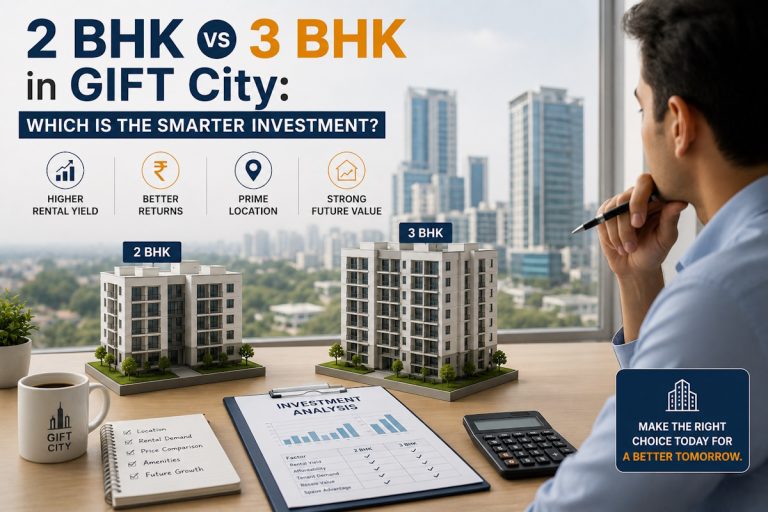
Deciding between a 2 BHK vs 3 BHK investment in GIFT City requires evaluating household formation trends in the region. Two-bedroom units remain the workhorse of the residential rental sector, offering the broadest appeal across young couples, executive roommates, and senior management support teams.
Long-Term Lease Commitments
Families leasing three-bedroom units tend to establish multi-year roots driven by school academic years and corporate relocation programs. This longevity provides consistent cash flow, predictable annual rent escalations, and significantly lower re-painting and marketing expenses over a five-to-ten-year holding period.
Developer Due Diligence and Execution Risk
The regulatory and environmental standards in this special zone are rigorous, demanding developers with proven engineering expertise and strong balance sheets. Assessing execution risk is vital for protecting your committed capital.
Construction Velocity and Regulatory Adherence
Verify that the developer has completed statutory filings under Gujarat RERA and holds clear land development allotments from the GIFT City authorities. Delays in completing underground infrastructure tie-ins, such as district cooling pipeline connections or automated waste chute integrations, can delay project handovers even if the primary structural frame is complete.
Financial Solvency and Past Track Record
Review the developer’s delivery history across previous phases or comparable urban markets. Developers with established institutional backing and low leverage ratios are far better positioned to absorb supply chain fluctuations and deliver projects within committed timelines.
Operational Governance and Facility Upkeep
The long-term value of your asset is linked to the maintenance quality of the shared building services. High-speed elevators, centralized water filtration systems, and district cooling distribution plants require dedicated maintenance contracts. Choosing a developer that engages institutional property management firms safeguards your resale pricing over the long term.
Strategic Decision-Making Framework for Buyers
Before issuing an expression of interest or signing an agreement for sale on residential properties in GIFT City, systematic investors should execute a structured evaluation process that pressure tests assumptions against market realities.
Defining the Holding Horizon
Real estate within an evolving international financial center should be viewed through a five to ten year lens. This timeframe allows the underlying commercial ecosystem to mature, corporate office towers to reach full occupancy, and retail infrastructure to activate, driving compounding residential demand.
Staged Capital Deployment
For investors seeking to acquire multiple doors, staggered entry points across off-plan construction stages and near-possession towers can help smooth cash outflows while balancing immediate rental generation with future capital appreciation upside.
Pre-Commitment Verification Checklist
Before transferring earnest money, confirm these key operational variables with your advisory team:
- Validation of Gujarat RERA registration number and approved sanction plans.
- Verification of district cooling connection charges and utility billing structures.
- Analysis of dedicated parking rights allocated to the specific apartment.
- Assessment of historical absorption and current vacancy trends in adjacent delivered towers.
- Clarity on exit transfer fees, developer assignment guidelines, and leasing lock-in clauses.
Frequently Asked Questions
1. Can non-residents and individuals not working in GIFT City buy residential property here?
Yes. The regulatory authorities have opened residential real estate ownership and occupancy to the general public. Anyone, including domestic investors and NRIs, can purchase, lease, or reside in residential units regardless of their employer’s location.
2. What is the typical rental yield expected from residential properties in GIFT City?
Gross rental yields generally range between 4% and 7%, depending on unit size, furnishing standard, and lease structure. Smaller, fully furnished configurations typically capture higher percentage yields, while larger premium apartments deliver long-term tenancy stability and high absolute appreciation.
3. How do district cooling systems affect residential operational costs?
District cooling eliminates individual air conditioning condenser units, lowering domestic electricity bills and reducing maintenance downtime. While there are fixed and consumption-based charges, overall energy efficiency is higher than traditional residential HVAC systems, making units attractive to quality corporate tenants.
4. Are bank financing and home loans available for GIFT City residential projects?
Yes. Major Indian retail and commercial banks provide structured home loan products for approved residential projects, subject to standard underwriting, income verification, and title diligence clearances.
5. Is it better to invest in an under-construction project or ready-to-move inventory?
Under-construction units offer staggered milestone payments and entry-level pricing with higher potential capital appreciation upon delivery. Ready-to-move inventory eliminates construction execution risk and begins generating immediate rental income, making it the preferred option for yield-focused investors.