For the sophisticated investor, the narrative of real estate in India has shifted from simple land banking to the pursuit of high-performance, yield-generating assets. Within the specialized ecosystem of Gujarat International Finance Tec-City, this evolution is most visible in the widening gap between traditional structures and those designed with sustainability at their core. We are seeing a distinct “green premium” where sustainable buildings GIFT City are not just preferred but are actively commanding higher rental valuations and superior tenant retention rates compared to their conventional counterparts.
This premium is not incidental. It is the result of a convergence between global corporate mandates, lower operational costs, and a regulatory environment that rewards efficiency. As institutional capital and multinational corporations relocate to India’s first operational smart city, their site selection criteria are increasingly dominated by Environmental, Social, and Governance (ESG) standards. For an investor, understanding how these sustainability benchmarks translate into a 15% rental yield advantage is critical for making an informed capital allocation in this burgeoning market.
The Institutional Shift Toward ESG Real Estate Investment India
The global investment landscape has undergone a fundamental transformation, with ESG metrics now serving as a primary filter for institutional asset managers. When we look at the demand for office and commercial space within the IFSC, the tenants are no longer just local enterprises. They are global investment banks, fintech leaders, and consulting giants. For these organizations, occupying sustainable buildings GIFT City is often a non-negotiable requirement dictated by their global headquarters to meet carbon-neutrality targets.
The Correlation Between LEED Certification and Tenant Quality
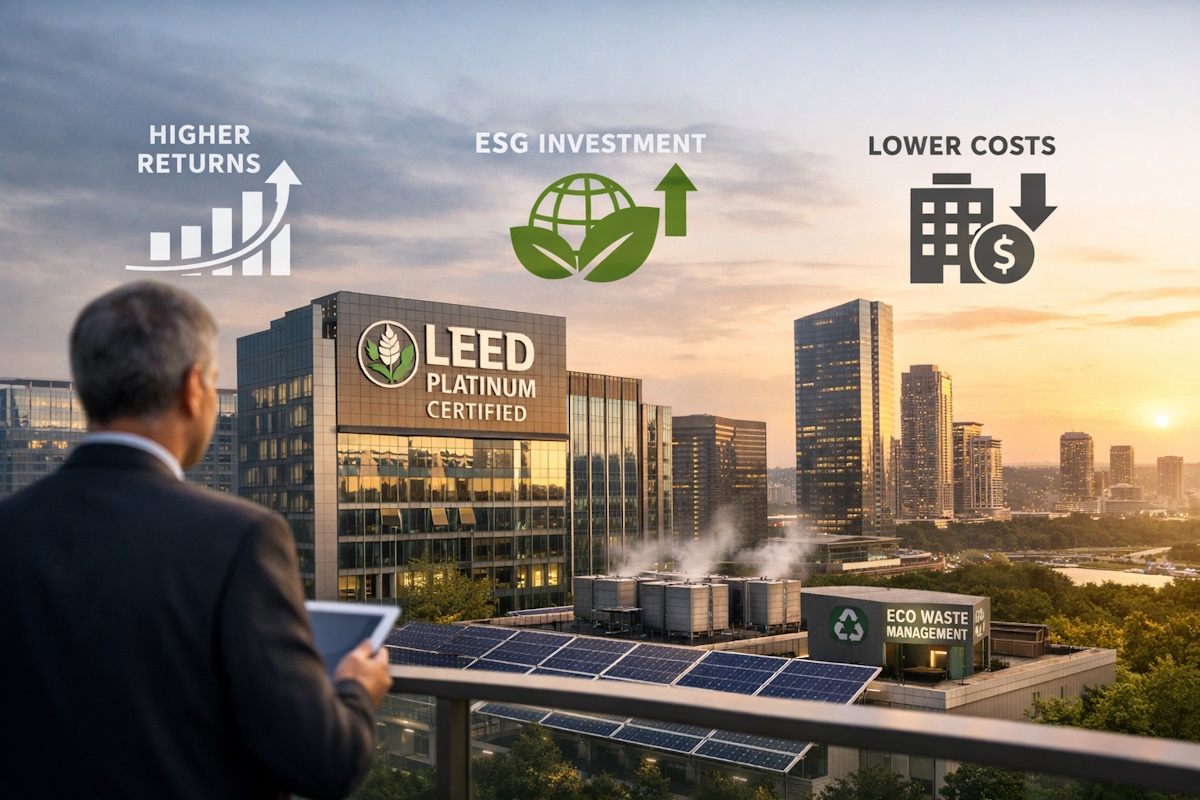
Leadership in Energy and Environmental Design (LEED) serves as a universal language for building efficiency. In GIFT City, buildings with Gold or Platinum ratings attract a specific tier of “sticky” tenants. These are organizations that sign long-term leases, often 9 to 15 years, providing investors with predictable cash flows. Because these tenants have their own sustainability reporting requirements, they are willing to pay a premium to ensure their workplace aligns with their corporate identity. This demand-supply imbalance for high-rated green space is a primary driver for the 15% yield advantage observed in the district.
Why High-Net-Worth Investors Are Prioritizing Green Assets
For HNIs and family offices, the move toward ESG real estate investment India is also a strategy for risk mitigation. There is a growing realization that “brown” assets, or buildings with poor energy performance, face the risk of premature obsolescence. In a fast-evolving regulatory landscape, these older or less efficient buildings may eventually require expensive retrofitting or face higher vacancy rates as regulations tighten. By investing in sustainable buildings GIFT City today, investors are essentially future-proofing their portfolios against upcoming environmental taxes or stricter building codes.
GIFT City Green City Infrastructure: A Structural Advantage for Yield
One of the most significant reasons why sustainable buildings in this zone outperform others is the underlying GIFT City green city infrastructure. Unlike traditional Indian urban centers where developers must provide their own power backup, water treatment, and cooling solutions, GIFT City offers centralized utilities that are designed for maximum efficiency. This centralized approach reduces the initial capital expenditure for developers and, more importantly, lowers the monthly maintenance costs for the eventual owners and tenants.
District Cooling System GIFT City Benefits for Landlords
The district cooling system is perhaps the most tangible example of how sustainability drives ROI. Traditional air conditioning is often the largest operational expense for any commercial building in India, frequently accounting for 40% to 50% of the electricity bill. The district cooling system GIFT City benefits the investor by shifting the burden of cooling to a highly efficient, centralized plant that uses chilled water to regulate temperatures across the city. For a tenant, this results in significantly lower utility bills. For a landlord, this “utility saving” allows for a higher base rent, as the total cost of occupancy remains competitive even with a 15% premium on the rent itself.
Automated Waste Collection and Water Management
Beyond cooling, the city’s automated vacuum waste collection system and zero-discharge water management contribute to a cleaner, more efficient environment. These systems reduce the need for on-site manpower and heavy machinery for waste handling. When an investor evaluates the “triple net lease” potential of a property, these infrastructure advantages directly improve the net operating income. Lower common area maintenance (CAM) charges mean more of the tenant’s budget can be allocated to rent, which directly inflates the owner’s yield.
Quantifying the 15% Premium: A Financial Breakdown
Investors often ask if the 15% premium is a marketing claim or a financial reality. When we analyze recent lease transactions within the SEZ and non-SEZ areas of GIFT City, the data supports the latter. The premium manifests in three distinct ways: higher base rentals, lower vacancy periods, and reduced “rent-free” incentives during fit-outs. Sustainable buildings GIFT City consistently see faster absorption rates because the pool of eligible tenants is larger, including all major MNCs with ESG mandates.
Lower Operational Expenses and Higher Net Operating Income (NOI)
In a standard commercial lease, the Net Operating Income is what truly defines the asset’s value. Because green buildings in GIFT City utilize advanced building management systems (BMS), they require less frequent repairs and have lower energy consumption in common areas. Over a 10-year holding period, the cumulative effect of these savings, combined with the annual rent escalations on a higher base, results in a significantly higher internal rate of return (IRR). Gift City Realty has observed that investors in LEED-certified projects often see their payback period shortened by 18 to 24 months compared to traditional assets.
The Impact of ESG on Exit Valuation and Liquidity
Liquidity is a major concern for real estate investors. When it comes time to exit, sustainable buildings GIFT City are far more attractive to Real Estate Investment Trusts (REITs) and institutional buyers. These large-scale buyers are often prohibited from purchasing assets that do not meet certain ESG thresholds. Therefore, by holding a green asset, you are not just earning more rent today; you are ensuring a wider pool of buyers and a higher valuation multiple when you decide to sell.
Evaluating Investor Risk: The Cost of Non-Compliance
The flip side of the green premium is the “brown discount.” Investors who overlook the importance of sustainable buildings GIFT City may find themselves holding assets that struggle to compete. As more LEED-certified supply comes online, older or less efficient buildings are forced to drop their rents to attract “B-tier” or “C-tier” tenants. This leads to a downward spiral of lower yields, reduced maintenance budgets, and further asset depreciation.
Regulatory Pressures and Future Carbon Taxes
India’s commitment to achieving net-zero emissions by 2070 means that the regulatory environment will only become more stringent. We anticipate that GIFT City, as a model for future Indian urban development, will be the first to implement carbon-related reporting for commercial buildings. Investors who are already positioned in ESG-compliant assets will navigate these changes seamlessly, while others may face significant “compliance costs” to upgrade their buildings to meet new standards. In this context, the 15% yield premium is also a form of insurance against future regulatory shocks.
Tenant Retention and the Human Factor
Sustainability is not just about energy and water; it is also about the indoor environment. LEED-certified buildings emphasize air quality, natural lighting, and thermal comfort. In the post-pandemic era, corporate tenants are prioritizing employee wellness to encourage a return to the office. Sustainable buildings GIFT City provide a superior work environment that helps tenants retain talent. From an investor’s perspective, a happy tenant is a long-term tenant, which minimizes the “churn” costs associated with finding new occupants and refurbishing spaces.
Strategic Selection: How to Identify Top Sustainable Assets
Not all “green” buildings are created equal. As an investor, you must look beyond the brochures and verify the actual certifications and performance metrics. When Gift City Realty advises clients, we focus on several key indicators that determine the longevity of the green premium. It is important to distinguish between “green-washing” and genuine sustainable design that impacts the bottom line.
Key Metrics for GIFT City Investors
- Certification Tier: Prioritize Platinum or Gold LEED ratings, or equivalent IGBC ratings, as these are the benchmarks required by Fortune 500 companies.
- Integration with District Cooling: Confirm the building’s efficiency in utilizing the city’s centralized cooling system.
- Building Management Systems: High-quality sensors and automation are essential for maintaining the operational savings that drive yield.
- Developer Track Record: Investigate whether the developer has a history of maintaining green standards post-construction.
Navigating the Selection Process
The process of acquiring a sustainable asset in GIFT City involves more than just a price-per-square-foot calculation. It requires a deep dive into the building’s utility agreements, its ESG compliance certificates, and the specific profile of existing or targeted tenants. For NRIs and institutional buyers, working with an advisor who understands the nuances of the GIFT City landscape is essential to avoid overpaying for “green features” that do not translate into actual rental premiums.
Final Considerations for the Sustainable Investor
The transition toward sustainable buildings GIFT City is not a fleeting trend; it is a fundamental shift in how value is created and preserved in the real estate market. The 15% rental yield premium is a reflection of a market that is finally pricing in efficiency, occupant wellness, and long-term viability. For the investor, the decision is clear: green assets offer a path to higher income, better tenants, and superior exit opportunities. In the competitive landscape of ESG real estate investment India, staying ahead of the sustainability curve is the most effective way to ensure your portfolio remains resilient and profitable for decades to come.
FAQs
1. Do sustainable buildings in GIFT City have higher maintenance costs?
On the contrary, sustainable buildings usually have lower operational and maintenance costs due to efficient systems and the city’s centralized infrastructure, such as the district cooling system. While the initial quality of the build is higher, the ongoing expenses for the owner and tenant are typically reduced, contributing to a higher net yield.
2. How does LEED certification specifically affect the resale value?
LEED certification increases the pool of potential institutional buyers, including REITs and global funds, who are often mandated to only purchase ESG-compliant assets. This higher demand and “future-proofed” status generally lead to higher valuation multiples and better liquidity during an exit.
3. Is the 15% rental premium applicable to residential properties in GIFT City?
While the 15% figure is most documented in the commercial sector due to corporate ESG mandates, residential projects with green certifications are also seeing higher demand. High-earning professionals working in the IFSC often prefer sustainable living environments, leading to higher occupancy rates and a modest premium in rental income for residential landlords.
4. What is the role of Gift City Realty in identifying these assets?
Gift City Realty provides specialized advisory services to help investors filter through projects based on their sustainability ratings, operational efficiency, and tenant-attraction potential. We focus on data-driven ROI analysis to ensure our clients invest in assets that truly command a green premium.
5. Can existing buildings be upgraded to meet these sustainability standards?
While retrofitting is possible, it is often more cost-effective to invest in new-age sustainable buildings that were designed with GIFT City’s green infrastructure in mind from day one. Retrofitting in a high-density zone like GIFT City can be technically challenging and expensive compared to entering a purpose-built green project.